Here is one of the pictures featuring the Try This At Home. Numerous images associated with the Try This At Home can be utilized as your point of reference. Below, you'll find some additional pictures related to the Try This At Home.
Try This Surprisingly Smart Lightbulb Tip (Your Uber Driver Will Thank You)
Try This Surprisingly Smart Lightbulb Tip (Your Uber Driver Will Thank You)
This story is part of Home Tips, CNET's collection of practical advice for getting the most out of your home, inside and out.
Light bulbs that change colors on command are a smart home staple, but there aren't a lot of obvious ways to make them a practical part of your day-to-day. Sure, they're lots of fun for a kids room, and useful to have at Halloween or when you're throwing a party, but how often have those colors actually come in handy?
The truth about color-changing smart bulbs is that it's all about how -- and where -- you use them. If you've been looking for new ways to put them to work, there's one spot at home you might not have considered, and I'm confident that it's a place where you'll get plenty of practical use out of those automated color changes.
See that blue light on the porch? So can your delivery driver -- and in a multiunit home like this one, it's a great way to help them find the right door.
Ry Crist/CNET
Stick a multicolor smart bulb on your front porch
Or your stoop. Or your front window. Or the light in the yard -- wherever, just so long as you've got a color-changing bulb that people can see from the street. That last bit's important, because we're going to use this thing as a signal that helps people find your house -- specifically, the rideshare and delivery drivers trying to earn a living by bringing meals, groceries and other home goods to your doorstep.
With Americans staying home more than ever during the past two years, delivery services like those have seen massive growth. If you're anything like me, you've come to appreciate the occasional (OK, more than occasional) convenience of a well-timed burrito delivery in the middle of your remote workday. With a color-changing smart bulb outside your home, it's easy to help those drivers find your address -- just change the color to something distinctive when you order and make a note to your driver to look for the colored light. You'll be doing your driver a solid, and helping ensure that your food gets to the right place, too.
Along with deliveries and pickups, it's also a useful trick when you're having people over for a social visit. And, even when you aren't using it to help people find your place, a bulb on your porch that you can set to turn on automatically whenever the sun goes down is great to have on hand, not to mention the fact that you'll have a nice head start on the Halloween decorations. Here's how to get it set up.
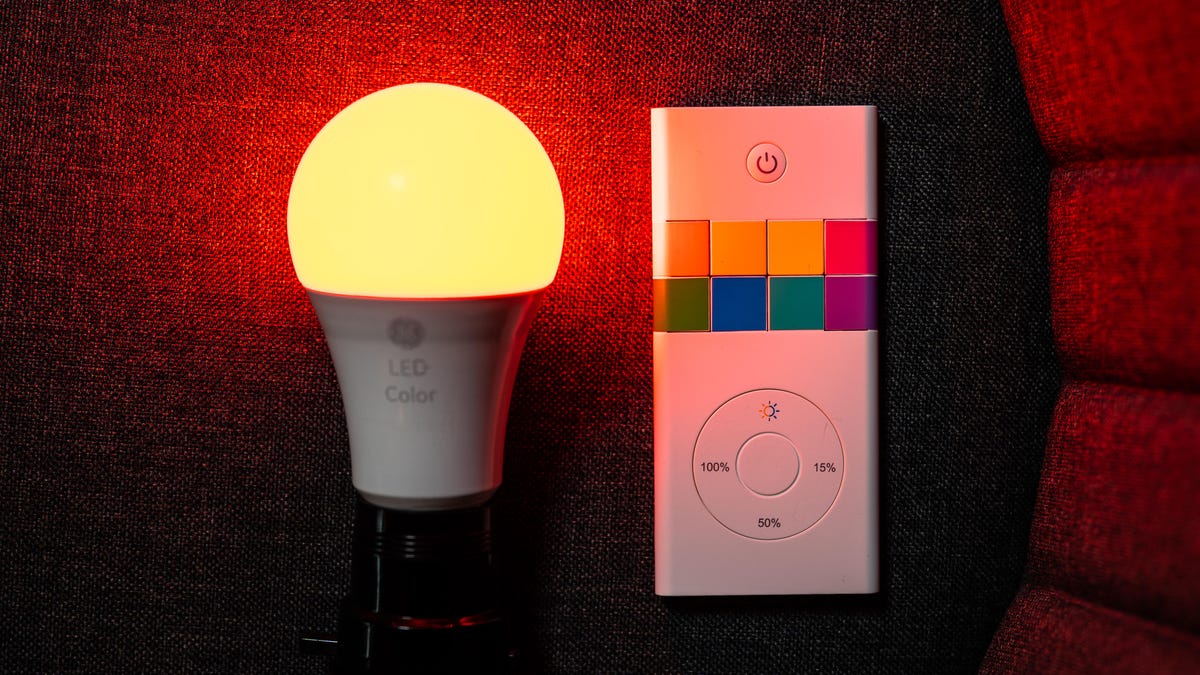
Just about any color-changing smart bulb will work -- and if you don't want your bulb to be smart, a nonconnected color-changing bulb with a remote like this one from GE will do the job, too.
Chris Monroe/CNET
Step 1: Pick out a bulb
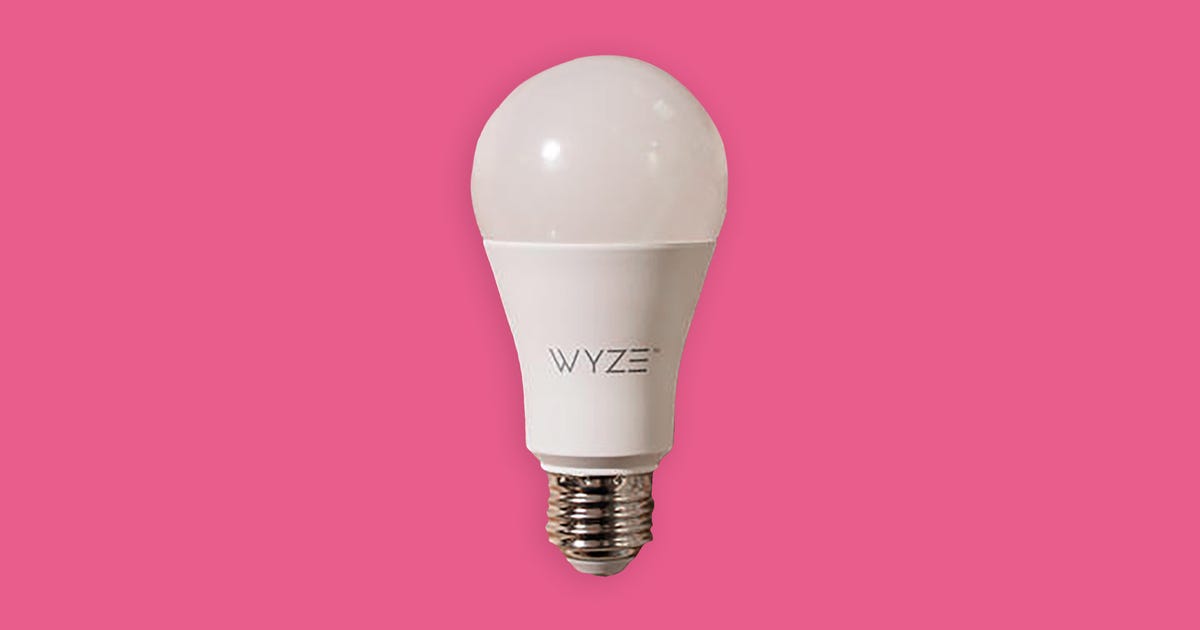
You've got no shortage of options here. Big names like Philips Hue and Lifx will get the job done, but less expensive bulbs from Sengled, GE Cync, Wyze, TP-Link Kasa, Govee and others will work, too, so in most cases you won't need to spend more than $15 per bulb or so. If you need a floodlight instead of a standard, A-shaped bulb, you'll find lots of options, as well: Cree, Feit Electric, Lifx, Philips Hue, Sengled, Wiz and others all sell them, and most cost less than $20.
Any color-changing bulb will do, but you'll want to put some thought into how you plan to control the thing. All of them should let you change the color from your phone, using an app, but if you already use voice assistants or home automation platforms in your house -- Alexa, Google Assistant, Apple HomeKit, SmartThings -- you'll want to make sure to pick a bulb that works with your setup. Later this year, smart bulbs that support Matter, a new universal smart home standard that works with all of those other platforms, should start hitting the market, too.
And, if you aren't interested in smart bulbs that you can control with your voice or with an app, that's fine: Just look for nonsmart color-changing bulbs that come with a remote, like this one from GE. Again, you shouldn't need to spend much more than $10.
Step 2: Pair with your bulb
This part's easy -- just screw the bulb in where it needs to go, turn it on, download the app to your Android or iOS device, and follow the instructions to pair it with your phone.
Keep in mind that different bulbs connect in different ways. If it's a Wi-Fi bulb, it'll pair directly with your home network via your router. If it's a Bluetooth bulb, it'll pair directly with your phone whenever it's within Bluetooth range. Zigbee bulbs need a Zigbee hub on your network that's capable of receiving the signal and translating it into something your router can work with.
Once you've connected, you can use the bulb's app to change the color yourself whenever you're expecting a delivery. If your bulb supports voice commands via Alexa, Google Assistant or Siri -- and just about all of them do at this point -- the app should offer instructions on how to set that up, as well.
Most meal delivery apps have a field where you can leave instructions for your driver at checkout. This is where you want to tell them to look for the light.
Screenshot by Ry Crist/CNET
Step 3: Give your driver a heads up
Don't forget to loop your driver in on the plan. Before you place your order or request a ride pickup, look for a field where you can leave special instructions for your driver -- tell them to "look for the blue light," and you'll be all set. Same goes for pizza delivery if you're ordering online, or via the brand's app.
And that should do it -- a color-changing bulb on the porch that'll help delivery drivers find your front door each and every time you order. It's novelty meets practicality, all without costing very much, and a great way to put those colors to work.
For more tips, check out five inexpensive ways to tech out your patio, and which appliances you should unplug at home to save money.
It was back in January, at CES 2012, that we first saw the $1,399 13-inch Acer Aspire S5 ultrabook. Of course, if you remember the S5 from CES, you'll recall its most unique feature -- a tiny motorized door at the back of the bottom panel that opens at the touch of a button, revealing a ports-and-connections block, including HDMI and Thunderbolt (making this one of only a handful of Thunderbolt laptops). Acer calls this the MagicFlip I/O Port.
It's certainly clever, and it earns points for originality and engineering. But call me crazy, I'd prefer to have my USB ports sitting right on the side of the laptop, easy to access without having to push a button and wait.
Another potential issue is that the MagicFlip is just one more mechanical part to potentially break down (but note that it has worked perfectly fine in the CNET Labs for several days and dozens of activations). If, for whatever reason, it gets stuck or stops working, you're sitting on a laptop with very limited connectivity. Especially in a thin, light ultrabook, having fewer moving parts is better -- hence the move to SSD storage over spinning-platter hard drives.
That said, the motorized port door is not even the most noteworthy thing about the S5, nor its biggest selling point. Even compared with other 13-inch ultrabooks, this system is incredibly thin and light. It weighs only 2.6 pounds (without its power adapter), and is 15mm thick at its thickest point (tapering to 11mm at the front).
That makes the 13-inch MacBook Airlook and feel a bit chunky in comparison, which is no easy task. Acer also manages to work in an Intel Core i7 CPU (but no discrete graphics, sorry), so it's certainly powerful enough for everyday use.
At $1,399, this is scraping the high end of the ultrabook market, and I'm not sure even the extreme portability justifies the price, but it's certainly tempting -- this is a laptop that's simply fun to use.
What I'd love to see is a version of the S5 that stays as thin and light, but skips the gimmicky motorized flap, perhaps adding a millimeter or two to fit in the USB and HDMI ports. The MagicFlip can't be an inexpensive part to include. Dropping it might allow Acer to bring the price down closer to $1,000, where it would be much harder to resist.
Price as reviewed
$1,399
Processor
1.9GHz Intel Core i7-3517U
Memory
4GB, 1333MHz DDR3
Hard drive
256GB SSD (128GB x2, RAID 0)
Chipset
Intel HM77
Graphics
Intel HD4000
Operating System
Windows 7 Home Premium (64-bit)
Dimensions (WD)
9.8 x 2.6 inches
Height
0.43-0.59 inches
Screen size (diagonal)
13.3 inches
System weight / Weight with AC adapter
2.6/3.3 pounds
Category
13-inch
In a matte-black brushed metal, the Acer Aspire S5 looks and feels sophisticated, if anonymous. Only a small chrome Acer logo on the back of the lid gives away your laptop's provenance. The system is so light, at barely 2.6 pounds, that the metal body (aluminum and magnesium) helps it feel more substantial and secure.
The look is very minimalist, as you'd expect from a laptop without visible ports. Besides the keyboard and touch pad, only the button to activate the MagicFlip door sits on the keyboard tray -- a tiny sliver-style power button is relegated to the left side panel, along with an SD card slot.
The keyboard makes good use of the available real estate, leaving little dead space around it. The keys are island-style, flat-topped and widely spaced, but a little on the shallow side. The stiff construction helps with typing, as there's absolutely zero flex, even under heavy use.
The one serious shortcoming here is that the keyboard is not backlit. For a $1,400 laptop, even one as thin as this, that's simply unacceptable. Less seriously, a few keys, such as Tab and Caps Lock, are on the small side, and the multimedia function keys are spread around haphazardly. You'll have to press Fn+Arrow Up and Fn+Arrow Down to raise and lower the volume, but Fn+F8 to mute -- that's an entirely different area of the keyboard.
The large click-pad-style touch pad isn't as responsive as you'd find on a MacBook, but the multitouch gestures worked well, including the all-important two-finger scroll.
The big design feature on the Aspire S5 is the MagicFlip. Hit the button on the upper right of the keyboard tray, and the motor (loudly) whirs to life, pushing the port flap open, and lifting the entire rear edge of the laptop up. It actually makes for a decent ergonomic kickstand if you need a slightly higher angle for comfortable typing.
Of course, very few laptops have all their ports on the back edge, because it's often simply more convenient to have them on one of the sides, but it's not a deal breaker. Smartly, the port door will not close if it detects something plugged into one of the two USB 3.0 ports, or the HDMI or Thunderbolt ports. And, if you close the lid while the MagicFlip door is open, the door will close itself after a few seconds (provided nothing is plugged in).
That said, every single person I showed the Aspire S5 to asked exactly the same question: "What do you do when the door breaks down?" While I didn't have any trouble with the MagicFlip door while testing the Aspire S5, it's still a legitimate question. Adding extra motors and moving parts is always a bit of a roll of the dice, especially in highly portable devices that stand a good chance of being knocked around regularly.
Many PC makers have bitten the bullet over the past couple of years, and stopped loading up their desktops with preinstalled bloatware and ad-ware icons. Acer must have not gotten the memo. Preloaded desktop icons for eBay and Netflix don't feel right on a $1,400 laptop; you'll also find desktop links for Nook, Skype, McAfee, and a half-dozen Acer-branded products and services.
Some of those icons point to Acer's oddly named clear.fi media management software, which is perfectly usable, but unless you plan on going all-Acer, all the time, you may not want to take the time required to learn a new set of proprietary software.
The 13-inch display has a native resolution of 1,366x768 pixels, another area where the system's features don't live up to its high price. For $1,399, I'd expect at least a 1,600x900-pixel display. The screen itself looks very good when viewed straight on, but off-axis viewing deteriorated quickly. While the display isn't covered in edge-to-edge glass, I liked the look achieved by the thin, brushed-metal bezel around it.
The built-in stereo speakers, positioned on the far left and right sides of the bottom panel, were thin-sounding, as one would expect from such a small laptop, but fine for casual media consumption.
Acer Aspire S5
Average for category [13-inch]
Video
HDMI, VGA (via included adaptor), DisplayPort (via Thunderbolt)
VGA plus HDMI or DisplayPort
Audio
Stereo speakers, headphone jack
Stereo speakers, headphone/microphone jacks
Data
2 USB 3.0, SD card reader
2 USB 2.0, 1 USB 3.0, SD card reader
Networking
Ethernet (via USB dongle), 802.11n Wi-Fi, Bluetooth
Ethernet, 802.11n Wi-Fi, Bluetooth, optional mobile broadband
Optical drive
None
DVD burner
With such a thin laptop, you've got to choose what ports and connections to include carefully. The MagicFlip port compartment has limited room, but I think Acer made mostly the right call in including twin USB 3.0 ports and HDMI. The Thunderbolt port is a bit of a high-end gimmick right now, if only because there are so few accessories that support it. But, it's nice to see someone other than Apple try out this still newish technology.
The trade-off, of course, is that some common connections, such as an Ethernet jack or VGA video output, get relegated to external dongles. I'm generally fine with that, even for the Ethernet jack, but you should consider your exact needs (for example, I recently ran into someone who needed a thin laptop with a VGA output, because she was always connecting to older projectors).
Simply looking at a laptop's size is no longer a reliable indicator of what sort of processor you're going to find in there. This model, despite being the slimmest ultrabook currently available, packs in a new third-generation Intel Core i7 CPU. It's the ultra-low voltage version of the Core i7, but it's still more than powerful enough for all but the most demanding users. Thanks to the fast CPU and solid-state hard drive, applications launched quickly, and the system even booted up and resumed from sleep very quickly.
Discrete graphics have turned up in a small handful of ultrabooks, but not here. That means you'll have to rely on the basic Intel HD4000 graphics, which is fine for casual games and playing HD video, but not much more.
Ultrabooks are supposed to emphasize best-in-breed battery life, thanks to efficient CPUs and SSD drives. Unfortunately, this is one area where the S5 falls down a bit. With an Intel Core i7 CPU, a motorized port door to power, and very little room in its slim chassis for a battery, it's perhaps not all that surprising that the system only ran for 4 hours and 37 minutes on our video-playback battery-drain test. Sony's Vaio T ultrabook ran for an hour longer and a 13-inch MacBook Air about 3 hours longer as a comparison.
Acer includes a standard one-year parts and labor warranty with the Aspire S5. The company has a support Web site and I was able to navigate to a specific support page for the Aspire S5, which included driver downloads and support documents, as well as access to e-mail, chat, and phone support. Annoyingly, Acer won't show you the toll-free support phone number until you enter your laptop's serial number, but the number is 866-695-2237.
The Acer Aspire S5 leans heavily on its motorized port door, but it really doesn't need gimmicks to sell itself. This is the current leader in the arms race for the thinnest officially labeled ultrabook, and has the rare quality of being just plain fun to use. That said, I'd kill for a backlit keyboard.
Find out more about how we test laptops.
System configurations: Acer Aspire S5-391-9880 Windows 7 Home Premium (64-bit) w/ SP1; 1.7GHz Intel Core i5-3317U; 4GB DDR3 SDRAM 1333MHz; 128MB (Dedicated) Intel HD 4000; 256GB LITEONIT SSD (2x RAID 0)
Lenovo IdeaPad U310 Windows 7 Home Premium (64-bit) w/ SP1; 1.7GHz Intel Core i5-3317U; 4GB DDR3 SDRAM 1333MHz; 64MB (Dedicated) Intel HD 4000; 500GB Samsung 5400rpm
iPhone 13, iPad Mini and all the details of Apple's big announcements last week
iPhone 13, iPad Mini and all the details of Apple's big announcements last week
Update, Sept. 21: CNET reviewed the iPhone 13, Mini, Pro and Pro Max. Original story follows.
Apple's iPhone 13 event has been put to bed, and in it we got the expected iPhone 13 announcement, as well as a refreshed 10.2-inch iPad, a big upgrade for the iPad Mini and a new Apple Watch Series 7. There were a few small announcements, too. We saw some upcoming show previews for Apple TV Plus, including the new season of The Morning Show and fresh titles like Foundation, and a comedy series, The Problem With Jon Stewart. (Stewart joked they may need to add a comma to that title.)
We also got an announcement date for the release of the new mobile operating systems, iOS 15 and iPadOS 15: Sept. 20. Get ready to download and install them on your iPhone and iPad.
iPhone 13, Mini, Pro and Pro Max
Apple showed off a complete new line of iPhones. They all get updated to a new A15 Bionic chip, a six-core CPU with two high-performance cores, four high-efficiency cores and a quad-core GPU.
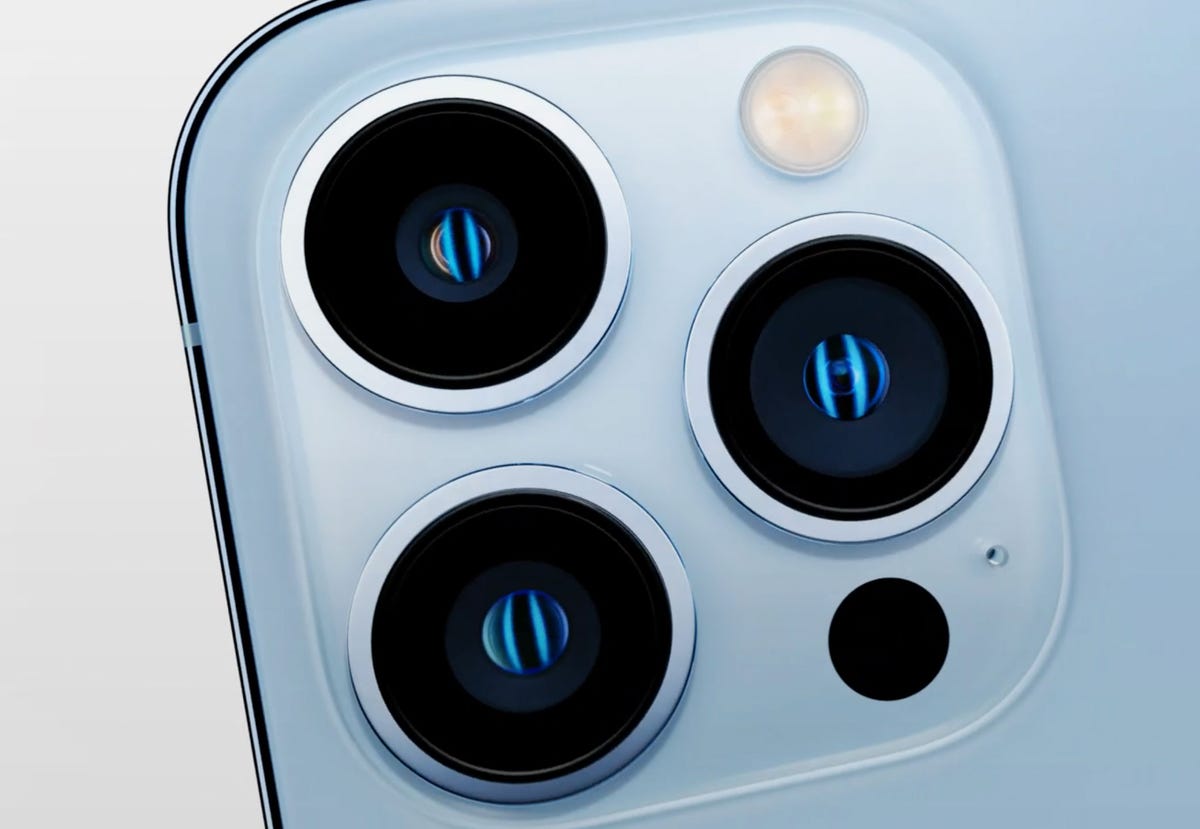
The iPhone 13 Pro has wide-angle, ultrawide and telephoto cameras.
Apple/Screenshot by Stephen Shankland/CNET
All the back cameras have been significantly upgraded with wider apertures and new video features. The buzziest is Cinematic mode, which will allow phones to have professional-level "rack focus" where you can slide between focus subjects gracefully in a video. You can also choose where to focus by tapping on the screen, or even holding down to lock focus on a subject.
iPhone 13 brings a new design and stylish colors. Here's what to know
iPhone 13: Apple adds larger battery, more storage, cinematic video mode
iPhone 13 Pro cameras: Why this pro photographer is excited
iPhone 13 cameras stand out with macro photography, cinematic video
iPhone 13 price and preorder: How and when to buy Apple's new phones
iPhone 13 Pro and Pro Max: 120Hz display, 3 new cameras and all the goodies
iPhone 13's starting storage is finally one we can recommend
iPhone 13 release date: All models will be available on Sept. 24
Apple's iPhone 13 Mini promises to be small but mighty
iPhone 13 Pro finally gets 1TB of storage for $1,499, 1TB Pro Max for $1,599
Here's which iPhones are getting lower prices, and which Apple will stop selling
iPhone 13 battery life: Your phone charge will last hours longer, Apple says
Apple touts iPhone 13's privacy features, but doesn't address spyware worries
iPhone 13 Pro gets Super Retina XDR display with ProMotion
iPhone gets 3x optical zoom for the first time
iPhone 13 will support 5G in 60 countries, work on over 200 carriers this year
Apple's iPad Mini sees a big upgrade: Support for USB-C charging
The iPhone 13 Pro camera now has a macro lens, able to shoot a subject from less than an inch away. Apple says it's also made improvements to the software that recognizes people's skin tones, and you can now apply tone and warmth filters that the camera will remember.
Apple says that despite the faster chip, 5G, better cameras and other features, the iPhone 13 has longer battery life than its predecessor. One way it does this is by shifting to LTE "when 5G speeds aren't needed."
The iPhone 13 Pro's camera lenses exploded.
Apple/Screenshot by James Martin/CNET
Apple is also getting its device to rely on the internet less. Many Siri requests for example will stay on the device, a first in the 10 years since the voice assistant was first introduced.
The iPhone 13 Pro has a bigger battery, a new Super Retina XDR display with 1,000 nits of peak outdoor brightness, 25% higher than last year. And it can change frame rate on the fly, increasing frame rate to 120Hz when you need to match games and some video, but ramping it down to 10Hz when you don't.
Prices remain the same as the last generation. The iPhone 13 starts at $799 (£779, AU$1,349). The iPhone 13 Mini starts with double the capacity, 128GB, at $699 (£679, AU$1,199). You can also get a 512GB version now, which used to only be available on the Pro models. The iPhone 13 Pro will keep its $999 (£949, AU$1,699) starting price and the iPhone 13 Pro Max will start at $1,099 (£1,049, AU$1,849). Preorders open this Friday, Sept. 17, and the phone will appear in stores on Sept. 24.
Apple/Screenshot by Chris Pavey/CNET
Apple Watch Series 7
The new watch has a larger display, with 20% more screen area than the Series 6 and 50% more than Series 3. But the dimensions of the watch have barely changed, Apple says. And it has "softer, more rounded corners" with a "wraparound" feel on the sides.
Apple says it redesigned buttons in the software to make them easier to tap as well, and it can fit 50% more text on screen than last year's watch.
The newest Apple Watches now have a "crack-resistant front crystal," with a "more robust geometry" and IP6X certification for additional dust resistance over the earlier model.
It has a bunch of new colors, bands and even a new charger that's faster. Like the iPad, Apple says it's 100% recycled aluminum.
The Apple Watch Series 7 will be $399, with international prices yet to be announced. It's not coming until later this fall, though. Apple will also keep selling the Apple Watch Series 3 for $199 and last year's Apple Watch SE for $279.
Since launching last year, Apple's focused its $10 per month Fitness Plus service on getting you to sweat. But this year, it's adding a meditation option, which will include all sorts of different calmness, kindness and gratitude meditations. Just like Apple's other classes, it'll be updated weekly on your phone and watch.
Apple's always had hidden features to compete with friends in its motion and activity app, and now the company's adding group workouts too. In this case, you can start a workout with (or against) your friends from an iMessage chat conversation. Apple says up to 32 people can participate and you'll even know when friends are ahead of you in a bike class, for example.
The new iPad Mini.
Apple/Screenshot by James Martin/CNET
iPad and iPad Mini
The new 10.2-inch iPad incorporates the A13 Bionic chip, Apple says, which is 20% faster than the A12 "in every aspect of the chip from the CPU and GPU to the neural engine." (The iPhone 13 has the new A15 Bionic chip.) It has a larger display, with 20% more screen area than the Series 6 and 50% more than Series 3. The dimensions of the watch have barely changed, Apple says. And it has "softer, more rounded corners" with a "wraparound" feel on the sides.
But the Mini is the bigger upgrade.
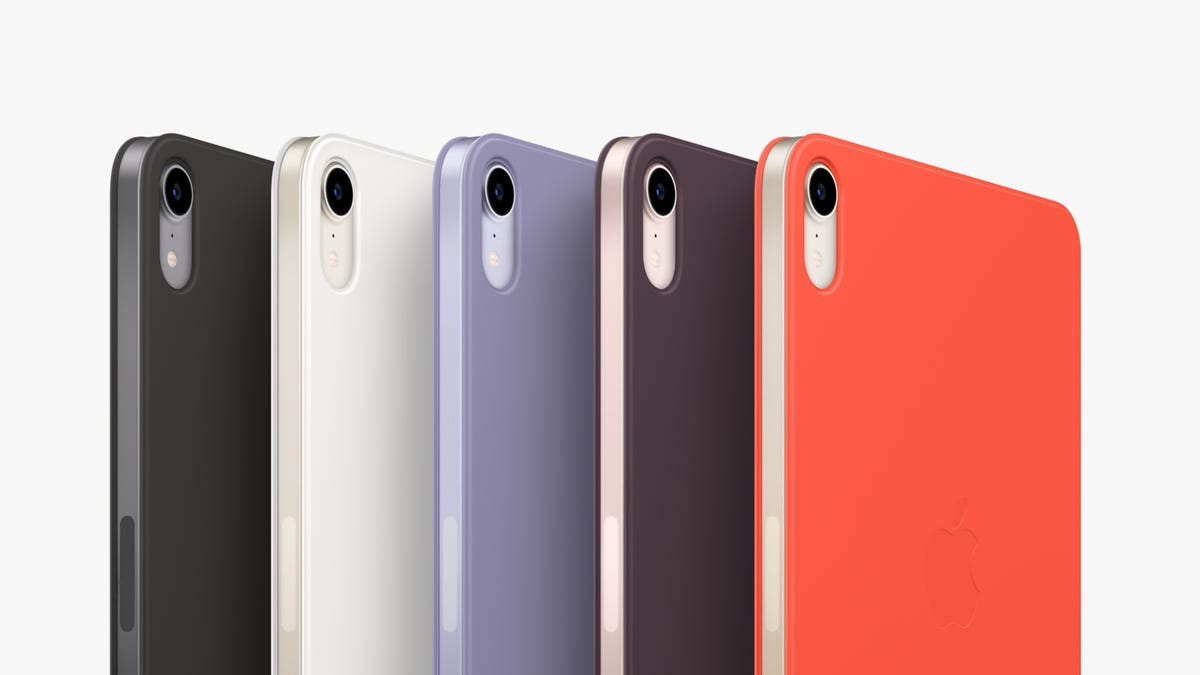
It ditches the home button, and has thinner screen bezels to fit the larger 8.3-inch True Tone screen, which has an antireflective coating and a brightness of 500 nits. It also comes in an array of colors, including purple, pink, "starlight" (a light gray) and space gray.
It also has Touch ID built into the power button, just like last year's iPad Air.
Apple says that the iPad Mini upgrade means that all the company's iPads are now made from 100% recycled aluminum, as well as 100% recycled tin (for the solder). Apple says it uses 100% recycled rare earth elements in the enclosure magnets (though not everywhere).
Apple's iPads have always been portrait-oriented devices. The front-facing camera's always been at the top of the device when held vertically, and its speakers have always been at the bottom. With the iPad Mini, Apple's moved the selfie camera to the top of the landscape orientation, and added stereo speakers meant to be heard in landscape as well.
The new iPad Mini's colors.
Apple/Screenshot by James Martin/CNET
Last year, Apple introduced faster 5G wireless to the iPhone. This year, it's adding the technology to all its iPads, starting with the iPad Pro in April. Now, the iPad Mini gets 5G, which Apple said can pull down 3.5 gigabits of data per second. It also gets a USB-C port like its iPad Pro big brothers.
The iPad starts at $329 (£319, AU$499) and the iPad Mini starts at $499 (£479, AU$749).
Our liveblog archive follows.
And that's it
11:31 a.m. PT
Apple closes with another tour through California landmarks. Like in its previous videos, it includes production health and safety info, including daily health screenings, face coverings "worn by everyone."
So when can you get it?
11:18 a.m. PT
The iPhone 13 Pro will keep its $999 starting price, and the iPhone 13 Pro Max will start at $1,099.
Preorders start Sept. 17 and ship Sept. 24.
iPhone 13 Pro as a video camera
11:12 a.m. PT
Apple pushed hard on the idea of using the iPhone 13 Pro as a professional-level video camera. It hired Oscar-winning film director Kathryn Bigelow to try it out, showing how well it handles low-light imagery.
iPhone 13 Pro camera upgrades
11:09 a.m. PT
Apple's updates for its wide and ultrawide allow for better low light performance, Apple says, and can also do macro photography -- shooting a subject as close as 2 centimeters away.
Apple says it's also made improvements to the software that recognizes people's skin tones, and you can now apply tone and warmth filters that the camera will remember.
iPhone 13 Pro and Pro Max
11:05 a.m. PT
Apple says it's the "most pro design," which is probably the most Apple thing I've heard the company say in a while.
It comes in four colors: silver, graphite, gold and "sierra blue."
Apple
The iPhone 13 Pro has a bigger battery, Apple added. And it includes a better GPU than the iPhone 13.
Apple said it's announcing a new "Super Retina XDR display" which has 1000 nits of peak outdoor brightness, 25% higher than last year. And it can change frame rate on the fly, increasing frame rate to 120Hz when you need, but ramping it down when you don't. In its demo, Apple showed it going down to 10Hz.
Better battery life
10:58 a.m. PT
Apple says that despite the faster chip, 5G, better cameras and other features, the iPhone 13 has longer battery life than its predecessor. One way it does this is by shifting to LTE "when 5G speeds aren't needed," Apple said. And the company's A15 Bionic chip is more efficient, Apple said.
Apple is also getting its device to rely on the internet less. Many Siri requests for example will stay on the device, a first in the 10 years since the voice assistant was first introduced.
Apple said it's keeping prices the same this year. iPhone 13 Mini starts at $699, with double the starting capacity to 128GB. (You can also get a 512GB version now, which used to only be available on the Pro models.)
A new automatic focus
10:52 a.m. PT
Apple said Cinematic Mode follows where the subject of a video looks, changing focus when they look away, and again when they look back.
Apple
Apple said you can also choose where to focus by tapping on the screen, or even holding down to lock focus on a subject. It's all shot in Dolby Vision HDR, Apple says, which is fancy talk for high end video formats.
Camera upgrades and Cinematic Mode
10:50 a.m. PT
Apple says its back cameras have gotten serious upgrades with the iPhone 13. The 12 megapixel camera can take in 47% more light, Apple says, with an F1.6 aperture.
The ultrawide camera has an F 2.4 aperture.
When it comes to video, Apple says it's adding "cinematic mode," which will allow phones to have professional-level "rack focus" where you can slide between focus subjects gracefully in a video. Apple of course created a demo "movie" to show it off.
iPhones get new A15 Bionic chip
10:45 a.m. PT
"Frankly, the competition is still playing catchup to our chips," Apple says. This year, the iPhone 13 gets A15 Bionic.
It has a 6-core CPU, with 2 high-performance cores and 4 high-efficiency cores. Apple says it's up to 50% faster than the leading competition. It also has a 4-core GPU, Apple says. It has 30% faster graphics than the competition.
iPhone 13 is here
10:40 a.m. PT
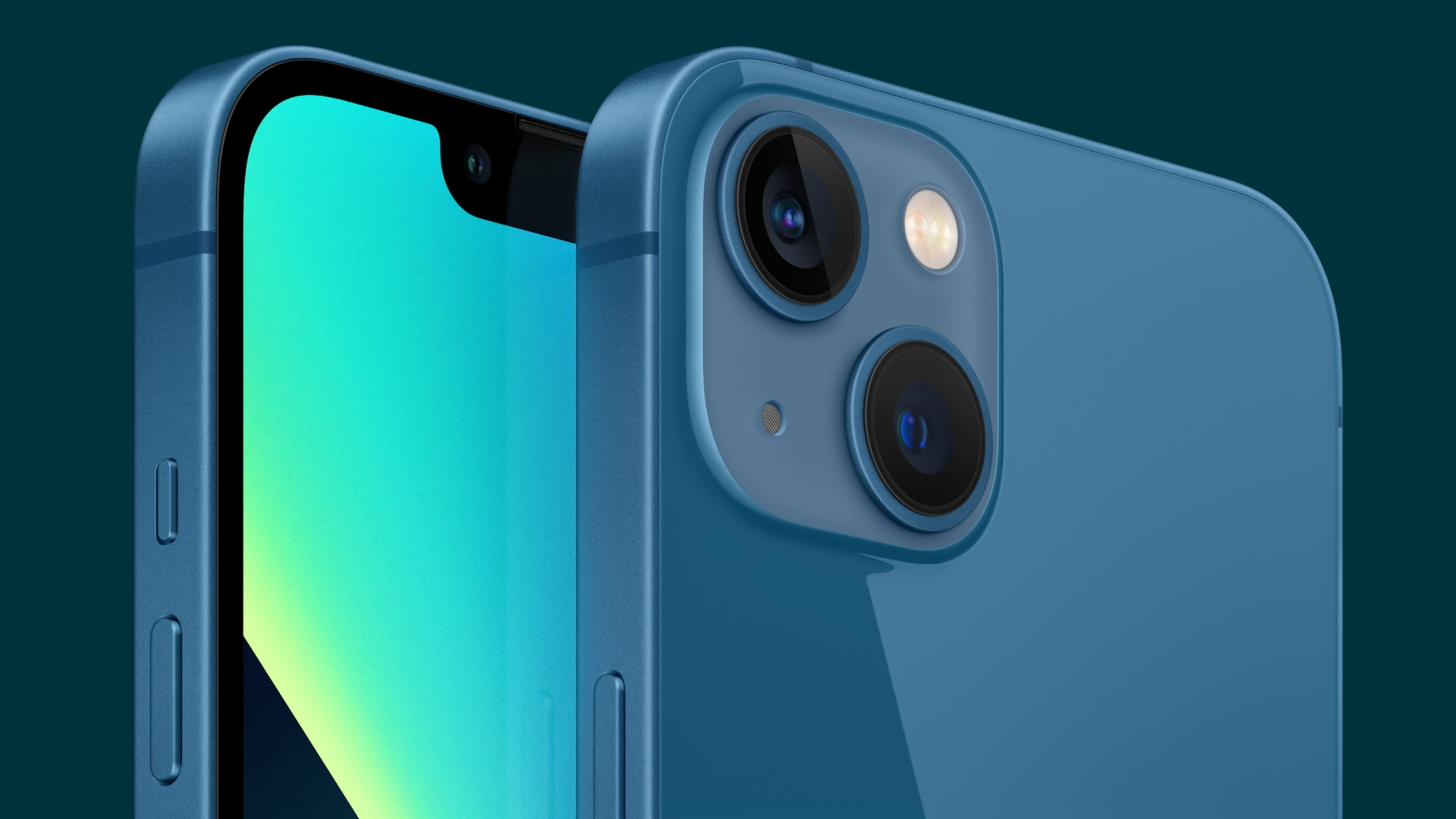
The new device has two rear lenses, arranged diagonally. It also comes in pink now, along with blue, "midnight," "starlight," and product red.
Apple
The antennas are made with recycled plastic water bottles, Apple says. And they have a sensor notch that's 20% smaller.
Apple Fitness Plus gets into group workouts
10:36 a.m. PT
Apple's always had hidden features to compete with friends in its motion and activity app, and now Apple's adding group workouts too. In this case, you can start a workout with (or against) your friends from an iMessage chat conversation.
Apple says up to 32 people can participate and you'll even know when friends are ahead of you in a bike class, for example.
Apple Fitness Plus adds meditation
10:35 a.m. PT
Since launching last year, Apple's focused its $10 per month Fitness Plus service on getting you to sweat. But this year, it's adding a meditation option, which will include all sorts of different calmness, kindness and gratitude meditations. Just like Apple's other classes, it'll be updated weekly on your phone and watch.
Apple Watch gets more durable
10:30 a.m. PT
Apple said its newest Apple Watches now have a "crack resistant front crystal," with a "more robust geometry."
It also has IP6X certification, which means it's duster resistant.
Of course, it has a bunch of new colors, bands and even a new charger that's faster.
Like the iPad, Apple says it's 100% recycled aluminum.
The Apple Watch Series 7 will be $399. Apple will also keep selling the Apple Watch Series 3 for $199, last year's Apple Watch SE for $279.
It's not coming until later this fall, though.
Apple Watch Series 7: a whole new design
Apple Watch 7 launches a full keyboard
Apple Watch Series 7 is real
10:27 a.m. PT
It has a larger display, with 20% more screen area than the Series 6 and 50% more than Series 3.
The dimensions of the watch have barely changed, Apple says. And it has "softer, more rounded corners" with a "wraparound" feel on the sides.
Apple
Apple says it redesigned buttons in the software to make them easier to tap as well, and it can fit 50% more text on screen than last year's watch.
100% Recycled Aluminum
10:23 a.m. PT
Apple said the iPad Mini upgrade means that all the company's iPads are now made from 100% recycled aluminum, as well as 100% recycled tin (for the solder). Apple says it uses 100% recycled rare earth elements in the enclosure magnets (not everywhere).
Apple finds landscape
10:19 a.m. PT
Apple's iPads have always been portrait-oriented devices. The front-facing camera's always been at the top of the portrait-oriented device. And its speakers have always been at the bottom.
With the iPad Mini, Apple's moved the selfie camera to the top of the landscape orientation, and adding stereo speakers meant to be heard in landscape as well.
It'll start at $499, more expensive than the $399 starting price for the previous generation
iPad Mini gets USB-C, 5G
10:18 a.m. PT
Last year, Apple introduced 5G superfast wireless to the iPhone. This year, it's adding the technology to its iPads. First, with the iPad Mini, which Apple said can pull down 3.5 gigabits per second. It also gets USB like its iPad Pro big brothers.
iPad Mini gets a big upgrade
10:14 a.m. PT
Tim Cook announced the new iPad Mini, which ditches the home button, and has thinner borders. It also comes in an array of colors: purple, pink, "starlight" and space gray.
Apple says it's 8.3 inches, and offers true tone, anti reflective coating, and 500 nits of brightness.
It also has Touch ID built into the power button, just like last year's iPad Air.
The new iPad Mini has a 40% jump in CPU performance, and 80% "leap" in GPU, Apple says.
Apple iPad gets refreshed for 2021 with an A13 chip, 12-megapixel camera, True Tone display
iPad updates
10:09 a.m. PT
Cook starts by talking about how strong the iPad business has been growing, up 40% in the past year.
"Today, it gets even better," he says.
The new iPad will include the A13 bionic chip, Apple says, which is 20% faster "in every aspect of the chip from the CPU and GPU to the neural engine."
Apple's Melody Kuna, a senior manager of iPad product design, says it's up to 3x faster than the best selling Chromebook and up to 6x faster than the best selling Android tablet.
It'll also include a better rear and front camera, she said.
Apple TV Plus
10:07 a.m. PT
Apple started by discussing his company's $5 per month video service, Apple TV Plus, showing off a bunch of previews for hit shows like Ted Lasso and The Morning Show, as well as upcoming titles like Foundation, and a comedy series, The Problem With Jon Stewart. (Stewart joked they may need to add a comma to that title.)
Apple
Love, California
10:04 a.m. PT
Tim Cook starts Apple's event with a video montage of all the things he says Apple loves about California. All its landmarks, singing people, it's definitely a fun place to start.
"California has always been a place for people with big ambitions and big dreams, a place where people are fueled with optimism to make things better, to make things that can change the world. It is such an important part of who we are at Apple, and inspires us in everything we create and do. We're proud to call California our home."
No more pop and rock
9:57 a.m. PT
Apple used to have a playlist prepared for its events with hit songs from hit groups like Coldplay all the way to little-known musicians who'd suddenly find fame in background of Apple ads and events. But ever since Apple started streaming its events amid the pandemic, it's switched to more artsy -- what I'll call corporate classical and pop music.
For what it's worth, I checked on Apple-owned Shazam to see if maybe this was an artist I'd never heard of. Nope -- Shazam hasn't heard it either. At least it's kinda catchy.
Our show has started
9:50 a.m. PT
Apple's event is nearly ready to begin, and CNET's live pre-show is running now at the top of this page. You can watch live as we discuss all the rumors and expected products. Also, get some insight into the minds of our great reviewers.
Spyware scare
9:17 a.m. PT
While we're all waiting to see what Apple releases, make sure you take this moment to update your iPhones, iPads and other Apple devices. Like, now. Go. I'll wait.
Apple put out a surprise update Monday that closes a security hole in a reported "zero-click" hack. This attack, which is tied to the Pegasus spyware reportedly used to spy on dissidents, world leaders and journalists, can be delivered through a text message. Supposedly, you can't do anything to stop when it arrives -- the hack goes into effect as soon as your phone receives the message. Apple's update closes that hole.
By the way, you can find out if you've been hacked using a free tool available online.
Will there be enough?
9:03 a.m. PT
It used to be that when new iPhones came out, people lined up around the block outside Apple Stores to be among the first to get their hands on the device. It would then typically be promptly sold out and nearly impossible to find for days or even weeks. Apple's gotten better at managing demand, and so many people buy online now that the dramatic iPhone lines are largely a thing of the past. But what of supply?
In the pandemic, we've learned that our international supply chains are rather fragile, and our reliance on overseas manufacturing has led to shortages of all sorts of products, from cars to video game consoles to garlic. So far, indications are Apple's been able to avoid these issues, in part thanks to its aggressive long-term planning. That doesn't mean you'll have easy access to an iPhone at launch, but it shouldn't be as hard to find as, say, a PlayStation 5.
There are rumors the Apple Watch on the other hand may have limited supplies at launch. But that's because of a non-pandemic problem. According to rumors, Apple struggled to get production going smooth in order to produce at high volume.
Unusual location
8:31 a.m. PT
Pretty much every virtual event Apple's held so far has been set on its multibillion dollar "spaceship" headquarters in Cupertino, California. But this time Apple CEO Tim Cook tweeted out a picture of a different location the company will be holding at least part of its event from: The desert.
It's a good bet this may be a reference to the rumored satellite emergency call capabilities being built into the next iPhones. We'll have to see.
§
Apple's new iPhone 13 line debuted Tuesday at Apple's September event, showing a tweaked design with a variety of new features for those upgrading from earlier iPhone models. The lineup consists of four new phones: the iPhone 13, the 13 Mini, the 13 Pro and the 13 Pro Max. The new phones will run iOS 15, come with a larger battery, more storage, a new A15 Bionic processor, a smaller notch and an abundance of new camera features. The base model of the iPhone 13 and 13 Mini are available in five colors: pink, blue, midnight (black), starligh t (white) and Product Red. The iPhone 13 Pro and 13 Pro Max will also get a giant camera upgrade as well as a new display with 120Hz high refresh-rate display.
Read on for our first take on Apple's iPhone 13 lineup and the answers to all of your questions about the phone's specs, features, design, price and how to get your hands on one yourself. Plus, here's everything we know about iOS 15, and here's what we know about a potential October Apple event.
How much will the iPhone 13 cost, and how much storage does it have?
The iPhone 13 price depends on which of the four variants you buy, how much storage you choose and whether you're purchasing through a carrier or unlocked. Here's everything to know about the iPhone 13 price structure and preorder details.
Without a carrier discount, the iPhone 13 starts at $829 (£779, AU$1,349) for 128GB, which is twice the storage of the base iPhone 12 model. The iPhone 13 Mini starts at $729 (£679, AU$1,199) for the same 128GB of storage. Like the iPhone 12, if you buy an iPhone 13 or 13 Mini tied to a US carrier, you'll receive a $30 discount.
The iPhone 13 Pro starts at $999 (£949, AU$1,699) and the 13 Pro Max at $1,099 (£1,049, AU$1,849) for 128GB of storage. For the first time, you have the option to get 1TB of storage on an iPhone. The extra storage is only available on the Pro models and pushes the iPhone 13 Pro Max's price to $1,599. Below is a breakdown of prices (without a carrier discount) and storage options.
iPhone 13 series US prices and storage
Model
128GB of storage
256GB of storage
512GB of storage
1TB of storage
iPhone 13 Mini
$729
$829
$1,029
N/A
iPhone 13
$829
$929
$1,129
N/A
iPhone 13 Pro
$999
$1,099
$1,299
$1,499
iPhone 13 Pro Max
$1,099
$1,199
$1,399
$1,599
Apple/Screenshot by James Martin/CNET
What is the iPhone 13's screen size?
The four iPhone 13 models have the same size screens as the iPhone 12 series. The iPhone 13 Mini has a 5.4-inch display, the iPhone 13 and 13 Pro have a 6.1-inch screen, while the iPhone 13 Pro Max has a 6.7-inch display. All the new phones have brighter screens.
Does the iPhone 13 Pro have a 120Hz refresh rate?
Both Pro models now get a higher 120Hz refresh rate, which makes animations and scrolling look smoother and gaming more immersive. Android phones, whether they are expensive or not, commonly feature a high refresh rate screen. Up to now, the only Apple device to offer such a refresh rate was the iPad Pro, which uses an LCD screen instead of the OLED found on the iPhone 13 Pro and 13 Pro Max. Here's some more information on the iPhone 13's 120Hz refresh rate, ProMotion and why it may not work exactly the way you think.
How long does the iPhone 13 battery last?
Probably the most welcomed feature announced for the iPhone 13 is a bigger battery. Apple didn't share the size, but claims that the new battery along with iOS 15, the A15 chip and updated display adds 2.5 hours of battery life to the iPhone 13 (compared to the iPhone 12).
The iPhone 13 Mini should get an 1.5 hours more than the iPhone 12 Mini. That's a significant increase: The battery life on the iPhone 12 Mini was a compromise some people weren't willing to make. So it's exciting to see the new Mini get such a big bump in just a year.
Apple says that the Pro models should see a similar increase in battery life with the iPhone 13 Pro getting 2.5 hours more and the 13 Pro Max getting an additional 1.5 hours.
How many cameras does the iPhone 13 have?
The iPhone 13 and 13 Mini get an updated camera system, which is apparent from the new diagonal orientation of the two rear cameras. In fact, Apple says the new orientation is a result of making more room for a new sensor-based stabilization system -- which previously was only on the iPhone 12 Pro Max. (The cameras on the iPhone 12 were stacked vertically.)
All four models get an improved 12-megapixel main camera and a better ultrawide lens and sensor. The new hardware, along with the new A15 Bionic chip, means a handful of improvements and new features, including being able to capture 47% more light.
The iPhone 13 Pro also has a new triple-camera system with better lenses and sensors. The telephoto lens comes with 3x optical zoom, which is 1.5x longer than the camera on the iPhone 12 Pro and 1.2x longer than the tele lens on the 12 Pro Max. Take a look below at the different telephoto lenses the Pro models of the iPhone 13 and 12.
To put things in perspective, this is an enormous improvement for the iPhone, but it still pales in comparison to the telephoto cameras on the Galaxy S21 Ultra and phones from Huawei.
iPhone 13 Pro telephoto lens specs vs. 13 Pro, 12 Pro, 12 Pro Max