Galaxy Watch 4: Samsung is coming for Apple Watch's crown with Wear OS 3
There's one clear go-to smartwatch for iOS: the Apple Watch. But for Android, there hasn't been a singular option. Will the Samsung Galaxy Watch 4 finally be that watch? At Samsung's newest folding-phone-focused Unpacked announcement where the latest Galaxy Z Fold 3 and Z Flip 3 phones were unveiled, the company also announced the Galaxy Watch 4 and Watch 4 Classic -- which can be preordered now and go on sale Aug. 27. I've already started to wear them and test them: here's the full review. They're the first Samsung watches to have the Google co-designed Wear OS 3, which isn't coming to other smartwatches until next year. Following the already-excellent Watch Active 3, will the Galaxy Watch 4 be even better? It certainly looks like it.
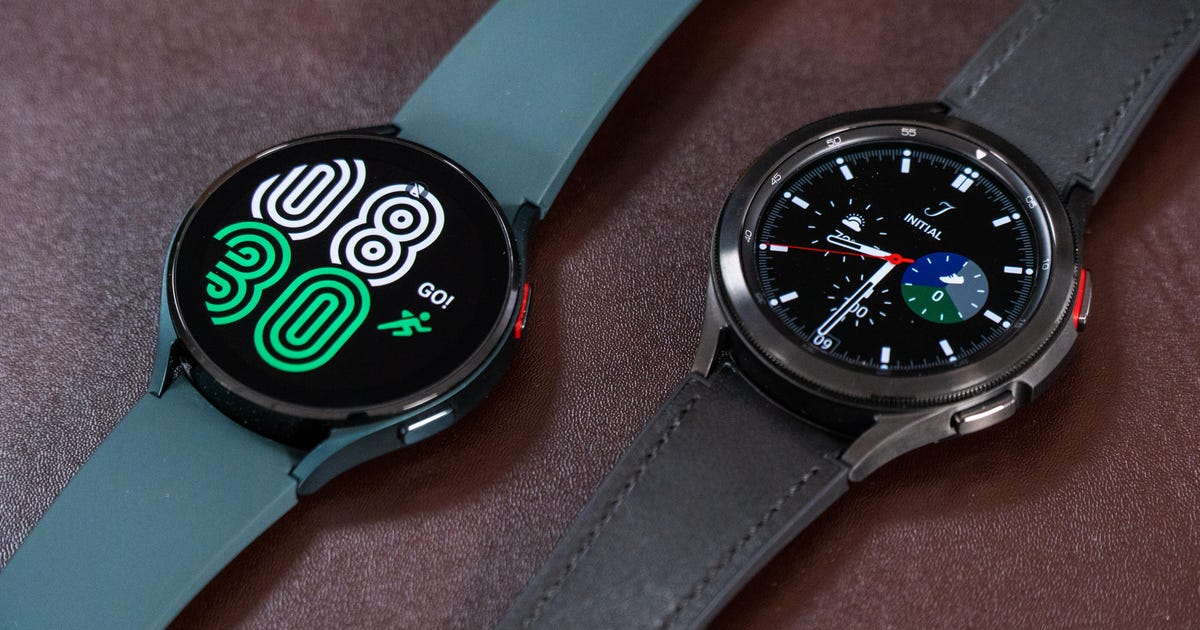
Much like previous Samsung watches, there are two designs: a sleeker, less expensive Watch 4 and a more traditional-looking Watch 4 Classic. The latter brings back Samsung's physically rotating outer bezel and has more traditional watch-like looks and straps. The prices ramp up based on either design ($250 for the aluminum 40mm Watch 4, $350 for the stainless steel 42mm Watch 4 Classic), size (the larger 44mm Watch 4/46mm Watch 4 Classic cost an extra $30) or LTE data compatibility (an extra $50 on top of that). In the UK, the Watch 4 starts at £249, and the Classic at £349. Australian prices are TBD.
Samsung's watches have always been good. Then there's also been Fitbit and even Google Wear OS. But Samsung's Galaxy Watch 4 is looking to tie it all together and reboot the Android watch landscape by finally not having a weird split between Samsung's watch experience and Google's.
Promises of better watch-phone connection
The Watch 4's new Google- and Samsung-developed OS will eventually show up on other smartwatches. But for Samsung's newest watches, it should mean a more Android-fluid connected experience. Notifications, calls, controlling your phone, syncing with your phone settings: Samsung promises that the Watch 4 will do all this better than previous watches. Samsung's also promising better battery life and speedier performance. That battery life may still only be about two days, but it'll be enough to go to bed with and track sleep overnight. Samsung also renamed its watch: The Watch Active name is gone. (Welcome back, Galaxy Watch.)
The Galaxy Watch 4 is only made for Android phones, with no plans for iOS compatibility right now. While previous Wear OS and Samsung watches could pair with iPhones, the Watch 4 is clearly made to be a seamlessly connecting watch for Android (and specifically Samsung) phones. Samsung's "One UI" philosophy is about syncing wallpapers, designs and settings across phone and watch. Will the watch feel like a seamless extension of the phone? We'll see when we test-drive one.

The new rear sensor array includes electrical bioimpedance, which promises scale-like body fat/BMI estimates.
Drew Evans/CNETHealth tech: Snore detection and bioimpedance-based body analysis
There are several new health features on the Watch 4 on top of the ones that carried over from the Samsung Galaxy Watch 3. Besides heart rate, blood oxygen and electrocardiogram (and stress-sensing/blood pressure testing that requires calibration with a blood pressure cuff), Samsung is adding a few extras to sleep tracking. Snore detection works using the paired Android phone's microphone, and the blood oxygen checks now run continuously once a minute overnight (or as a spot-check during the day).
Samsung also added a new sensor to its rear array: an electrical bioimpedance sensor for full-body analysis using a weak electrical current to measure how conductive you are -- and therefore showing what you're made of. This type of sensor tech hasn't been on recent smartwatches; the last wearable I remember promising bioimpedance was the Jawbone Up 3.
When using the body analysis feature, there will be readouts on your BMI, muscle mass and body water along with body fat percentages, much like some scales. I'm not sure how I feel about that! Samsung Health will use this readout to calculate a range of where your health is compared to optimal levels.
New sensor tech is always a toss-up: Will it work? Will it be useful? We don't know yet. Samsung is aiming for this to be a comprehensive body analysis tool, which sounds awfully ambitious. Last year, the Fitbit Sense also introduced new electrodermal stress-detection sensors, but I never found them meaningful in my everyday life. Jury's still out on the bioimpedance features, too.
Samsung Health remains the fitness and health platform default for the Galaxy Watch 4, despite the OS change. But a shift to Google Play for apps and new support for watch face complications should mean a lot of fitness apps make the shift, too. (Complications are basically those little watch-face widgets that show data from other apps, and they're pretty helpful.) Samsung's already announced that Strava, Calm and Adidas Running are supported. Spotify's also supported for on-watch music playback.
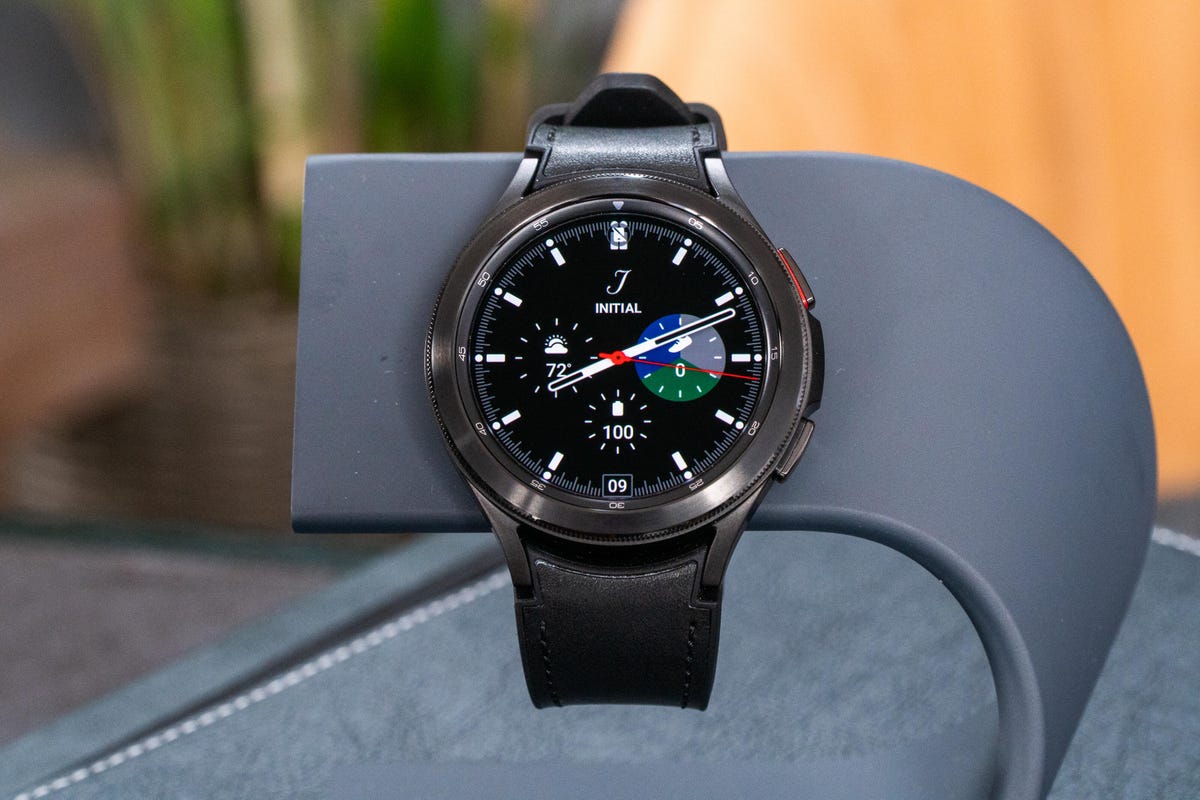
See that rotating bezel? It's back.
Drew Evans/CNETBoosted specs
The Watch 4's new processor should be faster than the last Watch 3 (20% faster CPU and 50% faster GPU, according to Samsung) and there's more RAM (1.5GB) and storage (16GB) than before. That should make animations and app-launching speedier. The Super AMOLED display is sharper: the 1.2-inch 42 and 40mm models have a 396x396-pixel resolution, while the 1.4-inch 44 and 46mm models are 450x450. The watches can also quick charge, gaining 10 hours of battery life on a 30-minute charge.
The rotating bezel is back
Both the Watch 4 and Watch 4 Classic lean heavily on touching the outer rim of the watch to "spin" and navigate: the Watch 4 has a touch-sensitive rim, while the Classic has a physical rotating bezel. Samsung's also putting touch controls into these watches to allow swipe navigation, much like Wear OS watches. You can choose how to interact.
A few other buttons on the side of the watch control moving back and forth in the interface and can be reprogrammed. One can be pressed and held for Samsung's Bixby assistant; the other for Samsung Pay. But you can make Google Assistant and Google Pay the go-to apps instead.

Some of the Google apps on the Galaxy Watch 4 have a familiar Google look.
GoogleGoogle apps onboard
Google's Wear OS 3 being on the Galaxy Watch 4 means it'll hook into Google Play, but it's also getting some revamped Google apps. Google's already committed to new YouTube, Google Maps, Google Pay and Messages apps, which have new designs for Wear OS 3. There are also third-party updates with new Tiles: Calm, Komoot, MyFitnessPal, Period Tracker, Sleep Cycle, Spotify and Strava are among the first to get updates. Google is committing to rolling out more updates over time, meaning that both Samsung and Google should be keeping this watch full of apps.
But you're stuck with Bixby for now. Samsung's voice assistant is still the default on the watch, which comes up when pressing and holding the top button. Google Assistant isn't available at the moment, which is frustrating -- that's one of the top things I'd want to access on a Google-connected watch.
Could this be the best Android watch?
The Galaxy Watch 4 looks like the ultimate fusion of a Samsung watch with Google watches -- and that could be a winning formula for using Google Maps, connected phone features and third-party fitness apps on Google Play, which is the Galaxy Watch 4's default app store. It should be the hardware-boosted Google watch that we've been waiting years for. The software interface seems exactly like what you'd expect: part Samsung, part Google. But is it worth waiting to see how it works out, or should you just go for this first model? Hard to tell, since it's the first of its kind.
It's not surprising that Samsung's new health features and its new OS aren't coming to older Samsung watches for now. Some of them might, but expect this to largely be a clean break and a reboot. And we also don't really know how many of the Galaxy Watch 4's features will carry over to the rest of Google's future Wear OS 3 watch lineup, which will include watches from Mobvoi, Fossil and eventually Fitbit.
Those Wear OS 3 watch updates won't come to those other watches until 2022, which makes the Galaxy Watch 4 the only new Google-connected Wear OS 3 watch this year. For that reason alone, it could very well be the best Android watch of the moment. As to how it actually feels and works? We'll have full hands-on impressions and a review in the days ahead... but the Galaxy Watch 4 looks extremely promising for any Android phone owner who wants a much more hooked-in watch.
§
Google's new Samsung-codesigned version of Wear OS is officially called Wear OS 3, and it'll be on Samsung's next-gen Galaxy Watch soon. But for many watch owners it won't arrive until 2022. Or, you won't be able to get the new software at all.
The latest news comes from a new update from Google, which will make watches eligible for the next version of Wear OS. According to Google, which shared the information with CNET, Mobvoi's TicWatch Pro 3 GPS, TicWatch Pro 3 cellular, and TicWatch E3 will get the upgrade, along with Fossil's next-gen smartwatches, which are coming this fall. But that software update won't be coming in 2021. Instead, it'll be in the middle of next year.
Fossil shared news of its next-gen smartwatches with CNET earlier this year, but now it looks like Fossil's watches (and Mobvoi's) won't have Wear OS 3 to start, instead they'll come with an option to upgrade the OS in the "mid to second half of 2022."
Google also cautions that the OS update involves a complete reboot to factory settings, and that for some watches the "user experiences will be impacted," suggesting some people could choose to keep the previous version of Wear OS. Google wouldn't clarify what those "impacted" experiences will be, but told CNET via email that it will "share more at the time of upgrade so users can make an informed decision."
Other Wear OS watches won't get Wear OS 3, as Google had indicated before, but some future software features are still expected, with security updates for at least "two years from device launch."
Samsung is expected to announce its newest Galaxy Watch on Aug. 11 during its summer Unpacked event. That watch will have Google's Wear OS 3, making it the only Wear OS 3 watch that's confirmed for 2021. Google wouldn't confirm whether other Wear OS 3 watches are expected this year or not, but for now it looks like Samsung may have an exclusive window on its Wear OS partnership.
Source