iPhone 13, iPad Mini and all the details of Apple's big announcements last week
Update, Sept. 21: CNET reviewed the iPhone 13, Mini, Pro and Pro Max. Original story follows.
Apple's iPhone 13 event has been put to bed, and in it we got the expected iPhone 13 announcement, as well as a refreshed 10.2-inch iPad, a big upgrade for the iPad Mini and a new Apple Watch Series 7. There were a few small announcements, too. We saw some upcoming show previews for Apple TV Plus, including the new season of The Morning Show and fresh titles like Foundation, and a comedy series, The Problem With Jon Stewart. (Stewart joked they may need to add a comma to that title.)
We also got an announcement date for the release of the new mobile operating systems, iOS 15 and iPadOS 15: Sept. 20. Get ready to download and install them on your iPhone and iPad.
iPhone 13, Mini, Pro and Pro Max
Apple showed off a complete new line of iPhones. They all get updated to a new A15 Bionic chip, a six-core CPU with two high-performance cores, four high-efficiency cores and a quad-core GPU.
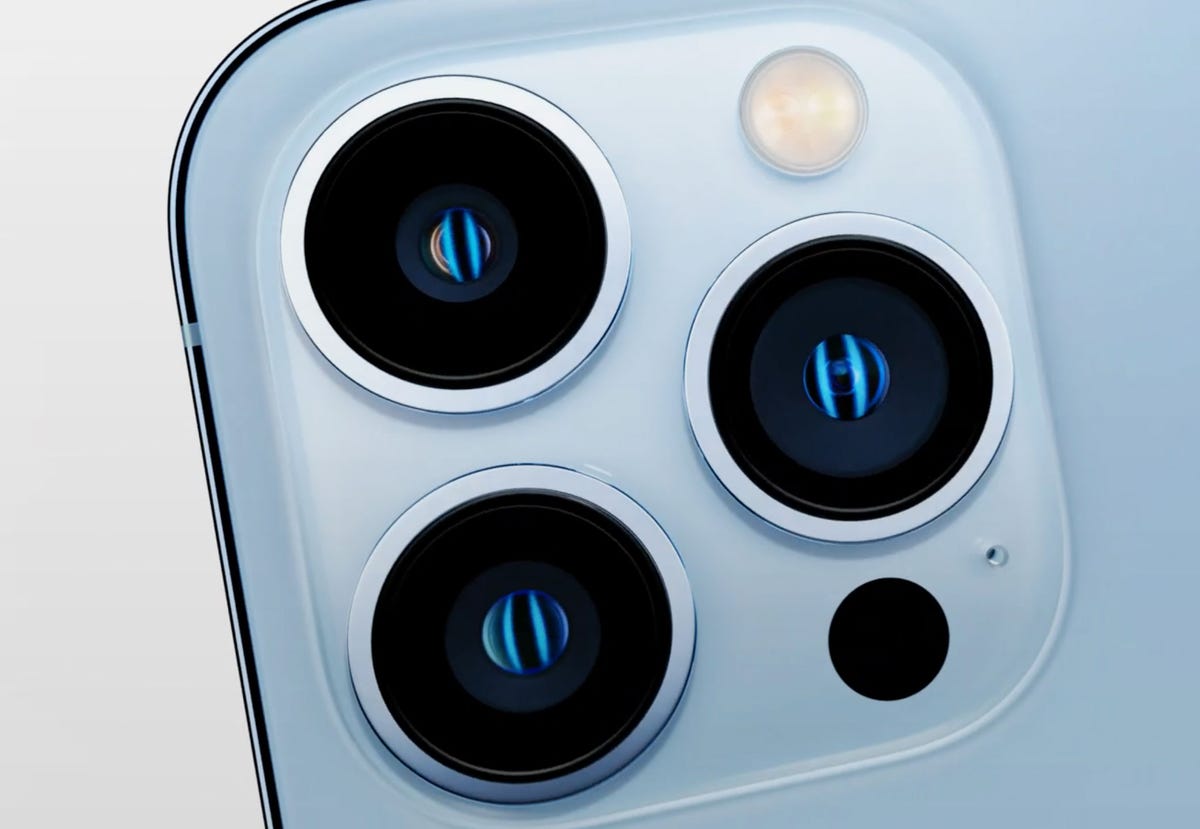
The iPhone 13 Pro has wide-angle, ultrawide and telephoto cameras.
Apple/Screenshot by Stephen Shankland/CNETAll the back cameras have been significantly upgraded with wider apertures and new video features. The buzziest is Cinematic mode, which will allow phones to have professional-level "rack focus" where you can slide between focus subjects gracefully in a video. You can also choose where to focus by tapping on the screen, or even holding down to lock focus on a subject.
- iPhone 13 brings a new design and stylish colors. Here's what to know
- iPhone 13: Apple adds larger battery, more storage, cinematic video mode
- iPhone 13 Pro cameras: Why this pro photographer is excited
- iPhone 13 cameras stand out with macro photography, cinematic video
- iPhone 13 price and preorder: How and when to buy Apple's new phones
- iPhone 13 Pro and Pro Max: 120Hz display, 3 new cameras and all the goodies
- iPhone 13's starting storage is finally one we can recommend
- iPhone 13 release date: All models will be available on Sept. 24
- Apple's iPhone 13 Mini promises to be small but mighty
- iPhone 13 Pro finally gets 1TB of storage for $1,499, 1TB Pro Max for $1,599
- Here's which iPhones are getting lower prices, and which Apple will stop selling
- iPhone 13 battery life: Your phone charge will last hours longer, Apple says
- Apple touts iPhone 13's privacy features, but doesn't address spyware worries
- iPhone 13 Pro gets Super Retina XDR display with ProMotion
- iPhone gets 3x optical zoom for the first time
- iPhone 13 will support 5G in 60 countries, work on over 200 carriers this year
- Apple's iPad Mini sees a big upgrade: Support for USB-C charging
- Apple's A15 Bionic chip powers iPhone 13 with 15 billion transistors
The iPhone 13 Pro camera now has a macro lens, able to shoot a subject from less than an inch away. Apple says it's also made improvements to the software that recognizes people's skin tones, and you can now apply tone and warmth filters that the camera will remember.
Apple says that despite the faster chip, 5G, better cameras and other features, the iPhone 13 has longer battery life than its predecessor. One way it does this is by shifting to LTE "when 5G speeds aren't needed."

The iPhone 13 Pro's camera lenses exploded.
Apple/Screenshot by James Martin/CNETApple is also getting its device to rely on the internet less. Many Siri requests for example will stay on the device, a first in the 10 years since the voice assistant was first introduced.
The iPhone 13 Pro has a bigger battery, a new Super Retina XDR display with 1,000 nits of peak outdoor brightness, 25% higher than last year. And it can change frame rate on the fly, increasing frame rate to 120Hz when you need to match games and some video, but ramping it down to 10Hz when you don't.
Prices remain the same as the last generation. The iPhone 13 starts at $799 (£779, AU$1,349). The iPhone 13 Mini starts with double the capacity, 128GB, at $699 (£679, AU$1,199). You can also get a 512GB version now, which used to only be available on the Pro models. The iPhone 13 Pro will keep its $999 (£949, AU$1,699) starting price and the iPhone 13 Pro Max will start at $1,099 (£1,049, AU$1,849). Preorders open this Friday, Sept. 17, and the phone will appear in stores on Sept. 24.

Apple Watch Series 7
The new watch has a larger display, with 20% more screen area than the Series 6 and 50% more than Series 3. But the dimensions of the watch have barely changed, Apple says. And it has "softer, more rounded corners" with a "wraparound" feel on the sides.
Apple says it redesigned buttons in the software to make them easier to tap as well, and it can fit 50% more text on screen than last year's watch.
The newest Apple Watches now have a "crack-resistant front crystal," with a "more robust geometry" and IP6X certification for additional dust resistance over the earlier model.
It has a bunch of new colors, bands and even a new charger that's faster. Like the iPad, Apple says it's 100% recycled aluminum.
The Apple Watch Series 7 will be $399, with international prices yet to be announced. It's not coming until later this fall, though. Apple will also keep selling the Apple Watch Series 3 for $199 and last year's Apple Watch SE for $279.
Since launching last year, Apple's focused its $10 per month Fitness Plus service on getting you to sweat. But this year, it's adding a meditation option, which will include all sorts of different calmness, kindness and gratitude meditations. Just like Apple's other classes, it'll be updated weekly on your phone and watch.
Apple's always had hidden features to compete with friends in its motion and activity app, and now the company's adding group workouts too. In this case, you can start a workout with (or against) your friends from an iMessage chat conversation. Apple says up to 32 people can participate and you'll even know when friends are ahead of you in a bike class, for example.

The new iPad Mini.
Apple/Screenshot by James Martin/CNETiPad and iPad Mini
The new 10.2-inch iPad incorporates the A13 Bionic chip, Apple says, which is 20% faster than the A12 "in every aspect of the chip from the CPU and GPU to the neural engine." (The iPhone 13 has the new A15 Bionic chip.) It has a larger display, with 20% more screen area than the Series 6 and 50% more than Series 3. The dimensions of the watch have barely changed, Apple says. And it has "softer, more rounded corners" with a "wraparound" feel on the sides.
But the Mini is the bigger upgrade.
It ditches the home button, and has thinner screen bezels to fit the larger 8.3-inch True Tone screen, which has an antireflective coating and a brightness of 500 nits. It also comes in an array of colors, including purple, pink, "starlight" (a light gray) and space gray.
It also has Touch ID built into the power button, just like last year's iPad Air.
Apple says that the iPad Mini upgrade means that all the company's iPads are now made from 100% recycled aluminum, as well as 100% recycled tin (for the solder). Apple says it uses 100% recycled rare earth elements in the enclosure magnets (though not everywhere).
Apple's iPads have always been portrait-oriented devices. The front-facing camera's always been at the top of the device when held vertically, and its speakers have always been at the bottom. With the iPad Mini, Apple's moved the selfie camera to the top of the landscape orientation, and added stereo speakers meant to be heard in landscape as well.
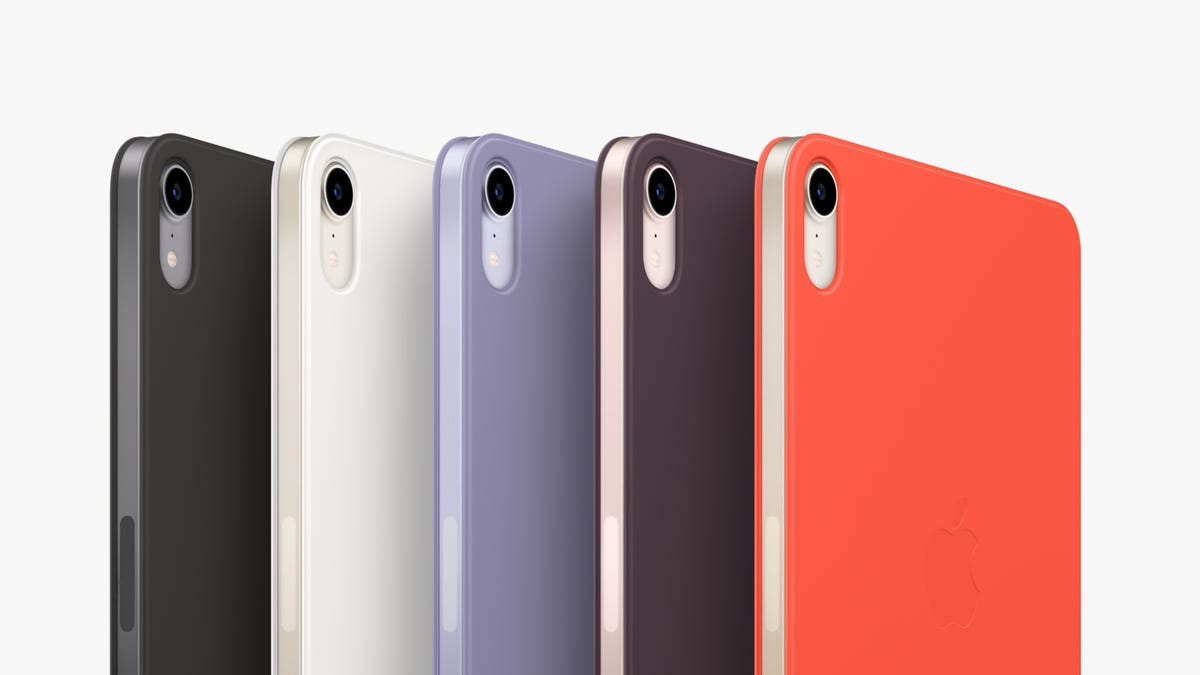
The new iPad Mini's colors.
Apple/Screenshot by James Martin/CNETLast year, Apple introduced faster 5G wireless to the iPhone. This year, it's adding the technology to all its iPads, starting with the iPad Pro in April. Now, the iPad Mini gets 5G, which Apple said can pull down 3.5 gigabits of data per second. It also gets a USB-C port like its iPad Pro big brothers.
The iPad starts at $329 (£319, AU$499) and the iPad Mini starts at $499 (£479, AU$749).
Our liveblog archive follows.
And that's it
11:31 a.m. PT
Apple closes with another tour through California landmarks. Like in its previous videos, it includes production health and safety info, including daily health screenings, face coverings "worn by everyone."
So when can you get it?
11:18 a.m. PT
The iPhone 13 Pro will keep its $999 starting price, and the iPhone 13 Pro Max will start at $1,099.
Preorders start Sept. 17 and ship Sept. 24.
iPhone 13 Pro as a video camera
11:12 a.m. PT
Apple pushed hard on the idea of using the iPhone 13 Pro as a professional-level video camera. It hired Oscar-winning film director Kathryn Bigelow to try it out, showing how well it handles low-light imagery.
iPhone 13 Pro camera upgrades
11:09 a.m. PT
Apple's updates for its wide and ultrawide allow for better low light performance, Apple says, and can also do macro photography -- shooting a subject as close as 2 centimeters away.
Apple says it's also made improvements to the software that recognizes people's skin tones, and you can now apply tone and warmth filters that the camera will remember.
iPhone 13 Pro and Pro Max
11:05 a.m. PT
Apple says it's the "most pro design," which is probably the most Apple thing I've heard the company say in a while.
It comes in four colors: silver, graphite, gold and "sierra blue."

The iPhone 13 Pro has a bigger battery, Apple added. And it includes a better GPU than the iPhone 13.
Apple said it's announcing a new "Super Retina XDR display" which has 1000 nits of peak outdoor brightness, 25% higher than last year. And it can change frame rate on the fly, increasing frame rate to 120Hz when you need, but ramping it down when you don't. In its demo, Apple showed it going down to 10Hz.
Better battery life
10:58 a.m. PT
Apple says that despite the faster chip, 5G, better cameras and other features, the iPhone 13 has longer battery life than its predecessor. One way it does this is by shifting to LTE "when 5G speeds aren't needed," Apple said. And the company's A15 Bionic chip is more efficient, Apple said.
Apple is also getting its device to rely on the internet less. Many Siri requests for example will stay on the device, a first in the 10 years since the voice assistant was first introduced.
Apple said it's keeping prices the same this year. iPhone 13 Mini starts at $699, with double the starting capacity to 128GB. (You can also get a 512GB version now, which used to only be available on the Pro models.)
A new automatic focus
10:52 a.m. PT
Apple said Cinematic Mode follows where the subject of a video looks, changing focus when they look away, and again when they look back.

Apple said you can also choose where to focus by tapping on the screen, or even holding down to lock focus on a subject. It's all shot in Dolby Vision HDR, Apple says, which is fancy talk for high end video formats.
Camera upgrades and Cinematic Mode
10:50 a.m. PT
Apple says its back cameras have gotten serious upgrades with the iPhone 13. The 12 megapixel camera can take in 47% more light, Apple says, with an F1.6 aperture.
The ultrawide camera has an F 2.4 aperture.
When it comes to video, Apple says it's adding "cinematic mode," which will allow phones to have professional-level "rack focus" where you can slide between focus subjects gracefully in a video. Apple of course created a demo "movie" to show it off.
iPhones get new A15 Bionic chip
10:45 a.m. PT
"Frankly, the competition is still playing catchup to our chips," Apple says. This year, the iPhone 13 gets A15 Bionic.
It has a 6-core CPU, with 2 high-performance cores and 4 high-efficiency cores. Apple says it's up to 50% faster than the leading competition. It also has a 4-core GPU, Apple says. It has 30% faster graphics than the competition.
iPhone 13 is here
10:40 a.m. PT
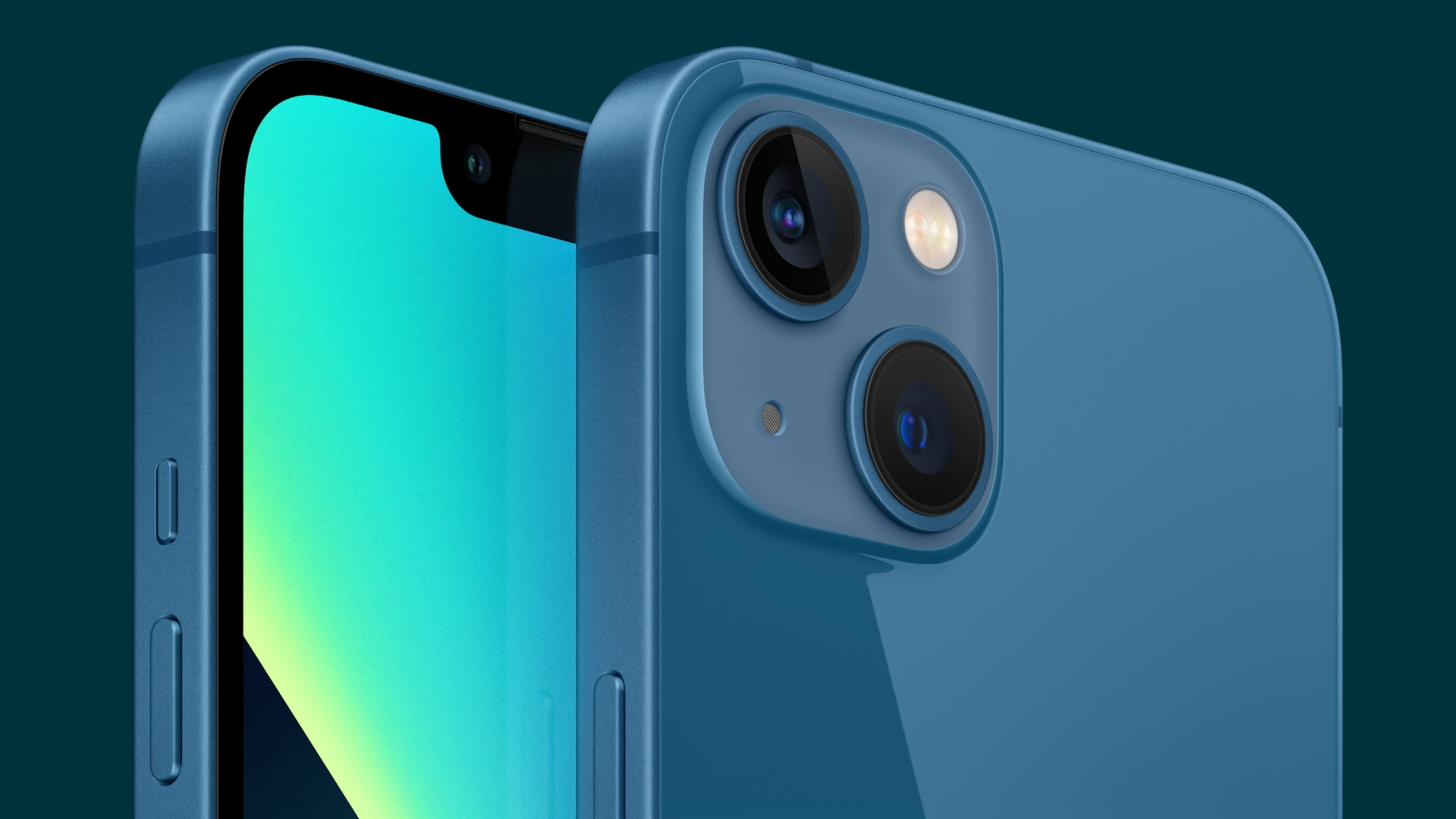
The new device has two rear lenses, arranged diagonally. It also comes in pink now, along with blue, "midnight," "starlight," and product red.

The antennas are made with recycled plastic water bottles, Apple says. And they have a sensor notch that's 20% smaller.
Apple Fitness Plus gets into group workouts
10:36 a.m. PT
Apple's always had hidden features to compete with friends in its motion and activity app, and now Apple's adding group workouts too. In this case, you can start a workout with (or against) your friends from an iMessage chat conversation.
Apple says up to 32 people can participate and you'll even know when friends are ahead of you in a bike class, for example.
Apple Fitness Plus adds meditation
10:35 a.m. PT
Since launching last year, Apple's focused its $10 per month Fitness Plus service on getting you to sweat. But this year, it's adding a meditation option, which will include all sorts of different calmness, kindness and gratitude meditations. Just like Apple's other classes, it'll be updated weekly on your phone and watch.
Apple Watch gets more durable
10:30 a.m. PT
Apple said its newest Apple Watches now have a "crack resistant front crystal," with a "more robust geometry."
It also has IP6X certification, which means it's duster resistant.
Of course, it has a bunch of new colors, bands and even a new charger that's faster.
Like the iPad, Apple says it's 100% recycled aluminum.
The Apple Watch Series 7 will be $399. Apple will also keep selling the Apple Watch Series 3 for $199, last year's Apple Watch SE for $279.
It's not coming until later this fall, though.
- Apple Watch Series 7: a whole new design
- Apple Watch 7 launches a full keyboard
Apple Watch Series 7 is real
10:27 a.m. PT
It has a larger display, with 20% more screen area than the Series 6 and 50% more than Series 3.
The dimensions of the watch have barely changed, Apple says. And it has "softer, more rounded corners" with a "wraparound" feel on the sides.

Apple says it redesigned buttons in the software to make them easier to tap as well, and it can fit 50% more text on screen than last year's watch.
100% Recycled Aluminum
10:23 a.m. PT
Apple said the iPad Mini upgrade means that all the company's iPads are now made from 100% recycled aluminum, as well as 100% recycled tin (for the solder). Apple says it uses 100% recycled rare earth elements in the enclosure magnets (not everywhere).
Apple finds landscape
10:19 a.m. PT
Apple's iPads have always been portrait-oriented devices. The front-facing camera's always been at the top of the portrait-oriented device. And its speakers have always been at the bottom.
With the iPad Mini, Apple's moved the selfie camera to the top of the landscape orientation, and adding stereo speakers meant to be heard in landscape as well.
It'll start at $499, more expensive than the $399 starting price for the previous generation
iPad Mini gets USB-C, 5G
10:18 a.m. PT
Last year, Apple introduced 5G superfast wireless to the iPhone. This year, it's adding the technology to its iPads. First, with the iPad Mini, which Apple said can pull down 3.5 gigabits per second. It also gets USB like its iPad Pro big brothers.
iPad Mini gets a big upgrade
10:14 a.m. PT
Tim Cook announced the new iPad Mini, which ditches the home button, and has thinner borders. It also comes in an array of colors: purple, pink, "starlight" and space gray.
Apple says it's 8.3 inches, and offers true tone, anti reflective coating, and 500 nits of brightness.
It also has Touch ID built into the power button, just like last year's iPad Air.
The new iPad Mini has a 40% jump in CPU performance, and 80% "leap" in GPU, Apple says.
Apple iPad gets refreshed for 2021 with an A13 chip, 12-megapixel camera, True Tone display
iPad updates
10:09 a.m. PT
Cook starts by talking about how strong the iPad business has been growing, up 40% in the past year.
"Today, it gets even better," he says.
The new iPad will include the A13 bionic chip, Apple says, which is 20% faster "in every aspect of the chip from the CPU and GPU to the neural engine."
Apple's Melody Kuna, a senior manager of iPad product design, says it's up to 3x faster than the best selling Chromebook and up to 6x faster than the best selling Android tablet.
It'll also include a better rear and front camera, she said.
Apple TV Plus
10:07 a.m. PT
Apple started by discussing his company's $5 per month video service, Apple TV Plus, showing off a bunch of previews for hit shows like Ted Lasso and The Morning Show, as well as upcoming titles like Foundation, and a comedy series, The Problem With Jon Stewart. (Stewart joked they may need to add a comma to that title.)

Love, California
10:04 a.m. PT
Tim Cook starts Apple's event with a video montage of all the things he says Apple loves about California. All its landmarks, singing people, it's definitely a fun place to start.
"California has always been a place for people with big ambitions and big dreams, a place where people are fueled with optimism to make things better, to make things that can change the world. It is such an important part of who we are at Apple, and inspires us in everything we create and do. We're proud to call California our home."
No more pop and rock
9:57 a.m. PT
Apple used to have a playlist prepared for its events with hit songs from hit groups like Coldplay all the way to little-known musicians who'd suddenly find fame in background of Apple ads and events. But ever since Apple started streaming its events amid the pandemic, it's switched to more artsy -- what I'll call corporate classical and pop music.
For what it's worth, I checked on Apple-owned Shazam to see if maybe this was an artist I'd never heard of. Nope -- Shazam hasn't heard it either. At least it's kinda catchy.
Our show has started
9:50 a.m. PT
Apple's event is nearly ready to begin, and CNET's live pre-show is running now at the top of this page. You can watch live as we discuss all the rumors and expected products. Also, get some insight into the minds of our great reviewers.
Spyware scare
9:17 a.m. PT
While we're all waiting to see what Apple releases, make sure you take this moment to update your iPhones, iPads and other Apple devices. Like, now. Go. I'll wait.
Apple put out a surprise update Monday that closes a security hole in a reported "zero-click" hack. This attack, which is tied to the Pegasus spyware reportedly used to spy on dissidents, world leaders and journalists, can be delivered through a text message. Supposedly, you can't do anything to stop when it arrives -- the hack goes into effect as soon as your phone receives the message. Apple's update closes that hole.
By the way, you can find out if you've been hacked using a free tool available online.
Will there be enough?
9:03 a.m. PT
It used to be that when new iPhones came out, people lined up around the block outside Apple Stores to be among the first to get their hands on the device. It would then typically be promptly sold out and nearly impossible to find for days or even weeks. Apple's gotten better at managing demand, and so many people buy online now that the dramatic iPhone lines are largely a thing of the past. But what of supply?
In the pandemic, we've learned that our international supply chains are rather fragile, and our reliance on overseas manufacturing has led to shortages of all sorts of products, from cars to video game consoles to garlic. So far, indications are Apple's been able to avoid these issues, in part thanks to its aggressive long-term planning. That doesn't mean you'll have easy access to an iPhone at launch, but it shouldn't be as hard to find as, say, a PlayStation 5.
There are rumors the Apple Watch on the other hand may have limited supplies at launch. But that's because of a non-pandemic problem. According to rumors, Apple struggled to get production going smooth in order to produce at high volume.
Unusual location
8:31 a.m. PT
Pretty much every virtual event Apple's held so far has been set on its multibillion dollar "spaceship" headquarters in Cupertino, California. But this time Apple CEO Tim Cook tweeted out a picture of a different location the company will be holding at least part of its event from: The desert.
It's a good bet this may be a reference to the rumored satellite emergency call capabilities being built into the next iPhones. We'll have to see.
§
Apple's new iPhone 13 line debuted Tuesday at Apple's September event, showing a tweaked design with a variety of new features for those upgrading from earlier iPhone models. The lineup consists of four new phones: the iPhone 13, the 13 Mini, the 13 Pro and the 13 Pro Max. The new phones will run iOS 15, come with a larger battery, more storage, a new A15 Bionic processor, a smaller notch and an abundance of new camera features. The base model of the iPhone 13 and 13 Mini are available in five colors: pink, blue, midnight (black), starligh t (white) and Product Red. The iPhone 13 Pro and 13 Pro Max will also get a giant camera upgrade as well as a new display with 120Hz high refresh-rate display.
Read on for our first take on Apple's iPhone 13 lineup and the answers to all of your questions about the phone's specs, features, design, price and how to get your hands on one yourself. Plus, here's everything we know about iOS 15, and here's what we know about a potential October Apple event.
How much will the iPhone 13 cost, and how much storage does it have?
The iPhone 13 price depends on which of the four variants you buy, how much storage you choose and whether you're purchasing through a carrier or unlocked. Here's everything to know about the iPhone 13 price structure and preorder details.
Without a carrier discount, the iPhone 13 starts at $829 (£779, AU$1,349) for 128GB, which is twice the storage of the base iPhone 12 model. The iPhone 13 Mini starts at $729 (£679, AU$1,199) for the same 128GB of storage. Like the iPhone 12, if you buy an iPhone 13 or 13 Mini tied to a US carrier, you'll receive a $30 discount.
The iPhone 13 Pro starts at $999 (£949, AU$1,699) and the 13 Pro Max at $1,099 (£1,049, AU$1,849) for 128GB of storage. For the first time, you have the option to get 1TB of storage on an iPhone. The extra storage is only available on the Pro models and pushes the iPhone 13 Pro Max's price to $1,599. Below is a breakdown of prices (without a carrier discount) and storage options.
iPhone 13 series US prices and storage
| Model | 128GB of storage | 256GB of storage | 512GB of storage | 1TB of storage |
|---|---|---|---|---|
| iPhone 13 Mini | $729 | $829 | $1,029 | N/A |
| iPhone 13 | $829 | $929 | $1,129 | N/A |
| iPhone 13 Pro | $999 | $1,099 | $1,299 | $1,499 |
| iPhone 13 Pro Max | $1,099 | $1,199 | $1,399 | $1,599 |
What is the iPhone 13's screen size?
The four iPhone 13 models have the same size screens as the iPhone 12 series. The iPhone 13 Mini has a 5.4-inch display, the iPhone 13 and 13 Pro have a 6.1-inch screen, while the iPhone 13 Pro Max has a 6.7-inch display. All the new phones have brighter screens.
Does the iPhone 13 Pro have a 120Hz refresh rate?
Both Pro models now get a higher 120Hz refresh rate, which makes animations and scrolling look smoother and gaming more immersive. Android phones, whether they are expensive or not, commonly feature a high refresh rate screen. Up to now, the only Apple device to offer such a refresh rate was the iPad Pro, which uses an LCD screen instead of the OLED found on the iPhone 13 Pro and 13 Pro Max. Here's some more information on the iPhone 13's 120Hz refresh rate, ProMotion and why it may not work exactly the way you think.
How long does the iPhone 13 battery last?
Probably the most welcomed feature announced for the iPhone 13 is a bigger battery. Apple didn't share the size, but claims that the new battery along with iOS 15, the A15 chip and updated display adds 2.5 hours of battery life to the iPhone 13 (compared to the iPhone 12).
The iPhone 13 Mini should get an 1.5 hours more than the iPhone 12 Mini. That's a significant increase: The battery life on the iPhone 12 Mini was a compromise some people weren't willing to make. So it's exciting to see the new Mini get such a big bump in just a year.
Apple says that the Pro models should see a similar increase in battery life with the iPhone 13 Pro getting 2.5 hours more and the 13 Pro Max getting an additional 1.5 hours.
How many cameras does the iPhone 13 have?
The iPhone 13 and 13 Mini get an updated camera system, which is apparent from the new diagonal orientation of the two rear cameras. In fact, Apple says the new orientation is a result of making more room for a new sensor-based stabilization system -- which previously was only on the iPhone 12 Pro Max. (The cameras on the iPhone 12 were stacked vertically.)
All four models get an improved 12-megapixel main camera and a better ultrawide lens and sensor. The new hardware, along with the new A15 Bionic chip, means a handful of improvements and new features, including being able to capture 47% more light.
The iPhone 13 Pro also has a new triple-camera system with better lenses and sensors. The telephoto lens comes with 3x optical zoom, which is 1.5x longer than the camera on the iPhone 12 Pro and 1.2x longer than the tele lens on the 12 Pro Max. Take a look below at the different telephoto lenses the Pro models of the iPhone 13 and 12.
To put things in perspective, this is an enormous improvement for the iPhone, but it still pales in comparison to the telephoto cameras on the Galaxy S21 Ultra and phones from Huawei.
iPhone 13 Pro telephoto lens specs vs. 13 Pro, 12 Pro, 12 Pro Max
| Model | Optical zoom | 35mm lens equivalent |
|---|---|---|
| iPhone 13 Pro Max | 3x | 77mm |
| iPhone 13 Pro | 3x | 77mm |
| iPhone 12 Pro Max | 2.5x | 65mm |
| iPhone 12 Pro | 2x | 52mm |
Source