Most powerful wi fi extenders the most powerful wifi extender high powered wifi extender wifi extender that actually works top wi fi extender wifi extender that really works the best wi fi extenders high powered wifi extender powerful handguns with little recoil this powerpoint this power jojo
This Powerful Little Wi-Fi Extender Is Even Better Now That It's 50% Off for Prime Day
This Powerful Little Wi-Fi Extender Is Even Better Now That It's 50% Off for Prime Day
This story is part of Amazon Prime Day, CNET's guide to everything you need to know and how to find the best deals.
No matter how strong your Wi-Fi signal is, it still might have trouble broadcasting to every corner of your home. Your average router might adequately cover an apartment or a small house, but you'll definitely encounter dead zones or limited connection if you have many devices connected to the internet, are dealing with a large home with multiple floors, or live in a home made from materials like brick, cement, metal or stone, which wireless signals have trouble passing through.
If you're in that boat, with bad signal in certain parts of your home, you've got several options: You can upgrade to a stronger router (like the TP-Link Deco W7200), use multiple routers together or simply move your router closer to wherever you need it most. But there is another option, that is both cheap and easy, for better internet connection. And thanks to Prime Day, it's way cheaper to give this option a shot.
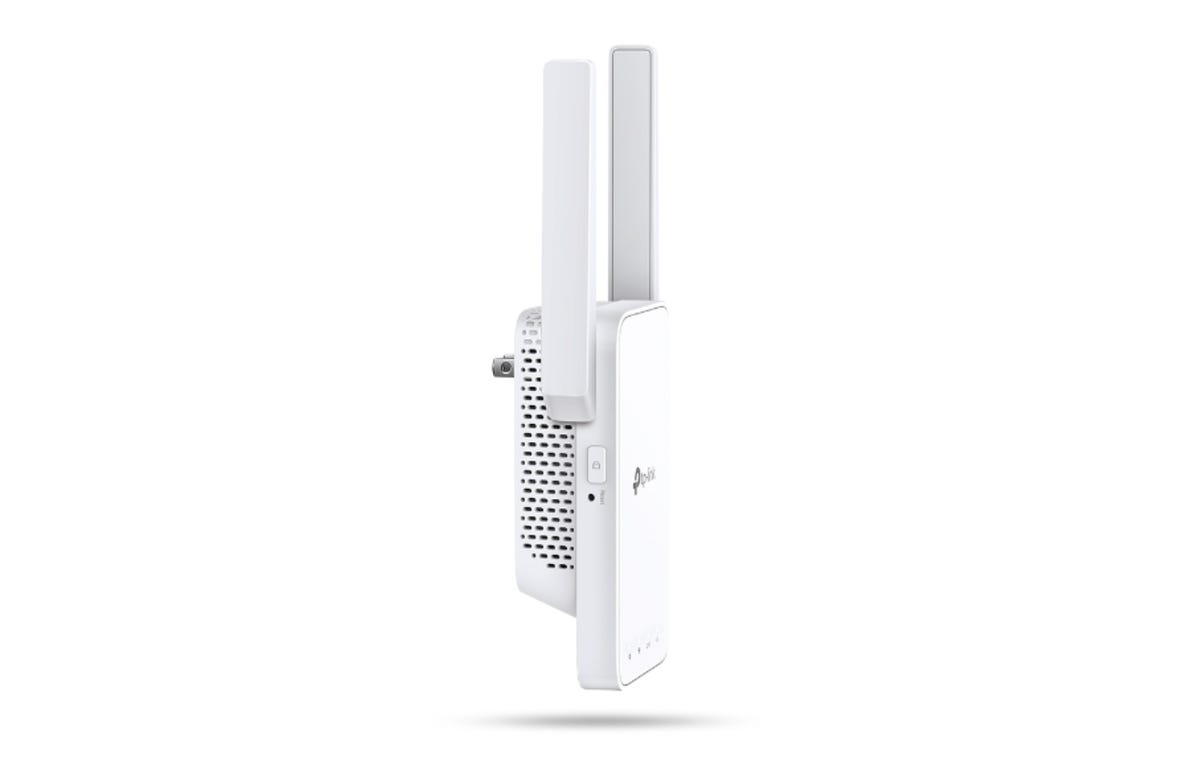
A Wi-Fi extender, like the RE315 Wi-Fi range extender from TP-Link, works with any common router to boost your Wi-Fi signal and give you coverage through your home. Right now, you can get the RE315 Wi-Fi Extender for only $25, which is 50% off its regular price. The discount is exclusive to Amazon Prime members.
According to TP-Link, the RE315 provides Wi-FI coverage up to 1,500 square feet, and allows you to connect up to 25 devices to the network at a single time, thanks to its dual 300Mbps 2.4GHz and 867Mbps 5GHz bands. Setup is also incredibly easy -- you can manage your Wi-Fi network with the TP-Link Tether app on your iPhone or Android.
You can plug your devices directly into the RE315.
TP-Link
The RE315 can also work as an access point to create a wireless local area network, or WLAN, in your home. Typically, a WLAN connection is faster and more reliable than Wi-Fi. There is also an Ethernet port on the RE315, so that you can connect your computer or TV with a cable.
And if you own a compatible OneMesh router, like the TP-Link Deco X90, you can connect the RE315 as part of a mesh network, which is a group of devices that work as a single Wi-Fi network, to more easily connect your devices to the internet. If you connect the RE315 to an incompatible mesh router, it creates a separate Wi-Fi network, but if it's connected to a compatible mesh router, it's just one network, so you wouldn't need to switch from one network to another as you move around.
How to buy a laptop to edit photos videos organic gardening how to buy a laptop to edit photos videos editor how to buy a laptop to edit photos videos damage how to buy a laptop touchpad how to buy a laptop to chromecast how to buy a laptop in dank memer how to buy a laptop youtube how to buy amazon return pallets how to buy a domain name how to buy a tesla how to lower blood pressure how to download youtube videos
How to Buy a Laptop to Edit Photos, Videos or for Other Creative Tasks
How to Buy a Laptop to Edit Photos, Videos or for Other Creative Tasks
Are you baffled by the multitude of laptop, desktop and tablet options being hurled at you as a generic "creative" or "creator"? Marketing materials rarely distinguish among the widely varying needs for different pursuits; marketers basically consider anything with a discrete GPU (a graphics processor that's not integrated into the CPU), no matter how low power, suitable for all sorts of creative endeavors. That can get really frustrating when you're trying to wade through a mountain of choices.
On one hand, the wealth of options means there's something for every type of work, suitable for any creative tool and at a multitude of prices. On the other, it means you run the risk of overspending for a model you don't really need. Or more likely underspending, and ending up with a system that just can't keep up, because you haven't judged the trade-offs of different components properly.
One thing hasn't changed over time: The most important components to worry about are the CPU, which generally handles most of the final quality and AI acceleration for a growing number of smart features; GPU, which determines how fluidly your screen interactions are along with some AI acceleration as well; the screen; and the amount of memory. Other considerations can be your network speed and stability, since so much is moving up and down from the cloud, and storage speed and capacity if you're dealing with large video or render files.
You still won't find anything particularly budget-worthy for a decent experience. Even a basic model worth buying will cost at least $1,000; like a gaming laptop, the extras that make it worth the name are what differentiates it from a general-purpose competitor, and those always cost at least a bit extra.
Andrew Hoyle/CNET
Should I get a MacBook Pro or a Windows laptop?
If what you're really wondering is whether the Mac is generally better than Windows for graphics, that hasn't been true for a while. Windows' graphics programming interface has gotten a lot better over time, which allows for broader support and better performance in the applications. But performing display calibration on both platforms can feel like walking barefoot over broken glass. Windows, because its color profile management seems like it hasn't changed since it originally launched in Windows NT, and MacOS because interface changes made in Monterey combined with ambiguity about supported calibrators, software and the new MacBook Pro screens has some folks gnashing their collective teeth.
MacBook Pros now have native M1 processor support for most of the important applications, which includes software written to use Metal (Apple's graphics application programming interface). But a lot of software still doesn't have both Windows and MacOS versions, which means you have to pick the platform that supports any critical utilities or specific software packages. If you need both and aren't seriously budget-constrained, consider buying a fully kitted-out MacBook Pro and running a Windows virtual machine on it. That's an imperfect solution, though, since VMs tend to be fairly bad ab out being able to access the full capabilities of the GPU.
Dan Ackerman/CNET
How do I know what specs are important?
The first decision you need to make is whether you'll need a workstation-class system or can get away with a normal laptop; the latter is generally cheaper. In order to use some advanced features, accelerate some operations or adhere to certain security constraints, some professional applications require workstation-class components: Nvidia A- or T-series or AMD W-series GPUs rather than their GeForce or Radeon equivalents, Intel Xeon or AMD Threadripper CPUs and ECC (error correction code) memory.
Nvidia loosened the reigns on its division between its consumer GPUs and its workstation GPUs with a middle-ground Nvidia Studio. The Studio drivers, as opposed to GeForce's Game Ready ones, add optimizations for more creation-focused applications rather than games, which means you don't necessarily have to fork over as much cash.
Companies which develop professional applications usually provide guidance on what some recommended specs are for running their software. If your budget demands that you make performance trade-offs, you need to know where to throw more money. Since every application is different, you can't generalize to the level of "video-editing uses CPU cores more than GPU acceleration" (though a big, fast SSD is almost always a good idea). The requirements for photo editing are generally lower than those for video, so those systems will probably be cheaper and more tempting. But if you spend 90% of your time editing video, it might not be worth the savings.
There are a few generalizations I can make to help narrow down your options:
More and faster CPU cores -- more P-Cores if we're talking about Intel's new 12th-gen processors -- directly translate into shorter final-quality rendering times for both video and 3D and faster ingestion and thumbnail generation of high-resolution photos and video. Intel's new P-series processors are specifically biased for creative (and other CPU-intensive) work.
More and faster GPU cores plus more graphics memory (VRAM) improves the fluidity of much real-time work, such as using the secondary display option in Lightroom, scrubbing through complex timelines for video editing, working on complex 3D models and so on.
Always get 16GB or more memory. Frankly, that's my general recommendation for Windows systems (MacOS runs better on less memory than Windows). But a lot of graphics applications will use as much memory as they can get their grubby little bits on; for instance, I've never seen Lightroom use less than all the available memory in my system (or CPU cores) when importing photos.
Stick with SSD storage and at least 1TB of it. Budget laptops may have a slow, secondary spinning disk drive to cheaply pad about the amount of storage. And while you could get away with 512GB, you'll probably find yourself having to clear files off onto external storage a little too frequently.
Get the fastest Wi-Fi possible, which at the moment is Wi-Fi 6E. Much has become split between the cloud and local storage, and even if you don't intend to use the cloud much your software may force it on you. For instance, Adobe really, really wants you to use its clouds and is moving an increasing amount of your files to cloud-only. And if you accidentally save that 256MB Photoshop file in the ether, you're in for a rude awakening when you try to open it next.
Do I need a 4K or 100% Adobe RGB screen?
Not necessarily. For highly detailed work -- think a CAD wireframe or illustration -- you might benefit from the higher pixel density of a 4K display, but for the most part, you can get away with something lower (and you'll be rewarded with slightly better battery life, too).
Color is more important, but your needs depend on what you're doing and at what level. A lot of manufacturers will cut corners with a 100% sRGB display, but it won't be able to reproduce a lot of saturated colors; it really is a least-common-denominator space, and you can always buy a cheap external monitor to preview or proof images the way they'll appear on cheaper displays.
For graphics that will only be appearing online, a screen with at least 95% P3 (aka DCI-P3) coverage is my general choice, and they're becoming quite common and less expensive than they used to be. If you're trying to match colors between print and screen, then 99% Adobe RGB makes more sense. Either one will display lovely saturated colors and the broad tonal range you might need for photo editing, but Adobe RGB skews more toward reproducing cyan and magenta, which are important for printing.
A display that supports color profiles stored in hardware, like HP's Dreamcolor, Calman Ready, Dell PremierColor and so on, will allow for more consistent color when you use multiple calibrated monitors. They also tend to be better, as calibration requires a tighter color error tolerance than typical screens. Of course, they also tend to be more expensive. And you frequently need to step up to a mobile workstation for this type of capability; you can use hardware calibrators such as the Calibrite ColorChecker Display (formerly the X-Rite i1Display Pro) to generate software profiles, but they're more difficult to work with when matching colors across multiple connected monitors.
Nfts that earn crypto how to protect your cryptocurrency what are crypto coins used for most secure crypto coin what is crypto security what is crypto prevent crypto security companies crypto security tokens
Crypto Security: Protect Your Coins and NFTs From Being Stolen
Crypto Security: Protect Your Coins and NFTs From Being Stolen
With crypto prices in free fall, crypto firms laying off thousands of workers and coins that are considered "stable" losing all their value, it's more important than ever to secure your remaining portfolio.
The current crypto crash isn't the only way people are losing their money. There have been an increasing number of scams that give thieves access to your accounts and crypto assets. Just recently in May, Seth Green had several NFTs worth over $300,000 stolen, after the actor connected his crypto wallet to a scam website pretending to be a credible NFT project.
Protecting your crypto means taking some of the same steps you'd use to safeguard your other digital accounts, such as creating and using strong passwords. However, crypto accounts have unique characteristics like seed phrases that require additional security. Also, the crypto industry still lacks the regulatory framework necessary for the retrieval of your crypto assets if they're stolen.
In this story, we'll cover several ways you can protect your cryptocurrency and NFTs from being purloined and explain why it's worth taking the time to properly secure your digital assets from being stolen. For more on crypto, learn five questions every investor should ask about cryptocurrency and the latest details on bitcoin's wild price swings.
Always follow these two basic password security rules
One of the easiest ways to protect your digital assets is with strong passwords. Ideally, you want your passwords to be at least eight characters long and include random capital letters, numbers and other special characters. If you can make your password longer, however, you should, because the longer the password, the harder it is to crack, in theory.
If you're worried about remembering all of your long, complicated and unique passwords, consider using a password manager, which makes it simple and secure to store and use your passwords from one place. We recommended choosing a password manager with encrypted storage and two-factor authentication for extra security.
Also, when creating an account, never repeat your passwords. If one of your accounts is compromised, your others will also be at risk.
A strong password is vital to keeping your digital assets secure.
James Martin/CNET
Use a hardware crypto wallet for your most treasured assets
Your crypto wallet serves as the gateway to your crypto assets. "Hot" wallets such as software or mobile apps operate online, while "cold" wallets are hardware devices that work offline. Crypto wallets don't hold the actual coins or tokens -- they store the private keys that prove you own your crypto assets and let you buy, sell or trade on blockchains.
Anytime you purchase cryptocurrency or NFTs, they must be stored somewhere. Most people keep their assets in a digital wallet or marketplace, such as Coinbase or MetaMask, because they're free and easy to use, but for your most valuable holdings, you may want to consider a physical wallet.
A hardware, or cold, wallet allows you to store cryptocurrency and NFTs on a physical drive, which you can connect to a computer to access. Hardware wallets are generally more difficult to hack into, so they're a preferred option when storing digital assets that are especially high in value.
The Trezor One hardware wallet ($48.49) works with bitcoin, ethereum, litecoin and a variety of other cryptocurrencies.
Trezor
Here's more on the different types of crypto wallets.
Keep the seed phrase for your crypto wallet secure and offline
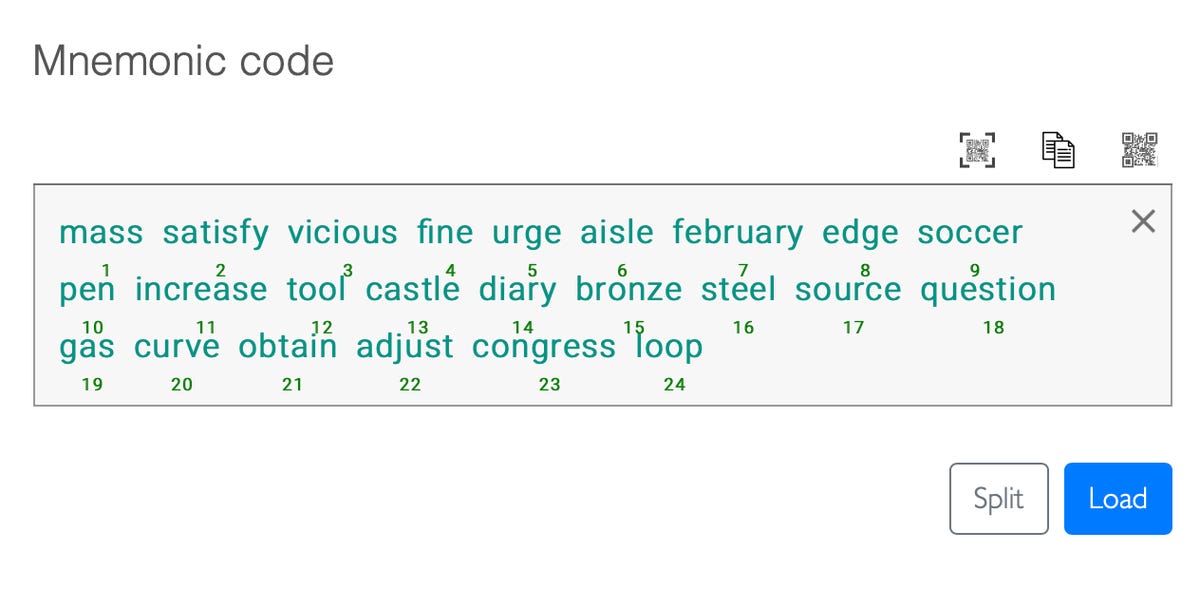
In addition to a password, most crypto wallets use a seed phrase for additional security. This seed phrase acts like a master password and is created whenever you set up a new wallet. A seed phrase is made up of 12 or 24 words that you can use to sign in to your account on other devices, or recover your account if you forget your password.
While this seed phrase provides additional security, it also comes with risk -- anyone who learns your seed phrase could potentially steal all the crypto assets recorded in your wallet. While you might be tempted to store your seed phrase somewhere online, it's crucial to write it down -- offline -- to prevent anyone from accessing it.
Once you write down your seed phrase, store it in a safe or lockbox, so that it's not easy for anyone else to access. Specialized seed phrase hardware tools, like Cryptosteel and Crypt Keeper, can securely store your 12 or 24 words in a portable system that's protected from fire and flooding.
If your seed phrase is either lost or stolen, but you still know your password, immediately log in to your wallet and generate a brand new seed phrase.
This is an example of a randomly created 24-word seed phrase.
Nelson Aguilar/CNET
Be wary of frauds in direct messages on Discord
Discord is one of the unofficial homes of crypto and NFT communities. It's where many crypto enthusiasts go to discuss upcoming NFT projects, cryptocurrency prices, real-life events and even personal lives. Fans of NFT projects use Discord to form communities -- but it's also where hackers and thieves go to compromise accounts.
Here's how it works: A hacker may directly message you, pretending to be part of a project that you're following and interested in. The DM looks official and usually claims that you can mint an NFT that's difficult to get, at a relatively cheap price, and includes a link to follow. But when you click the link, connect your wallet and attempt to purchase the NFT, your wallet is drained of all your NFTs and crypto. And there's really no way to get it all back.
The most important research you can do to avoid falling for a fake NFT website is to use verified channels to find the correct website when attempting to mint or purchase a newly created NFT. Even if you receive a link from what seems like a credible source, use multiple online sources like Google, Twitter and Opensea to verify that you have the correct URL for the project.
An even simpler method to avoid falling into a scam is to disable DMs on Discord. On your mobile device, launch the Discord app, tap your profile picture on the bottom right, go into Privacy & Safety, and toggle off Allow Direct Messages From Server Members. You'll no longer receive direct messages on Discord.
Discord is where people go to discuss cryptocurrency and NFTs, as well as prey on potential victims.
Discord
Don't fall for support scams on Twitter
Like Discord, Twitter is a hunting ground for hackers looking to swindle unsuspecting victims into giving away their assets.
On Twitter, anytime someone mentions "stolen account," "lost password" or even "MetaMask," an army of hackers may respond, offering to help recover stolen assets or restore access into accounts. Hackers may then ask for your seed phrase via DM and use it to steal your crypto or NFTs.
If you need support, go straight to the official customer service site on Twitter. Never give anyone your seed phrase, ever, even if an account is verified -- sometimes hackers have access to verified accounts. And never share your screen.
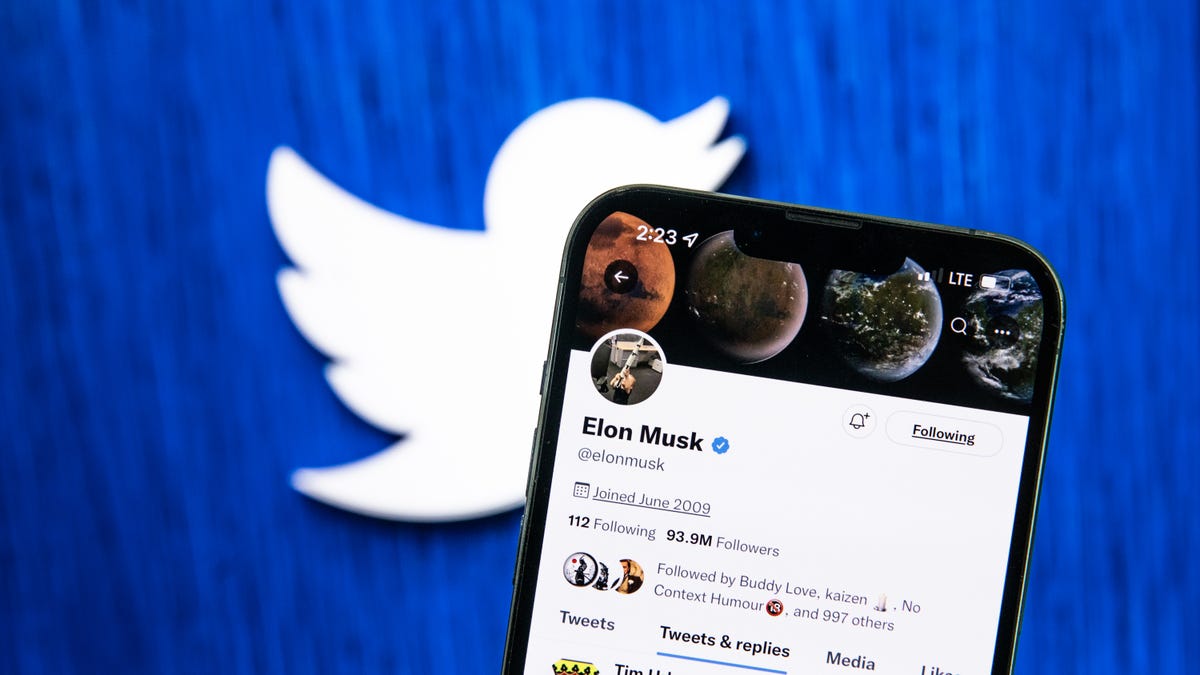
Not even Elon Musk can stop these Twitter scammers.
James Martin/CNET
For more about cryptocurrency security, learn whether it's possible to insure bitcoin and how the Securities and Exchange Commission is taking on crypto fraud.
Best instant pot deals be ready for game day with denzel best instant pot deals be ready for game day with ryan best instant pot deals be ready for you know best instant pot black friday deals best instant pot recipes best instant pot best instant mashed potatoes best instant coffee consumer reports
Best Instant Pot deals: Be ready for game day with a $40 multicooker
Best Instant Pot deals: Be ready for game day with a $40 multicooker
This story is part of Gift Guide, our year-round collection of the best gift ideas.
If you're looking for an Instant Pot, there are serious deals on the popular multicookers today. We found Instant Pots and Instant Pot accessories that are way down from their normal sticker prices. Amazon is running a mini Instant Pot sale that not only includes the brand's signature pressure cooker and slow cooker, but also an electric Dutch ovens, air fryers and more handy kitchen gear.
If you're starting from scratch with multicookers, the Instant Pot is a popular small appliance that functions as a pressure cooker, slow cooker, steamer and warmer, with a sauté mode so you can make tender meats like brisket, beef stew, shredded chicken and pulled pork from start to finish. An Instant Pot keeps all the food securely inside the pot with a safe-locking lid. It'll deliver easy meals that taste like they've taken hours to make -- but in reality require a fraction of the time.
Wondering how to spot a multicooker deal? Instant Pots come in more variations than laptops, it seems, and pricing is often all over the map. The main rule: $60 to $80 is the sweet spot for a standard 6-quart Instant Pot (without the air fryer attachment) and anything lower than that means we're venturing into all-time low territory. Newer models with more bells and whistles aren't likely to go that low. For instance, the souped-up Instant Pro is down to $100 today which is a full $30 off the normal price.
For a 3-quart model -- perfect for one to three people -- anything under $60 is a solid deal. Most Instant Pots come in 3-, 6- and 8-quart sizes, with the 6-quart models being the most popular for families. For a single person or even a couple, you could easily get away with a 3-quart.
We'll continue to update this post with the best Instant Pot deals for the holiday shopping season, so check back often.
Read more: Best air fryer for 2021: Ninja, Dash, Gourmia and more
Insignia
If you want a basic multicooker and aren't hung up on name brands, Insignia's version of the Instant Pot is down to a tempting $40. It has all the same functions as your basic Instant Pot but at one-third of the price. This is the popular 6-quart size which is perfect for families of three or four or those who host gatherings and might want to make easy batches of pulled pork, chicken chili, stews and more.
Instant Pot
This interesting hybrid cooker is less well known than Instant Pot's pressure cookers, but if you're in the market for either a Dutch oven or a slow cooker -- or if you need both -- this might be an ideal small appliance.
CNET has yet to test this one but it's essentially an enameled cast-iron Dutch oven (which we love) with its own heating base so you can precisely control the temperature of the food inside. Great for braising, stewing and warming food. And the Dutch oven can be removed and placed gracefully on the table for serving.
Instant Pot
We've seen this handy air fryer lid drop lower during Black Friday and other sales but this is still a nice $20 drop from the normal price. It'll turn any 6-quart Instant Pot into a powerful air fryer for making much healthier versions of your favorite fried snacks. It works great and doesn't take up much space in the cupboard either.
Instant Pot
This might be Instant Pot's sleekest model and it's $30 off right now. The jet black paint job fits a modern aesthetic, and the multicooker boasts 28 cooking programs and 10 modes: pressure cook, slow cook, sous vide, sauté, sterilizer, yogurt maker, food warmer, cake baker and steamer.
Instant Pot
If you need the whole kit and kaboodle (Instant Pot and air fryer lid) this is a solid price for the bundle. It acts as a pressure cooker, air fryer, slow cooker, steamer, sauté pan, food warmer, sous vide, roaster, broiler and dehydrator.
Wondering how the air fryer lid works? Check out the air-fried chicken I made in this exact Duo Crisp model a few weeks back. It's hard to fathom a kitchen appliance that does more than this one and you likely won't find the 6-quart version for cheaper than it is right now. For reference, the air fryer lid alone usually sells for $89.
Note, Target doesn't list this as "on sale" but it's a full $31 cheaper than you'll find it elsewhere including Amazon.
Taylor swift tops a worst carbon offenders list for private island taylor swift tops a worst carbon offenders list for private first class taylor swift tops a worst carbon offenders list format taylor swift tops a worst carbon offenders list for college taylor swift tops a worst carbon offenders list for first apartment taylor swift tops a worst carbon offenders synonym taylor swift tops appliances taylor swift tops and bobbins taylor swift tops accounting taylor swift tops auto taylor swift tops and trends
Taylor Swift Tops a Worst Carbon Offenders List for Private Jet Use
Taylor Swift Tops a Worst Carbon Offenders List for Private Jet Use
Taylor Swift's private jet has emitted the most carbon this year of any celebrity's plane, according to data released Friday by UK-based digital marketing agency Yard.
The singer's plane has taken 170 flights so far in 2022 with an average flight time of 80 minutes, leading to a total flight time of more than 380 hours. With average use of jet fuel estimated as 128 gallons per journey, the total CO2 emissions clocked in at 8,293 tons, according to the data.
To come up with these figures, Yard said it scraped data from Celebrity Jets, which tracks the use of private jets across the globe. Using this data, Yard then calculated probable total CO2 emissions for each celebrity's jet so far this year. BuzzFeed News reported the details earlier Friday.
"Taylor's jet is loaned out regularly to other individuals," said a spokesperson for Swift. "To attribute most or all of these trips to her is blatantly incorrect."
Second on the worst offenders list was boxer Floyd Mayweather, whose jet has a total flight time so far this year of 326 hours for estimated CO2 emissions of 7,000 tons. He was followed by Jay-Z, at 321 hours and 6,900 tons. The rest of Yard's top 10 list appears on the company's site.
Celebrity Jets last month made headlines when it revealed that some celebrities' planes take trips lasting less than 15 minutes.
Commenting on one of his jet's 14-minute flights, singer Drake responded earlier this week on Instagram: "This is just them moving planes to whatever airport they are being stored at for anyone who was interested in the logistics…nobody takes that flight."
Neither Mayweather nor Jay-Z's streaming company, Tidal, responded to requests for comment.
Facebook parent meta reports first ever revenue recognition facebook parent meta reports first ever revenue cycle facebook parent meta reports first ever revenue streams facebook parent meta cuts innovation facebook parent company facebook parent page general mclane facebook parents
Facebook Parent Meta Reports First-Ever Revenue Drop
Facebook Parent Meta Reports First-Ever Revenue Drop
Facebook's parent company Meta on Wednesday reported a revenue drop for the first time in its history as ad sales shrank amid growing economic concerns. The social media giant also missed earnings expectations for the second quarter.
In the April-June quarter, Meta reported revenue of $28.8 billion, a 1% decline from the same period last year. The company's performance narrowly missed the $28.9 billion that analysts surveyed by Thomson Reuters had expected. Meta earned $2.46 per share, missingexpectations of $2.56 per share.
Meta's first-ever revenue drop highlights the challenges the social media giant's ad business faces as it braces for an economic slowdown. Advertisers are pulling back amid growing concerns that the world economy could enter a recession. A strong dollar weighs on the value of overseas revenue. And marketers question the effectiveness of ads because Apple now allows users of its products to opt out of tracking.
Meta has trimmed costs and frozen some hiring to offset the revenue challenges. The company's expectations for the third quarter were also lower than analysts expected. Meta said it anticipates that revenue will be in the range of $26 billion to $28.5 billion, which is below expectations of $30.5 billion.
"We seem to have entered an economic downturn that will have a broad impact on the digital advertising business," Meta CEO Mark Zuckerberg said in a call with analysts. "It's always hard to predict how deep or how long these cycles will be, but I'd say that the situation seems worse than it did a quarter ago."
The advertising slowdown comes as Meta continues to spend on its vision for the metaverse, virtual spaces where people can work, play and socialize. But investing in products such as virtual reality headsets and video chat devices isn't cheap. The tech giant's metaverse business lost $2.8 billion in the second quarter. On Tuesday, the company said it will raise the price of its Quest 2 headsets by $100 in August.
At the same time, the company is also battling more competition from apps such as short-form video platform TikTok and photo-sharing app BeReal. Meta still makes most of its money by selling ads on Facebook and its photo- and video-sharing app Instagram.
But as Facebook and Instagram make changes to compete with TikTok, that's upsetting some of its users. Instagram has been testing a full-screen feed that looks more like TikTok. On Monday, celebrities Kim Kardashian and Kylie Jenner shared a meme urging the company to stop trying to imitate the popular video app and focus on photo sharing. Instagram CEO Adam Mosseri said in a tweet Tuesday that the platform will continue to support photo sharing but that he believes the app will be filled with more videos over time.
Insider Intelligence principal analyst Debra Aho Williamson said she thinks some of the "angst" among Instagram users about a possible redesign of the feed will "blow over," noting there have been other times when the company has survived user backlash.
"But the hubbub makes crystal clear that Instagram needs to get this (user interface) change right, or risk losing some of its biggest fans," she said.
Zuckerberg said the company is still focused on helping people connect with friends and family. Social media users, he said, are discovering interesting content in their feeds and then messaging that content to friends.
"This creates this flywheel of discovery and then social connection and inspiring people to create more content themselves," he said. The company said it's seen a more than 30% increase in the time people spend engaging with its short-form video feature Reels across Facebook and Instagram.
In the second quarter, 2.88 billion people used one of Meta's apps such as Instagram and WhatsApp daily, a 4% increase compared with the same period last year.
The company is also making more leadership changes. Meta's chief financial officer, David Wehner, will take on a new role as Meta's first chief strategy officer, overseeing the company's strategy and corporate development. Susan Li, the company's vice president of finance, will be promoted to CFO. Sheryl Sandberg, who announced in June she was stepping down as the chief operating officer, had her last earnings call on Wednesday. She will remain on the company's board of directors.
Meta's stock dropped by more than 4% in after-hours trading to $161.86 per share.
Macbook pro 2021 max option macbook pro 2021 apple store apple music top 100 2021 save in keep iphone how to save up for a iphone save 100 one piece pirate warriors 3 save 100 nfs heat save 100 gta sa save 100 red dead redemption 2 pc
Save $100 on Apple's new 2021 MacBook Pro right now
Save $100 on Apple's new 2021 MacBook Pro right now
The brand-spankin'-new 2021 Apple MacBook Pro has only been out a few days now but the entry-level configuration just got a decent price cut. Adorama has the 14-inch Pro with M1 Pro chip and 16GB memory for $1,899. That's a full $100 off the list price and $50 cheaper than Amazon's discounted price.
For more on the latest version of the top-shelf Pro, I'll shuffle you along to CNET editor Dan Ackerman's review. He loved the bigger, better screen, the MagSafe power connection, the return of the HDMI port and SD slot and especially the amazingly speedy M1 Pro chip. Ackerman gives the 2021 Pro positive marks, overall, even if it is a touch heavier than last year's model.
If you want to spend more, Apple will certainly let you go nuts. We crunched the numbers, in fact, and with hardware upgrades and the like, this machine can go as high as $6,099. But we know you prefer to keep at least some money in your wallet, so slide on over to Adorama to grab the Pro 14-inch while it's $100 off, if that configuration matches your power needs.
Intel tries intel to get chip ai in production intel ai chips vs cpu new chip from intel intel artificial intelligence chip new chip from intel ai chips vs cpu intel double connect technology intel amd cpu 비교 intel ai for all ai in chip design
Intel Doubles AI Chip Power to Expand the Revolution
Intel Doubles AI Chip Power to Expand the Revolution
What's happening
Intel offers details about Gaudi2, its second-generation chip for accelerating AI and a key part of its effort to catch up to Nvidia.
Why it matters
The AI revolution needs more horsepower to tackle challenges like self-driving cars and fusion energy.
What's next
Intel's Israel-based Habana Labs unit is working on another, faster successor called Gaudi3.
Intel took the wraps off a highly anticipated AI accelerator chip on Tuesday, a key part of the chipmaker's effort to reclaim ground lost to Nvidia and other rivals in the hot computing area.
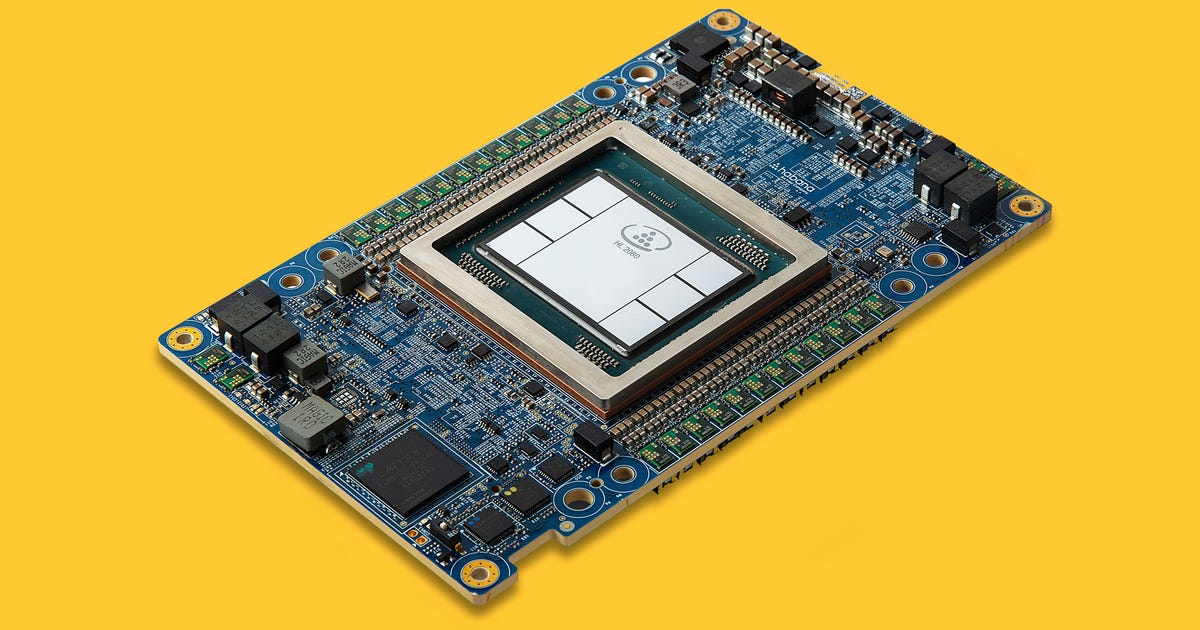
The Gaudi2, designed by Intel's Israel-based Habana Labs, is twice as fast as its first-generation predecessor, the chipmaker said at its Vision conference for Intel customers and partners. The chip should be in servers that ship by the end of the year, said Eitan Medina, Habana's chief operating officer.
AI chips like the Gaudi line accelerate the particular math calculations at the heart of today's artificial intelligence technology. A third-generation Gaudi3 is already being developed with higher performance, more memory and better networking abilities, Medina said.
The Gaudi2 and similar chips, like Nvidia's new H100, are designed to boost the artificial intelligence revolution that's sweeping the computing industry. The powerful chips are behind efforts to train AI models, which learn by processing complex real-world data to find patterns, more quickly and economically. They promise improved voice recognition for auto generating captions, as well as more involved operations, such as self-driving cars. (Mobileye, Intel's autonomous vehicle subsidiary, trains its AI systems with first-generation Gaudi processors, Medina said, but the company has other automotive customers, too.)
AI technology spending will surge 20% to $433 billion in 2022, IDC predicted in February. "AI has emerged as the next major wave of innovation," analyst Ritu Jyoti said in a statement.
Competing on price could be a winning strategy as AI spreads beyond giants with deep technical expertise like Amazon and Google, which use the technology for tasks like cutting shipments' packaging and showing search results. At a lower price tag, AI will likely spread to newer applications, such as screening for fraud, monitoring crop health and flagging trouble spots on medical scans.
"From the business penetration of AI," Medina said in an interview, "we are in the very early phases."
Intel trying to catch up
Along with new graphics processing units, Gaudi2 is a centerpiece of Intel's effort to reclaim computing leadership it's lost over the last two decades. During Intel's heyday, central processing units, the all-purpose brain of every computing device, were the stars of the computing show. GPUs, which Nvidia specialized in designing, were dedicated to speeding up video games.
Over time, GPUs took on important computing tasks that had been the domain of CPUs and expanded into AI. Investors noticed, giving Nvidia a market cap of $424 billion, more than double Intel's $181 billion.
Although AI-specific accelerators are a hot area, Nvidia is sticking with GPUs, which can also be used for supercomputer calculations and other high-performance computing tasks. That flexibility is a selling point, said Ian Buck, vice president of Nvidia's hyperscale and high-performance computing group.
The Gaudi2 AI processor from Intel's Habana Labs division
Intel
GPUs' flexibility advantage
"You don't know where your AI model is necessarily going to go," Buck said about the flexibility of GPUs. "If you're an AI startup, your productivity is everything."
Cruise, General Motors' self-driving car subsidiary, seems to agree with that approach. The company rents Nvidia GPUs on Google's cloud computing infrastructure because GPUs have more mature AI software and "extreme amounts of flexibility," said Hussein Mehanna, head of Cruise's AI work.
"There's always something new," and GPUs and GPU software can rapidly be adapted to cope, Mehanna said. "There's always a new architecture, some new types of layers that we're adding, merging [AI] models and separating models."
Plenty of startups, including Graphcore, SambaNova Systems, Tenstorrent and Cerebras, are, like Intel, working on more specialized processors to accelerate AI. In the view of Cerebras Chief Executive Andrew Feldman, GPUs were better than CPUs for AI, but now it's apparent their graphics origins are holding them back, and AI accelerators will prevail.
With AI accelerators now on the market to challenge the GPU approach, "the battle will be over the next five years," Feldman said.
Intel's two-pronged approach
Intel is betting both on AI-specific accelerators and flexible GPUs. Its Ponte Vecchio GPU is an enormously complicated processor that powers the Argonne National Laboratory's Aurora supercomputer, which is expected to be powered up this year. In 2023, Intel will sell Ponte Vecchio to the broader market and develop successor chips that are cheaper and made in larger quantities, says Raja Koduri, who worked on GPUs at two Intel chip rivals, AMD and Apple, before joining Intel in 2017.
Koduri also leads the new Arc line of conventional GPUs that accelerate video games in Intel PCs. The first of those products, code-named Alchemist, are now shipping, with more powerful products arriving later this year for laptops and gaming PCs. With a road map stretching to 2025, Intel also is working on successors called Battlemage and Celestial.
In other words, Intel is attacking Nvidia on all fronts. "The market is really hungry for a third player" besides Nvidia and AMD, Koduri said.
For AI customers, it's potentially confusing for Intel to offer both AI accelerators and general-purpose GPUs. Server processor chief Sandra Rivera, who oversees Intel's AI work, says Intel opted for a wider product range instead of a one-size-fits-all approach. The idea is to meet customers where they are, she said.
Expect Intel to take advantage of its position as a seller of CPUs, GPUs and AI accelerators that can be linked tightly together so customers don't have to assemble their own collections of IT gear.
"It's a playbook we've run for a long time," Rivera said. "Innovate and integrate."
Watch ai edit my skate video game watch ai edit my skate video music watch ai edit my skate video songs watch ai edit my cookies watch ai edit my photo watch edited movies online watch airwolf online free
Watch AI edit my skate video
Watch AI edit my skate video
It only takes a couple scrolls through my Instagram feed to find a bunch of people using Insta360 cameras to get some pretty mind-blowing shots. The company has designed accessories like the Invisible Selfie Stick to make it look like a drone is flying right in front of your face. The Bullet Time Handle puts you in a scene like that James McAvoy movie from a few years ago that probably not many people remember.
Yes, I got this shot with a selfie stick alone. But you'd only think I'm just holding my fist out there awkwardly.
Nic Henry/CNET
Insta360 also claims to use artificial intelligence to help you find stuff to do with your 360 shots. This ranges from fun little camera tricks like making clones of yourself to tapping a few buttons and letting the app edit a sizzle reel for you. As someone who's spent the last couple years staring at warped, unstitched 360 footage, this piqued my interest.
Seeing future clones of yourself really makes you conscious of your form.
Nic Henry/CNET
I got my hands on an Insta360 One R and took it to my local skate park, which just opened back up after being closed for three months. I wanted to see if I could, first of all, still pull off any tricks, but also I wanted the AI to make an edit for me. Watch the full experiment in the video above!
Animal crossing fireworks show when are fireworks in animal crossing animal crossing firework show firework festival animal crossing animal crossing wiki animal crossing pc animal crossing download
Animal Crossing Fireworks Guide: How Long Do Fireworks Last and More
Animal Crossing Fireworks Guide: How Long Do Fireworks Last and More
August is here, which means it's time for a summer Animal Crossing tradition: fireworks! New Horizons players can drop by their island and watch a stunning fireworks display every weekend this month, with a few exclusive items to earn as well. Here's everything you need to know about the fireworks show.
How long do fireworks last?
The fireworks show takes place every Sunday night in August. This year's fireworks fall on the following dates:
Aug. 7
Aug. 14
Aug. 21
Aug. 28
Each fireworks show begins at 7 p.m. and runs until midnight.
What to do during fireworks
Naturally, the main attraction of the fireworks show is the fireworks. You'll see them lighting up the night sky every few seconds until the show ends at midnight. You can even submit your own designs and have them turned into custom fireworks by speaking to Isabelle, who'll be stationed outside the Resident Services building.
That's not all that Isabelle will do. Speak to her and she'll also gift you a bopper to wear. There are four possible boppers you can receive:
Bulb bopper
Flower bopper
Heart bopper
Star bopper
Redd's raffle
Redd will also make an appearance during the fireworks show. The shifty fox will have a stall set up in the plaza outside the Resident Services building. For 500 bells, Redd will let you enter his raffle. Each pull will win some kind of prize, from balloons and pinwheels to treats like boba and cotton candy.
Here's the full list of items you can win from Redd's raffle:
Red Sparkler
Blue Sparkler
Fountain Firework
Bubble Blower
Uchiwa Fan
Pinwheel
Tweeter
Blue Balloon
Red Balloon
Yellow Balloon
Green Balloon
Pink Balloon
Ramune-Soda Frozen Treat
Orange Frozen Treat
Chocolate Frozen Treat
Plain Cotton Candy
Melon Cotton Candy
Ramune-Soda Cotton Candy
Strawberry Cotton Candy
Boba Milk Tea
Boba Coffee
Boba Strawberry Tea
Boba Mango Tea
Boba Green Tea
As mentioned, the fireworks show only happens during August, so you won't want to miss it. There are plenty of other in-game events to look forward to soon, though, including Halloween in October and Turkey Day in November.
Big tech s danger to kids finally aligns democrats vs republicans big tech s danger to kids finally aligns democrats running big tech s danger to kids finally aligns democrats for life big tech s danger to kids finally aligns democrats beliefs big tech s danger to kids finally aligns definition big tech s danger to kids finally aligns spotify big tech s danger to sobriety big tech s sticky fingers big tech silence big tech social media the tyranny of big tech big tech stocks
Big Tech's danger to kids finally aligns Democrats, Republicans
Big Tech's danger to kids finally aligns Democrats, Republicans
More than once over the course of a five-hour hearing before Congress on Thursday, Facebook CEO Mark Zuckerberg's parenting style became a point of focus for angry lawmakers. One House Republican asked if he had issues with his young daughters watching YouTube. Another asked if he lets them use Facebook's own services.
"My daughters are five and three, and they don't use our products," Zuckerberg said, before adding that he lets his older child use Facebook's chat app for kids.
The exchange typified a common refrain as the leaders of Facebook, Google and Twitter weathered a grilling from Congress -- the fourth such event in the last year where a Big Tech CEO took the hot seat -- over the misinformation that flows through their platforms. While lawmakers tried to advance their disparate agendas, one bipartisan theme emerged among Democrats and Republicans who are usually bitterly divided: the danger of Silicon Valley's services on children.
"Big tech is essentially handing our children a lit cigarette and hoping they stay addicted for life," said Rep. Bill Johnson, an Ohio Republican. Rep. Kathy Castor, a Democrat from Florida, peppered the CEOs with statistics that show a rising level of depression and suicidal thoughts among adolescents that coincides with the rise of social media.
Historically, Big Tech products have been reserved for people 13 and older. But in the past few years, companies like Google and Facebook have tried to push the bounds of those limits, creating services for younger and younger kids. (Twitter, primarily used by older users, evaded scrutiny on the issue.)
YouTube Kids, launched in 2015, is billed as a child-safe version of the massive Google-owned site. Last month, Google said it's testing new parental controls for kids 9 and up to use the full scale version of YouTube. Facebook four years ago unveiled a version of its Messenger chat app for kids to talk to their parents and friends. Now, the social network is working on a version of Instagram for kids under 13.
Facebook CEO Mark Zuckerberg said he doesn't let his young daughters use the company's products, except Messenger for Kids.
Screenshot by Sarah Tew/CNET
Technical issues like content moderation or the opaque advertising model of social networks are hard concepts to grasp, so lawmakers have glommed on to an issue that's more visceral and universal in nature: the safety of our children. It isn't a topic that the tech executives can easily swat away.
Even tech luminaries have sounded the alarm. Steve Jobs and Bill Gates talked about raising their kids with limited tech. Apple CEO Tim Cook, who has recently feuded with Facebook, has said he doesn't want his nephew on a social network.
"These hearings reflect an emboldened Congress and a tech industry that's on the defensive because the companies know that serious regulation and legislation is coming," said Jim Steyer, CEO of Common Sense Media, a child advocacy nonprofit. "No one is going to take Mark Zuckerberg seriously as a voice for parents, but the truth is our kids lives are being dramatically shaped by social media and internet platforms."
Silicon Valley companies have received blowback in the past when they've waded into kids products. YouTube Kids faced controversy in 2017 when the service's filters failed to recognize some videos that feature disturbing imagery but are aimed at children -- like Mickey Mouse lying in a pool of blood, or PAW Patrol characters bursting into flames after a car crash. Facebook's Messenger for Kids, meanwhile, suffered a bug in 2019 that let children join group chats with strangers.
Critics accuse Google and Facebook of skirting the Children's Online Privacy Protection Act, or COPPA, a federal law that regulates user data collection from sites with users who are under 13 years old. In 2019, the US Federal Trade Commission slapped the company with a record $170 million fine, as well as new requirements, for YouTube's violation of COPPA. In response, the video site made major changes to how it treats kids videos, including limiting the data it collects from those views.
The pushback from Congress on Thursday comes as lawmakers have drafted other legislation that deals with Silicon Valley's treatment of kids.
In September, Castor introduced the Kids Internet Design and Safety (KIDS) Act, in the House. This bill banned "auto-play" sessions on websites and apps geared for children and young teens. The legislation also banned push alerts targeting children and prohibited platforms from recommending or amplifying certain content involving sexual, violent, or other adult material, including gambling or "other dangerous, abusive, exploitative, or wholly commercial content."
Rep. Cathy McMorris Rodgers of Washington, who asked Zuckerberg if his kids use Facebook products, has introduced the Big Tech Accountability Platform, which is a road map for how Republicans are approaching regulating the tech industry. While Republicans are still concerned about the censoring of conservative voices online, they also are concerned with how the big platforms use their algorithms "to drive addiction," as well as the role the companies play "in child grooming and trafficking."
"Remember, our kids -- the users -- are the product," McMorris said Thursday. "You -- Big Tech -- are not advocates for children. You exploit and profit off them."
Samsung galaxy z flip3 pokemon edition samsung galaxy z pokemon pokemon go galaxy store samsung galaxy flip pokemon pokemon theme download for android samsung galaxy pokemon go pokemon go samsung galaxy version new pokemon theme song pokemon talk theme song pokemon galar theme song
Samsung Introduces Pokemon-Themed Galaxy Z Flip 3 Phone
Samsung Introduces Pokemon-Themed Galaxy Z Flip 3 Phone
A Pokemon-themed Galaxy Z Flip 3 phone is dropping on April 25, Samsung said on its Korean website Tuesday. Specifics are scarce, but Samsung's Korean announcement indicates the device will be packaged in a box filled with various Pokemon-themed collectibles, including a Pikachu keychain, a pack of cards, a Pikachu cover set, a Poke Ball stand and a Pokemon pouch.
The device will also include special Pokemon-edition ringtones, themes and wallpapers, according to Engadget.
Samsung hasn't yet released a price for its Pokemon-themed phone (the standard Galaxy Z Flip 3 retails for $1,000) or any additional details, but it's likely the device will be available for purchase only in South Korea.
The company didn't immediately respond to a request for comment.
Huawei launches new version of p30 pro phone with keyboard huawei launches new version of p30 pro phone with letters huawei launches new version of p30 pro phone with big huawei launches new version of p30 pro camera huawei launches new version of p30 pro color huawei launches new version of p30 pistol huawei launches new version of p30sk huawei launches new version of firefox huawei launches new version of roblox huawei news huawei launches this week
Huawei launches new version of P30 Pro phone with Google Mobile Services
Huawei launches new version of P30 Pro phone with Google Mobile Services
Over a year since the launch of the original series, a new version of the popular Huawei P30 Pro smartphone is set to come out in the UK starting June 3, Huawei said Tuesday. The 2020 phone has slight upgrades from the 2019 version: It comes with Android 10 preinstalled and will be available in the Silver Frost color option previously reserved for the Huawei P40 Pro. The device will be available for £699 ($853 or AU$1,330) in the company's stores and at select UK retailers and operators.
Like the original P30 Pro, the Huawei P30 Pro New Edition comes with a 6.7-inch screen, four rear cameras and Google's full suite of services, which include Gmail, Google Maps, and the Google Play Store.
The announcement of the new phone came ahead of US President Donald Trump's extension for another year of an executive order signed in May 2019, which prohibits American companies from using telecommunications equipment made by firms seen as posing a national security risk. The Commerce Department blacklisted Huawei following the executive order from Trump.
Huawei's P30 phones were the last flagships released by the Chinese telecom giant before it was slapped with the US trade ban, which means they're the most recent Huawei handsets to have access to Google Mobile Services from US-based Google. Earlier this year, Huawei released its new Huawei P40 lineup, but those phones don't have Google Mobile Services.
The United States has long alleged that Huawei maintains a tight relationship with the Chinese government and that equipment from the company could be used to spy on other countries and companies. Huawei has denied this.
In April, Huawei reported that revenue growth slowed sharply in the first quarter, amid pressure from the United States and the impact of the coronavirus pandemic.
The return of the 999 guy the return of the 999 plan the return of the 999 song the lord of the rings the return of the king the return of the king the return of the native the return of the pink panther the return of jafar halloween 4 the return of michael myers the return of the living dead the lord of the rings the return of the king the returned tv series
The return of the $999 MacBook Air
The return of the $999 MacBook Air
In a world of incremental computer updates, the latest MacBook Air, announced Wednesday, has a lot of interesting stuff going on inside it. There are new CPUs, including quad-core Intel 10th-gen options. The default storage jumps from a measly 128GB to a more reasonable 256GB. Intel Iris graphics are a step up without adding extra hardware from AMD or Nvidia. And the butterfly keyboard is getting swapped out for the much better Magic Keyboard design from last year's 16-inch MacBook Pro.
But my favorite development is the return to the classic, pre-2018 starting price, $999 (£999, AU$1,599). Well, there's a catch, but we'll come back to that.
Once upon a time
There was once a time I called the 13-inch Apple MacBook Air "the most universally useful laptop you can buy." That was back when the Air was a very college-student-friendly $999 and clearly outclassed anything in the Windows world you could get for the same price. Others might have matched or beat its processor speeds, but the Air had a slim, unibody aluminum shell, a near-perfect keyboard and an OS that wouldn't drive you (quite as) crazy.
But that was a long time ago. Over the years, the MacBook Air fell behind the competition, stubbornly clinging to its design and even most of its specs as other laptops evolved. In 2018, the system finally got a much-needed reboot, adding a high-res screen, slimmer bezels and Touch ID. But at the same time, it also added the much-maligned butterfly keyboard and kicked the price up to $1,199. That was later dropped to $1,099 and many retailers sold it for $999, showing that this product really does have a natural starting price -- $999 is an important psychological and financial barrier, especially for students, writers and anyone who needs maximum reliability and usability on a budget.
The new MacBook Air for 2020.
Apple
Make no mistake, the "big" MacBook Air rebirth happened in 2018, when its design merged with that of the MacBook Pro line. This is a further set of enhancements that doesn't do anything to the outside of the system, but makes some important changes inside.
Keyboard evolution
The most practically important of these is the keyboard. Apple has stuck with its long-suffering butterfly keyboard design far past anyone thought it would. That super-flat style was introduced in the late, great 2015 12-inch MacBook (a misunderstood classic I will defend until the end of time). That said, everyone pretty much hated the keyboard even as it crept across the product line, into the MacBook Air and MacBook Pro models.
The butterfly keyboard underwent several small revisions over the years, never quite making everyone happy (and gaining a reputation for stuck keys and other malfunctions), even if the keyboard hatred was, frankly, overblown.
Then along came the 16-inch MacBook Pro in late 2019. Not only did it make a major move by killing the long-standing 15-inch MacBook Pro screen, leaving Apple without a 15-inch laptop, it pulled the plug on the butterfly keyboard, replacing it with a similarly flat design that had a much better mechanism underneath. At the time, I said "After just a single day of typing on the new Magic-style keyboard on the 16-inch MacBook Pro, I'm ready to retcon the butterfly keyboard back to being a disaster. That's because the new keyboard is positively delightful, which is not praise I offer lightly. Put another way, my first thought early this morning while typing this review on the 16-inch Pro was, "Where the f*** has this been for the last four years?"
Now, that same updated keyboard is in the MacBook Air. No, Apple didn't blow out the screen bezels even more and force in a 14-inch screen, although that would have been interesting to see. Maybe that's waiting for the inevitable upgrade to the 13-inch MacBook Pro, which is now the odd-man-out and least-updated of the MacBook line.
The MacBook Air gets an improved keyboard style, letting go of the butterfly design of the past.
Apple
Finally, as much storage as your phone
One of the things really holding back both budget laptops and the non-budget MacBook Air has been small storage drives. The Air, even in its 2018 refresh (and at a premium $1,199 starting price), included only a 128GB solid state drive. With OS overhead, maybe some games, apps like Photoshop and Illustrator and how high-res photos and videos are these days, that's really not enough.
Unless you're a gamer or video editor, no one really needs 1TB or larger drives, but 256GB is really the new normal, especially if you don't want to feel like you're micromanaging storage all the time. The jump from 128GB to 256GB in the base $999 MacBook Air is welcome, if overdue. The $1,299 step-up version gets 512GB as its default. In both cases, 8GB is the standard RAM, which works only because of how efficiently MacOS deals with it, but really, the 16GB step-up should be the new normal, not a $200 upgrade.
At least you can upgrade that, unlike the 720p webcam, which feels stuck in time and keeps this from being a truly pro-level business machine, although that's a problem that plagues the entire MacBook line.
A core issue
More storage, better keyboard, new CPUs, better graphics. All welcome upgrades. The claim that the Air now has 10th-gen Intel quad-core processors is also welcome, but read the not-so-fine print. The $999 version is a dual-core Intel Core i3, which doesn't sound, at least on paper, like a very premium experience. After all, a Core i3 is what you get in cheap Black Friday doorbuster laptops.
I have not tested it yet, but I'm sure performance from that Core i3 is as good or better than the previous base-model dual-core Core i5 MacBook Air, which is fine for everyday office or student tasks, some modest graphic design and photo editing, etc. But I do cringe a bit at paying a thousand bucks for a Core i3 CPU. Jumping to a quad-core Core i5 is an extra $100, which seems like a smart investment. But then I'd want the 16GB of RAM as well, for another $200. At that point, you should look at the higher-end base model, which starts at $1,299 for the quad-core Core i5 and jumps to 512GB of storage, but again with just 8GB of RAM. So, add $200 to that and you're up to $1,499. At which point you might as well wait for the inevitable 13-inch MacBook Pro update.
No. That's what the obsessive upgrade monster in your head wants you to do. Start with the $999 base model, add $100 for the quad-core upgrade. Based on the on-paper specs for far, that's what you should do. As Kuill would say, I have spoken.