Computing Tech

Asus Zenfone 7 Pro is a flipping cool phone, but you'll have to pay for it


Asus Zenfone 7 Pro is a flipping cool phone, but you'll have to pay for it

Like

  • Flipping camera
  • Uninterrupted display
  • Long lasting battery
  • Refresh rates

Don't Like

  • Not water resistant
  • Phone gets hot
  • No support for wireless charging
  • Steep increase in price

More than a year after Asus impressed with a flipping camera on its flagship Zenfone 6, the company is back with the Zenfone 7 Pro. The phone's standout feature is a swiveling camera that smoothly flips over the top of the phone to take selfies. It also sports a large uninterrupted display, 5G connectivity, a blazing-fast processor, fast refresh rates and a massive battery. Alongside the 7 Pro, Asus launched a base variant called the Zenfone 7.

With these updated features, Asus bumped up prices significantly from the $499 Zenfone 6 to levels that are tough to justify. The higher-end Zenfone 7 Pro (the phone I received for review) costs approximately $960 (roughly £715 or AU$1,290) when converted from euros, whereas the Zenfone 7 starts at around $840 (about £625 or AU$1,130). Although the Zenfone 7 Pro comes with improved features like Qualcomm's most advanced chipset and a better flip camera, you aren't getting the value for money that made the Zenfone 6 such an excellent purchase. 

The phone comes with some drawbacks too. For example, it's not water resistant and there's no support for wireless charging. Plus the phone can get uncomfortably hot when charging or performing demanding tasks. If you're dead-set on showing off a flip-camera phone to your friends, then I'd recommend going for the more affordable Zenfone 7. The former looks identical to the 7 Pro and serves up most of its core features, but has less storage (128 GB versus 256GB), a different chipset (Snapdragon 865 versus Snapdragon 865 Plus) and no optical image stabilization in the camera. Meanwhile, the Zenfone 6's launch price was $499. If an IP rating is important to you, the OnePlus 8 Pro is a good Android alternative within a similar price bracket. 

Unfortunately, Asus doesn't currently have plans to officially rollout the phone in the US. But the Zenfone 7 and Zenfone 7 Pro are expected to be released in parts of Europe in late September for 699 euros and 799 euros respectively, so they'll be reasonably easy to import. 
screenshot-2020-09-01-at-12-29-48-pm.png

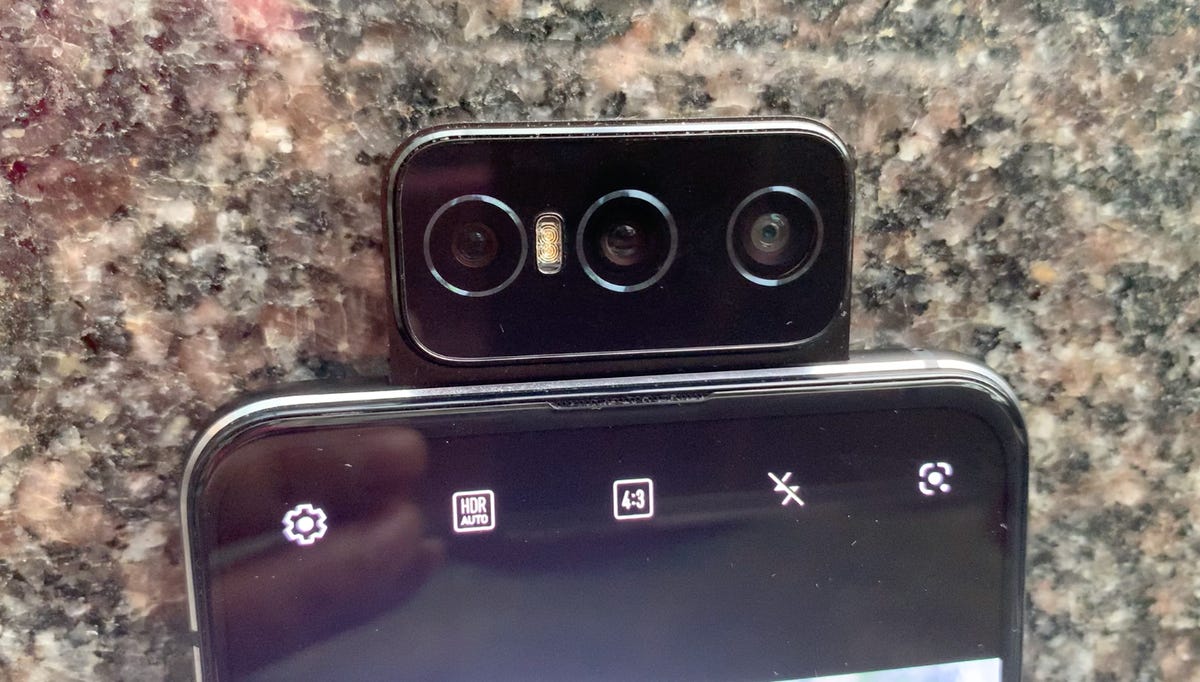
Asus added a third telephoto lens to the Zenfone 7 and 7 Pro (pictured here).

Sareena Dayaram/CNET

Asus doubles down on that flip camera

Since the flip camera influences many parts of the Zenfone 7 Pro's aesthetic, it's difficult to talk about design without first addressing its most distinctive physical feature. The camera unit is composed of three lenses that flip from back to front over the top of the phone (and vice versa) with a click of a button. This allows you to use its higher resolution cameras, which are normally reserved for the back of the phone, as front-facing shooters. Because of this, Asus eliminated the front camera altogether and as a result delivered a completely uninterrupted display, free of any notches or cut-outs that would typically house a lens. 
screenshot-2020-09-01-at-12-29-17-pm.png

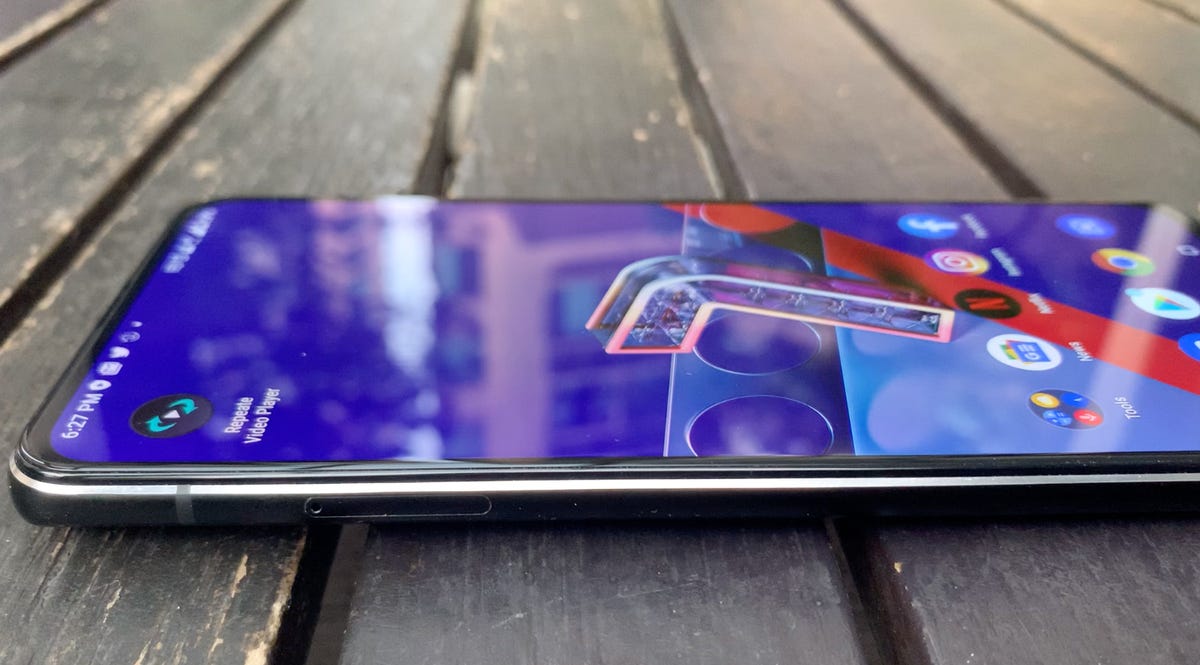
Like its predecessor, the Zenfone 7 Pro has a notch-less display. 

Sareena Dayaram/CNET

For the Zenfone 7 phones, Asus upgraded the flip-cameras's motor from the Zenfone 6, to one that it says is smoother, more durable and more versatile due to the addition of a new angle sensor. The company says the flip-cam can endure 200,000 flips, lasting you about five years or twice as long as the Zenfone 6. In the week or so that I've spent with this phone, I've had fun using the flip camera. I think it's a creative, clever and well-thought out solution that actually integrates with useful features. But, despite Asus' claims, I worry the constant emerging and re-emerging of the camera unit may make it prone to more wear and tear. For its part, Asus has added an auto-retract protection feature to its flip camera, which can sense when the handset is in a freefall. I tested this by dropping it on to a bed from a height of approximately four feet and can confirm it works. 

screenshot-2020-09-01-at-12-30-30-pm.png
Sareena Dayaram/CNET

The Zenfone 7 Pro is bulky, but has a great screen

Apart from the avant-garde flip camera setup, the sheer size and weight of the Zenfone 7 Pro was the next thing I noticed about it. It's one of the heaviest phones I've used and I often found myself navigating it with two hands. The phone I was given for review was entirely black except for the back which featured a dark green sheen. Overall, the color scheme was a bit too dark for my taste, but I can see why people would appreciate this finish. (The bundled charger and cable are black too.) On the right side of the handset, there are two buttons, namely, a volume control fingerprint reader that doubles up as a power button, which can be customised. The side fingerprint worked seamlessly and was easy to get accustomed to, but I do prefer an in-display reader. 

The Zenfone 7 Pro features a 6.67-inch AMOLED display with speedy 90Hz refresh rates. Most phones have a 60Hz display, which means the screen refreshes 60 times a second. But it's not as high as the 120Hz screens on the OnePlus 8 Pro and Galaxy S20. With the faster screen, the animations look smoother, while text and images are crisper. The phone runs on Android 10 out of the box and has a customized skin known as Zen UI. It reminds me of stock Android, but overall I found it clean, simple and easy to navigate.

screenshot-2020-09-01-at-12-27-37-pm.png
Sareena Dayaram/CNET

The Zenfone 7 Pro's three cameras

This camera took sharp and vibrant pictures in the sunlight and even in overcast weather conditions. Low light imaging was mostly good too and it did well brightening up some environments, especially when I used Night Mode. At times, however, pictures looked slightly artificially sharpened.

Out of the Zenfone 7 Pro's tri-camera module, it's the telephoto lens that is a new addition. It allows for 3x optical zoom and up to 12x digital zoom. At this level, pictures were blurry and grainy. If you intend on using zoom to capture details of faraway subjects, you won't achieve that with this phone, unfortunately. At 3x optical zoom, photos look crisp in sunny conditions, but tended to look grainy in trickier lighting environments. Overall, this camera definitely wasn't best-in-class, but then again this phone appeals to people who want a flipping camera and not necessarily the best camera.

As for video, there was support for up to 8K video at 30 frames per second with EIS. It makes for massive file sizes and isn't a video feature I expect to use much. But thanks to the flip cam, you have the option of making use of this high-tech feature from the phone's front.

outdoor-ultra-wide

Example of ultra-wide shot taken in daylight. 

Sareena Dayaram/CNET

outdoor-default-1x

Taken on default settings.

Sareena Dayaram/CNET
outdoor-3x

Example of 3x optical zoom. The photo turned out crisp, vibrant, and true-to-life.

Sareena Dayaram/CNET
night-mode-2

This photograph was captured using the Zenfone 7 Pro's dedicated night mode setting. You can see that it's been brightened compared to the photo below that was taken without night mode.

Sareena Dayaram/CNET

no-night-mode
Sareena Dayaram/CNET
p-20200827-112043

Taken indoors with natural light pouring through the window. The camera did a good job of taking a detailed and color-accurate photo.

Sareena Dayaram/CNET

default-blocks

The Zenfone 7 Pro's 5,000-mah battery lasts well 

Asus prides itself on the "unbeatable endurance" of its Zenfone batteries, so I was looking forward to experiencing its seemingly endless battery life and it didn't disappoint. It lasted me nearly 23 hours with what I would describe as moderate usage. Meaning I used my phone for about an hour of Zoom video calls, WhatsApp messaging, reading news on various social media apps and taking some photos. When I went to bed, I muted the phone and didn't switch on airplane mode, which would have preserved battery life even more. Also, when I continuously played an HD video on Airplane mode for battery tests, the phone lasted for more than 15 hours at 50% brightness.

When the battery did finally run out, it managed to hit a 50 percent charge in 30 minutes and get fully revitalized in 100 minutes or so, which is slightly longer than the quoted 93 minutes. Like the Zenfone 6, Asus decided to stick with a massive 5,000-mAh battery for the Zenfone 7 series. Though the capacity didn't increase with the new iteration, it added more battery-care features and a faster 30-watt charger. What really stood out was the degree of customization Asus provided in terms of battery-care features and charging. One new feature is the option to enable always slow charging, which the company says helps preserve battery capacity in the long run. Another example was the upper limit charging feature, which allows you to limit how much you charge your battery, say to 90% instead of the full hundred. Again, Asus says that's because regularly hitting a 100% charge degrades battery capacity over time.

At the heart of the Zenfone 7 Pro is the new Snapdragon 865 Plus processor, which is supposed to be 10% faster than the 865 processor found on most premium Android phones. In my experience, it was extremely snappy and totally capable. Nothing got in its way. Other fancy phones that use this processor include Samsung's pricier Galaxy Note 20, Note 20 Ultra and Oppo's Find X2 and Find X2 Pro. The Zenfone 7 Pro is backed up by 8GB RAM and 256GB of internal storage, and held up extremely well in benchmark tests.

Zenfone 7 vs. Zenfone 7 Pro


Asus Zenfone 7 Asus Zenfone 7 Pro
Display size, resolution 6.67-inch AMOLED; FHD 6.67-inch AMOLED; FHD
Dimensions (Inches) 6.49 x 3.04 x 0.37 inches 6.49 x 3.04 x 0.37 inches
Dimensions (Millimeters) 165.08 x 77.28 x 9.6 mm 165.08 x 77.28 x 9.6 mm
Weight (Ounces, Grams) 8.11 oz; 230g 8.11 oz; 230g
Mobile software Android 10 Android 10
Camera 64-megapixel (main camera), 12-megapixel (ultra-wide), and (telephoto) 64-megapixel (main camera), 12-megapixel (ultra-wide), and (telephoto)
Front-facing camera None None
Video capture 8K 8K
Processor Snapdragon 865 Snapdragon 865 Plus 5G
Storage 128GB 256GB
RAM 6GB/8GB 8GB
Expandable storage up to 2TB microSD card up to 2TB microSD card
Battery 5,000 mAh 5,000 mAh
Fingerprint sensor Side Side
Connector USB-C USB-C
Headphone jack None None
Special features Flip camera, 5G enabled, 90Hz refresh rate, 30W charging Flip camera, 5G enabled, 30W charging, 90Hz refresh rate
Price off-contract (USD) $840 (converted from 699 euros) $960 (converted from 799 euros)
Price (GBP) £625 (converted from euros) £715 (converted from euros)
Price (AUD) AU$1,130 (converted from euros) AU$1,290 (converted from euros)

First published Sept. 1.


Source

Tags:


Broken Pixel phone? Google Repair Center has a fix for you


Broken Pixel phone? Google Repair Center has a fix for you

Cracked screen? Water damage? Camera problem?

If your Pixel phone has a repair issue that's not covered by warranty, the Google Store now has an official place to get it fixed. The mail-in Repair Center is now open.

If your Pixel has a problem you can enter its unique identification number -- known as an IMEI, similar to a car's VIN number -- to get an estimate. Once you get the estimate, Google says you should back up and reset your phone and mail it in. You can use your own packaging or Google's prepaid packaging. Repairs take 7-10 days from the date Google receives your phone.

Don't want to mail it in? Google officially recommends uBreakiFix and Puls in the US.

The Repair Center currently supports the Pixel, Pixel XL, Pixel 2 or Pixel 2 XL. Google is expected to announce the Pixel 3 at an event on October 9.

Correction: An earlier version of this story listed the date of the Google event as October 3. It has been corrected to October 9.


Source

Tags:


GoPro enters licensing deal with Jabil for third-party gear


GoPro enters licensing deal with Jabil for third-party gear

GoPro is going more professional.

The iconic action cam company has entered a licensing partnership with Jabil, a manufacturing services company with expertise in electronics design. 

"This collaborative approach with Jabil will enable innovative, GoPro enabled products and services from some of the most exciting hardware and software companies out there," said Sandor Barna, GoPro's chief technology officer in a statement. 

Industries that could utilize GoPro-powered camera sensors and lenses, said Barna, include video conferencing, robotics, and self-driving cars. Jabil's vice president Irv Stein mentioned "strong demand in the enterprise action camera segment for applications in smart homes, military, fire, police, rescue and security."

According to Techcrunch the resulting products will not be part of the GoPro brand. The agreement excludes devices such as consumer action cams that compete directly against GoPro's own products.

Financial terms of the partnership were not disclosed, but it could be a stabilizing influence for GoPro amid a falling stock price and layoffs. In January the company scuttled its drone division and CEO Nick Woodman told CNBC that it would consider a sale to or partnership with another company.


Source

Tags:


Home Prices Keep Rising: How to Tap Into Your Home Equity and Snag a Lower Interest Rate


Home Prices Keep Rising: How to Tap Into Your Home Equity and Snag a Lower Interest Rate

Home prices have skyrocketed since the beginning of the pandemic and continue to increase across the US. In 2020, millions fled major cities for more space in the suburbs during the pandemic, increasing demand and driving up prices. Meanwhile, material shortages continue to inflate the price of new construction. Low inventory and cash-wielding house hunters continue to squeeze an already tight market even tighter -- and experts expect this trend to continue well into 2022.

These dynamics have combined to put many prospective buyers -- and some existing homeowners -- in a precarious position, potentially priced out of the market where they live. But there have been winners, too. If the market value of your home is higher than the amount you still owe on your mortgage, you have a real opportunity to leverage that differential. 

Below are a few ways to harness your home equity. 

Refinance your mortgage

Refinancing  can help you snag a lower interest rate, which can shorten your loan term, shave down your monthly payment and reduce the overall cost of your mortgage. It can also help you wriggle out of paying private mortgage insurance (PMI) if increased home value has grown your equity past the 20% threshold. Refinancing can also provide a way to pay down high-interest debt, like a credit card balance, or take cash out to finance a renovation or improvement.

The number of people refinancing surged during the pandemic, according to Freddie Mac. Single-family refinances totaled $2.6 trillion in 2020 -- the highest amount since 2003.  Rising interest rates have since caused the number of people refinancing to slow and refis are at their lowest level in three years. Refinance activity is down 80% from 2021 and now accounts for just 35% of market share, the lowest point since May 2019, according to Black Knight, a mortgage data company. Still, rates are historically low and Freddie Mac anticipates $1.2 trillion in refinance activity this year. So If you haven't looked at your interest rate recently, stop reading and do it now

And, since the Federal Reserve is expected to raise interest rates multiple times this year -- with a likely increase expected later this week -- you may want to lock in a low refinance rate sooner rather than later.

Get a home equity loan

These secured loans let you borrow a lump sum against your home equity. The specific loan terms depend on all of the usual financial credentials -- your credit score, debt payment history and income -- and lenders generally require at least 15% equity to qualify. Home equity loans typically feature a fixed interest rate, but repayment periods can vary (though most are for 15 or 20 years). 

To secure the best terms, the Federal Trade Commission recommends negotiating with multiple lenders and allowing them to compete for your business. Negotiable items might include lower fees, mortgage point prices and the fixed interest rate. 

Open a home equity line of credit -- HELOC

This revolving line of credit, which features a preset limit and variable interest rate, lets you withdraw, pay back and then withdraw again (if you like). Depending on your creditworthiness and debt-to-income ratio, you may be able to borrow up to 85 percent of the appraised value of your home, less the amount you owe on your mortgage. When you need cash, you can write a check or use the credit card attached to the HELOC account. Like other types of credit cards, you cannot spend more than the credit limit, and HELOCs typically come with the highest interest rates since they are variable and the loan is a type of revolving credit.

Cash-out refinance

In essence, a cash-out refinance lets you borrow a lump sum of money at a fixed -- and right now, a potentially very low -- interest rate. Rather than attaching a second loan to your original mortgage like a home equity loan, this loan pays off your first mortgage and replaces it with a new one that includes some amount of cash. You may be able to borrow up to 80% of the loan-to-value ratio, which means that after subtracting the cash-out, you'll still have 20% equity in your home.

Cash-out refinance loans usually have better interest rates than home equity loans because they are repaid before home equity loans during bankruptcy or foreclosure. Still, your specific terms will depend on your credit score, home value, income, and other factors. A knowledgeable mortgage broker should be able to help you weigh the pros and cons of each. 

Sell your house

The most obvious way to tap into your home equity is to sell. If there's excess money after you pay off your mortgage, you could use it to finance a cross-country move or a down payment on a new house. Last May, The Wall Street Journal reported that more than seven million households moved to a different county during the COVID-19 pandemic in 2020 -- nearly half a million more than in 2019. Remote working options and the desire for more space spurred a mass exodus from dense metropolitan areas into more affordable areas.

If your home's new value has you feeling like cashing in, keep a few things in mind before calling a listing agent:

  • Prices are higher -- nearly everywhere. The real estate market may look different than the last time you shopped for a house, and it's a good idea to learn what you can afford in your chosen location. Check out the National Association of Realtors' breakdown of median prices by home type and metropolitan area to see where you stand. You should also look at the latest mortgage interest rates and use our mortgage calculator to estimate your monthly payment on a new loan. 
  • Competition is fierce. We learned that most homes stay on the market just shy of seven days, which means that you'll need to make decisions quickly when it's time to buy. One way to speed things along is to get a mortgage preapproval before you start shopping. Preapproval allows your realtor to submit an offer immediately, which could make all the difference in a competitive market. 
  • A home equity windfall is rare. The US hasn't seen a housing boom like this in nearly 25 years. Although selling your home could drastically increase your net worth, it's wise to consider all of your options before buying another property. Consult a financial advisor about the different ways to use a financial windfall, real estate included. 

§

This story is part of The Year Ahead, CNET's look at how the world will continue to evolve starting in 2022 and beyond.

The last 22 months have been some of the wildest in real estate history, as the COVID-19 pandemic accelerated the speed and intensity of recent trends. Home prices surged to record-breaking highs. Interest rates dropped to historic lows. And, amongst it all, the new era of online home buying and selling took further root. On top of that, just about every contemporary macro-economic trend -- from inflation to supply chain woes to labor shortages -- made an appearance in the 2021 housing market, increasing the advantages of existing homeowners, daunting prospective homebuyers and, ultimately, further widening wealth inequality in the US.

Though no one can predict what the next year will bring, we've asked some industry experts to help us read the tea leaves. Perhaps most significantly, home prices are expected to continue to rise, though at a slower rate than last year. As such, the 2022 housing market will present challenges for new buyers looking to get a foothold. For those looking to sell, new technologies like iBuying will continue to streamline and simplify real estate transactions. And existing homeowners will likely have another year to capitalize on rising property values through refinancing -- if they haven't already

Experts also predict an extension of two major 2021 trends: low housing inventory and supply chain issues, both of which will continue to hamstring construction and renovations. Meanwhile, there are two new spectres on the scene: inflation and rising interest rates. "For a homebuyer, 2022 is going to require patience and strategy," said Robert Dietz, chief economist the National Association of Home Builders.

"If you think you're going to wait on the sidelines for the market to cool off, that usually doesn't work," cautions Karan Kaul, senior research associate at the Urban Institute. "Timing" the market is a tricky enterprise, and prices seem unlikely to decrease meaningfully any time soon. 

With the caveat that political and virological developments can wreak havoc on this unpredictable corner of the economy, here are some of the major factors experts see influencing the housing market in 2022. 

Still smoking: Home prices continue to rise

If you already own a home, you're more than likely to be in a fortunate position. Skyrocketing home values have continued to increase equity for homeowners in many US regions throughout the pandemic, according to Dietz. 

Combined with historically low interest rates, a record-breaking number of homeowners were able to tap into their home equity in 2020. As property values surged during the first year of the pandemic, cash-out refinancing levels were at their highest since the 2007 financial crisis.

Of course, this creates a much more difficult situation for prospective homebuyers. And that's unlikely to change much in 2022. Although prices are expected to increase at a lower rate next year, they are expected to continue to rise. And that -- in addition to higher interest rates -- will create considerable headwinds for buyers throughout 2022. 

Clogged supply chains cause more delays

Supply chain disruptions caused by the COVID-19 pandemic continue to delay shipments which impedes new construction. That is only making the market that much more competitive along with the rising price of existing homes across the US. And the number of people looking to buy is also increasing, thanks in large part to millennials entering the housing market in growing numbers.

"We've seen so much interest in buying homes over the past year and a half, it's a bit difficult to project when that is going to lose some steam," according to Robert Heck, vice president of mortgage at Morty, a mortgage-tech start-up. But it's clear there are still plenty of buyers trying to enter the market despite prices continuing to creep up.

"Despite the fact that builder confidence is pretty strong right now, in the short run there is a lack of building materials, higher cost of building materials like lumber, appliances, windows and doors, and even garage doors," said Dietz. And further complicating the picture is a sustained labor shortage, particularly for skilled construction workers.

Delivery delays can extend build time by as much as four to eight weeks for a typical single family home. And if there aren't enough contractors on hand to use those materials once they show up, it's clear that demand will continue to outweigh supply for some time to come.

Macro headwinds: Interest rates and inflation 

Prospective homebuyers will want to keep their eyes on some wonky stuff in 2022. The Federal Reserve announced that it will wind down bond purchasing and look to raise interest rates next year. And higher interest rates will only make things more difficult for those looking to buy, as they raise both the average monthly payment and the total lifetime cost of a mortgage. 

 And don't forget about inflation! That will almost certainly increase both the cost of home building materials and skilled labor. In fact, the National Association of Realtors' anticipates that annual median home prices will increase by 5.7% in 2022.

And yet it's not all doom and gloom. Mortgage interest remains are still quite low. And there are pockets of affordability in many regions of the US, creating a key opportunity for those fortunate enough to be able to work remotely. 

"Mortgage rates are still at historical lows, and it's been harder than ever to predict where things are going thanks to the ongoing COVID-19 pandemic," said Heck.

Tech innovations reshape home buying

Digital lending has already impacted the way Americans shop for homes. The rapid rise of online real estate brokerages and mortgage marketplaces has made it easier than ever to browse properties and finance a home. That's unlikely to change: Almost 40% of millennials said they would feel comfortable buying a home online in a recent Zillow study. 

"Consumers like the ability to bid remotely, and to really take a look at properties and neighborhoods online," said Miriam Moore, division president of default services at ServiceLink, a mortgage transactional services provider. This will likely impact both sides of transactions, as sellers learn to adapt their home's curb appeal to someone looking at it on their phone and buyers (and agents and investors) look for ways to arbitrage the market.

An evolving challenge: Climate change

Perhaps the biggest unknown in real estate is how soon climate change will become the dominant factor. According to experts across the industry, every part of the homebuying process will eventually be affected by changing weather patterns, encroaching shorelines, shifting flood zones and an increasingly complicated insurance marketplace. Case in point: Moore, who is in the mortgage business, has seen an increase in inspections due to weather and fire over the last year.

New construction may prove to be both more energy efficient and more durable in the face of extreme weather. "People want to live in energy efficient homes, but they can only buy them if they exist," said Kaul, at The Urban Institute.

The stakes couldn't be higher. Buying a house remains one of the most reliable ways to build wealth and has long been a key milestone for Americans in establishing long-term financial security. And although interest rates remain as low as ever, given all of the other trends impacting the real estate market in 2022, the balance of power is likely to remain in the hands of sellers.


Source

Tags:


Concerned about foldable phones' durability? Here's how Motorola tests the Razr hinge


Concerned about foldable phones' durability? Here's how Motorola tests the Razr hinge

For my review of the latest Motorola Razr, which is now available, I tested the updated foldable phone for 10 days in September. Occasionally when I opened or closed the phone, an onlooker would react with disbelief. One woman working behind the register of a coffee shop's to-go window actually gathered her (masked and socially distanced) co-workers and asked me to show them how the Razr folded in half. When I demonstrated the screen folding like paper, her response was: "That is amazing. Where do I get one?"

And that's the "magic" of foldable phones at their core. They seemingly do the impossible by letting you take something rectangular and rigid and fold it into something smaller than a drink coaster. That magic comes from years of design, testing and revisions. And the engineers and designers who worked on the upcoming Motorola Razr know it's anything but magic to make a 6.2-inch phone fold in half.

But all that work can be easily overshadowed. The review units of 2019's Samsung Galaxy Fold raised the flag about how folding screens would work in the real world. A number of them had defects that let dust or other particles get underneath the screen and wreak havoc. Any concerns people had about folding displays were instantly amplified.

Then in February 2020 after months of delays, Motorola released its Razr (2019) with a foldable screen and CNET's video team tested the display's durability. My colleague Chris Parker used a FoldBot and attempted to open and close the phone 100,000 times. After 27,000 folds the Razr (2019) wasn't able to be tested further. Reflecting on that test and how SquareTrade modified its FoldBot to handle the Razr, Parker concluded:

"Does [it] feel like a durable, resilient phone that will stand up to extended real-world use? To me it does."

These incidents might make you wonder if foldable screens are durable. And if so, how do we know? Jeff Snow, general manager of innovation products at Motorola, thinks it's natural to ask durability questions about foldable screens. 

"The new thing about the phone is the fact that the screen folds open and you can light it up," said Snow. "People are not used to phones with those folding screens. So the questions in their minds are, 'Is it going to last?' 'How many times can I actually do that action?'"

Motorola claims the screen on its upcoming, updated Razr (2020) can be folded 200,000 times. To give you an idea how many times that is, you could open and close the phone 100 times a day for five years and still not hit that number.

To show me how the company determined and tested the number of times the upcoming Razr's screen could be folded, I visited a lab at Motorola in Chicago -- while wearing a mask and social distancing -- to meet Snow and Tom Gitzinger, director and principal engineer of innovation and architecture for Motorola. I got to see for myself how Motorola tests the screen on the upcoming Razr. 

Motorola's screen folding machine lab

In a room that looks like a college black box theater are a number of lights all focused on a roughly 10-foot-wide machine. There is a camera on a tripod pointing at the machine which gives the entire space an odd television show vibe. On the top of the waist-high machine on their backs, are four Razr (2020) phones. The machine fully opens and closes all four phones at the same time over and over.

p1001097

Here are two of the four phones mid-close on the screen fold test machine.

Patrick Holland/CNET

Throughout the design and manufacturing process, Motorola uses similar machines to test the folds on the Razr (2020). Unlike the Samsung Galaxy Z Flip, which is designed to be opened to a variety of positions, the Razr is built to either be fully open and flat or completely closed. And unlike the Foldbot, Motorola's machine uses a wire to open the Razrs perfectly flat and an arm to close them shut. The wire is thin enough to nestle between the two halves of the phone when it's closed.

To recreate those 200,000 folds in less than five years' time, the machine fully opens and closes the phones once every 4 seconds. There is a calming quality to hearing four phones shut closed every 4 seconds. It's like a soft-sounding metronome. It takes Motorola 10 days to fold each phone 200,000 times with this machine.

Owners' feedback helps improve the new Razr

Over the past six months Motorola reached out to people who own the Razr (2019) to learn how they use the phone. According to Snow, Razr owners open and close their phones on average 40 times a day. And "super users" (the 99th percentile), average 100 times a day. Hence, Motorola designed the Razr (2020) to handle 200,000 folds.

"We're not changing the parameters of testing," said Snow. "But we want to make sure that we're understanding people and exceeding their expectations."

The screen and hinge allow the Razr to fold in half

The phone's "zero gap" design, screen and hinge allows the Razr to achieve a high level of screen durability. The newest Razr (2020) largely uses that same design as the Razr (2019) albeit with tweaks. In fact, if you want to learn more about the hinge take a look below at a video I made last year about its design and how it allows the Razr (2019) to fold flat.

The screen itself is made of five different layers and then sprayed with a hard coating. When the layers are combined the screen has a thickness of 355 microns (3.5 millimeters). To give you a sense of how thin that is, the Motorola Edge Plus uses a similar OLED panel stack for the curved edges of its screen which is three times the thickness of the Razr's display stack.

And it's not just the display that is folding in half. There are a number of connections including the four 5G antennas that have to traverse the hinge. And like other foldable phones, the battery in the Razr is actually two batteries, one on each end. Not only does this help with balance, but it adds another level of complexity as both have to connect through the Razr's hinge mechanism.

How Motorola addressed the squeak/creak

When I reviewed the Razr (2019) in February, it suffered from a squeak/creak. It was like a muffled crunching sound but loud. During my time with the updated Razr (2020), the squeak/creak was mostly absent until Friday -- my eighth day with the phone. And when it did squeak, it was a quieter sound, more like breaking in a pair of new leather boots. Gitzinger explained the noise by comparing it to a bag of potato chips.

"You can't possibly open a potato chip bag without making a noise. It's super thin. It's a lot more crunchy and crinkly than something like this [the foldable display]. But the same principle applies," said Gitzinger. "You've got this big, significant surface that moves around, and it's pushing air that creates some of the noises. We were able to eliminate other noises by putting in some old friction adhesives and tapes and surfaces to enable everything to slide past one another a bit more easily."

I asked a friend how they felt about the squeak/creak on the newer Razr (2020) and they said it didn't bother them. I guess when it comes to screen notches, foldable screen creases and now foldable phone squeaks, some people will get used to these things while others will be annoyed.

Only time will tell

With the improvements made, Motorola is confident about the retooled Razr's durability. In fact, the company runs 40 different lab checks to test both the design and quality of the phone during development and manufacturing.

That said, the true indicator for how durable the screen on the Razr (2020) or any foldable phone is time. Until then, just like magic, foldable phones require a bit of faith.

For more details make sure to check out my review of the 2020 Motorola Razr.


Source

Tags:


Man in Darth Vader costume robs a bank: Definitely Dark Side


Man in Darth Vader costume robs a bank: Definitely Dark Side

Darth Vader robber
This is a wanted man in a Darth Vader costume. Pineville Police

We all know Darth Vader is a fictional bad guy. A criminal recently co-opted the Sith Lord's look during the commission of a serious crime. The State Employees Credit Union in Pineville, N.C., was robbed on Monday, and what's generated attention across the globe is the costume robber wore.

The robber dressed as Darth Vader and carried an unusual long gun. A lightsaber would have been much less frightening. The outlaw didn't just opt for a Darth Vader mask (which doesn't appear to be terribly screen-accurate), but showed up wearing a full costume complete with the chest computer and black gloves.

The criminal got away with cash. Pineveille Police lieutenant Corey Copley told local station WCNC, "You see all kinds of disguises here and there, but this one in my experience is the most unusual."

The investigation is ongoing and the Pineville Police are still looking for leads as to the robber's identity. The costume is uncommon, so the cops are hopeful it will help lead them to the suspect. "He has shown somebody that he's got this and hopefully the person, one of your viewers, will be able to see and call and give us some tips on that," Copley told WCNC.

The incident sets up an interesting real-life metaphor. The thief is Darth Vader, dedicated to the evil ways of the Dark Side. The Pineville Police are the crusading Jedi, set on bringing light to the galaxy. If the story holds true to form, then the bad guy will be apprehended and his Death Star of criminal activities brought to a close.

(Via Boing Boing)


Source

Tags:


8 Affordable Therapy Options That Don't Require Insurance


8 Affordable Therapy Options That Don't Require Insurance

Every year, more Americans seek cognitive behavioral therapy and counseling to prioritize their mental health and overall wellbeing. Unfortunately, with the growing cost of living and an uncertain economic outlook, many therapy-goers find it difficult to afford treatment – even with insurance or other financial assistance programs.

Things are even more challenging for those looking for affordable therapy without insurance. For these folks, a single therapy session can cost as much as $250, which isn't feasible in most households.

However, there is some good news. These days, uninsured people looking for affordable therapy have more options than ever, including sliding scale payments, employer-sponsored programs and mental health apps.

Below, you'll find several cost-effective ways to access cheap or free therapy, none requiring insurance. Read on to discover how to find affordable therapy that works for you.

Read More: 6 Best Teas for Anxiety and Stress for 2022

Affordable therapy options to try without insurance

Sliding scale payments

Since therapists set their prices, they can choose to reduce their rates for patients with lower incomes or those who don't have insurance. Also known as a sliding scale, this payment system is set up at a therapist's discretion and can often decrease therapy fees by half or more (depending on a patient's income).

On the plus side, sliding scale payments can help economically disadvantaged people access therapy at a rate proportionate to their income. However, since mental health professionals make less money on these types of patients, these appointments are in high demand -- and often difficult to find.

To find a participating practice, you can use a therapist search engine (like Psychology Today or GoodTherapy) and apply the filter for sliding scale payments.

Low-cost clinics

Another way to access affordable therapy without insurance is by visiting a low-cost clinic. These are generally run by local universities or hospitals, where students train to become mental health professionals. They often provide affordable (or even free) counseling as a way for their trainees to get real-life experience with patients under the supervision of qualified professionals.

Low-cost clinics are an excellent option for those who don't have insurance or can't cover the out-of-pocket costs of traditional therapy. Keep in mind that the staff at these clinics usually aren't fully qualified yet, so they won't have as much knowledge or experience as an experienced therapist.

If you're interested in finding a low-cost clinic near you, contact your local university or psychology institute and ask if they offer student-led therapy services.

Employee Assistance Program 

Some companies have an Employee Assistance Program for workers struggling with mental health issues. With these types of programs, the employer will typically pay for a certain number of therapy sessions or mental health services to help with things like stress, anxiety, depression, substance abuse, trauma and grief. 

One of the biggest benefits of an EAP is that your employer covers all the costs. On the downside, EAPs are designed to focus on specific, short-term concerns rather than long-term mental health. As such, they aren't a solution for complex or extensive issues.

To find out if your company offers EAPs, reach out to your manager or your human resources department. If you qualify, they should be able to give you information about how to access a therapist that's covered by your EAP.

Woman drinking coffee and using laptop to look for employee assistance program
Luis Alvarez/Getty Images

Community mental health centers

Across the country, you'll find government-run community centers where individuals can receive mental health support -- no matter their income or insurance status. These clinics provide a range of services, including crisis assistance, substance abuse counseling and mental health care for veterans, with many accepting Medicaid or offering sliding scale payment options.

One advantage of community mental health centers is that they're available to everyone and deal with a comprehensive variety of conditions and disorders. Because of this, the centers' resources are often stretched thin, and you may face a lengthy wait to see a therapist.

Your state's behavioral or mental health department can help you access these services. In Missouri, for example, you can use this map to find your nearest community mental health centers based on your county.

University services 

If you're in college, you might be able to access therapy through your school's health center. Universities and community colleges recognize that students deal with all kinds of mental health issues while they're in school and put programs in place to support their pupils. For instance, the University of Michigan offers professional and peer-to-peer counseling, therapy apps, wellness coaching, self-guided meditation and more.

On the positive side, these university-sponsored services are often included with tuition. However, they're typically meant for short-term help. If you need long-term therapy, your school's counselor will likely refer you to another mental health professional outside the university.

Visit your school's website or contact the administration team to learn more about therapy and mental health services.

Group therapy

Group therapy is a cost-effective alternative if you don't have insurance and can't afford individual therapy. Instead of meeting with a mental health professional by yourself, you'll come together with a therapist and a small group of people dealing with similar issues like stress, depression, grief, substance abuse or something else. 

On average, group therapy costs around $30 to $80 per session – about half the price of individual therapy. It also lets you connect with others who are in a similar situation as you. On the downside, you won't receive one-on-one attention from your therapist, which could be difficult if you deal with highly personal issues. Plus, for group therapy to be effective, you'll need to be comfortable discussing your mental health in front of multiple others.

To learn more about group therapy or find sessions near you, search online or reach out to a local therapist specializing in your area of concern (such as addiction, chronic illness, trauma or another area).

Support groups

Similarly, support groups provide a safe space for people who are going through a similar experience. They're led by peers (rather than therapists) and are free to attend. For example, Al-Anon is a support group for friends and families of people with alcohol use disorder who want to gather and discuss how their loved one's addiction has affected them.

One of the key advantages of support groups is that they're organized and attended by people with first-hand experience with whatever you're struggling with -- whether that's substance abuse, grief, stress or another challenging issue. But since support groups are run as peer-to-peer sessions, they don't provide the opportunity to dive deeply into your personal situation with the help of a qualified therapist.

As mentioned, support groups are focused on a single topic, so the best way to find a relevant group near you is through online research (for example, "cancer support groups in Denver"). If you'd prefer to meet virtually, there are also plenty of free online support groups that tackle all sorts of tough issues.

Mental health apps

Thanks to technology, mental health care is now accessible from anywhere and for everybody -- including people who live in rural areas, individuals with disabilities and people without insurance. For about $60 to $90 per week, online therapy apps like Talkspace, BetterHelp and Cerebral allow you to speak with a therapist from the comfort of your home. 

These virtual mental health services are ideal if you're unsure about meeting a mental health professional face-to-face or if you can't find a therapist near your home. On the other hand, you might find it harder to connect or develop trust with your therapist in a virtual setting. On top of that, the subscription fees for these apps can be pricey.

To learn more, check out CNET's reviews of the best online therapy services and mental health apps.

Close up of hands holding smartphone with mental health mobile app
Prostock-Studio/Getty Images

Does free therapy exist?

Unfortunately, therapy can still be expensive, even with discounts or sliding scale payment options. While there are a handful of ways to access free online therapy or in-person counseling appointments, they're often hard to find. If you don't have a budget for individual therapy right now, you may find the following resources helpful.

  • Warmlines and hotlines: If you need to talk to someone at a given moment, consider calling a mental health support line (known as a warmline or hotline). Both are free phone numbers you can dial to chat with a peer or volunteer trained in mental health. Warmlines are available for casual, non-emergency conversations, whereas hotlines like the National Suicide Prevention Lifeline are for urgent crises (dial or text 988).
  • Free clinics: From student training clinics to community mental health centers, you may be able to find facilities in your area offering free therapy. Some mental health professionals also offer several pro bono sessions every week or month. These services are typically set aside for low-income and uninsured patients.
  • Support groups: No matter what you're struggling with, chances are that you're not alone. To meet people in a similar situation, research local or virtual support groups that revolve around your particular mental health concern.

Bottom line

These days, there are several pathways to find affordable therapy without insurance as a result of  advances in mental health technology. Whether you're insured or not, there are many ways to find cost-effective mental health care, including low-cost clinics, group therapy, community centers, support groups and mental health apps.

The information contained in this article is for educational and informational purposes only and is not intended as health or medical advice. Always consult a physician or other qualified health provider regarding any questions you may have about a medical condition or health objectives.


Source

Tags:


Netflix With Ads Won't Let You Download Shows, Report Says


Netflix With Ads Won't Let You Download Shows, Report Says

Netflix's upcoming ad-supported tier might not include a popular feature. The streaming giant doesn't plan to let subscribers download content for offline viewing on its ad-supported tier, according to a report Wednesday from Bloomberg. 

The new ad-supported tier, which is expected to arrive in early 2023, apparently won't allow customers to download TV shows and movies to their devices unless they pay for a more expensive subscription. 

The removal of the download feature from what will likely become Netflix's cheapest plan was discovered by a developer, Steve Moser, looking into the company's iPhone code, according to Bloomberg. Moser also found that you will not be able to skip over ads or use playback controls while ads are running, the report said.

Read also: Best Streaming Service of 2022: Netflix, HBO Max, Disney Plus and More

Netflix is also reportedly not allowing ads to be shown during children's programs, according to Bloomberg Friday.

Rival streaming services Hulu and Disney Plus have also recently announced new ad-supported tiers as part of their lineup. Meanwhile, the ad-free version of Hulu will increase from $13 per month to $15 a month on Oct. 10, and the ad-free version of Disney Plus will increase from $8 per month to $11 a month on Dec. 8. 

Currently, Netflix's premium option, which lets you have four streams at once, is $20 a month.

Netflix said it is still deciding how to launch its lower priced ad-supported tier and has nothing further to share at this time. 

Read also: Netflix: The 44 Absolute Best Movies to Watch

Correction, Aug. 18: An earlier version of this story had incorrect prices for Hulu's ad-free tier. Hulu without ads will see its price increase from $13 a month to $15 per month on Oct. 10. 


Source

Tags:

Computer and Tech News

Search This Blog

Menu Halaman Statis

Contact Form

Name Email * Message *

histat