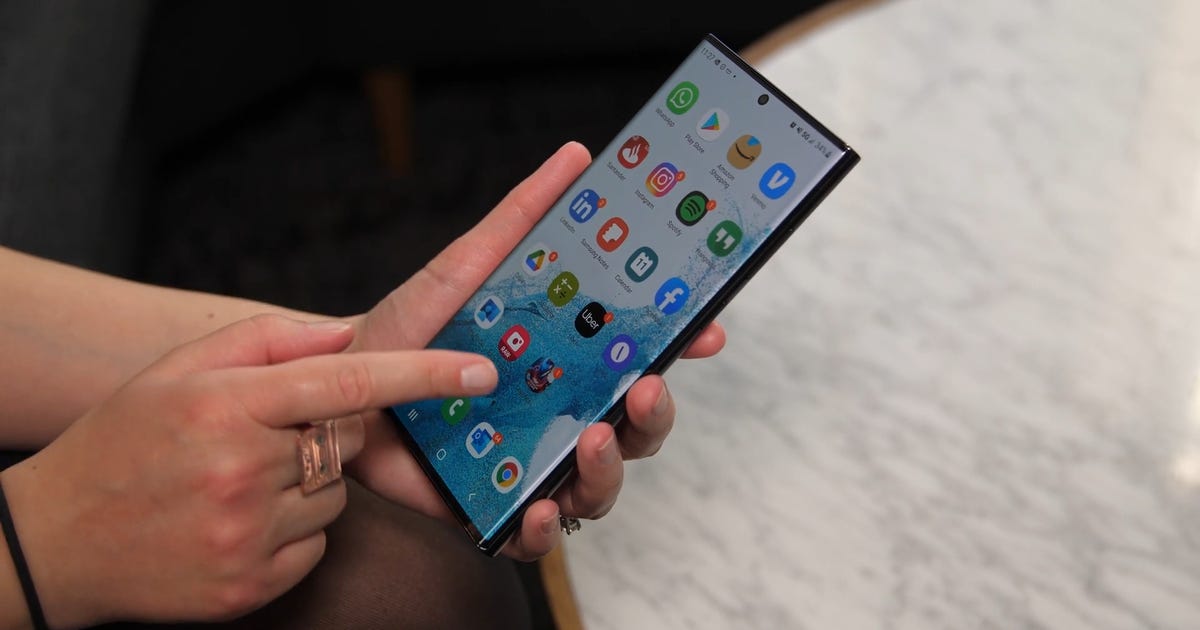
Here is one of the pictures featuring the Samsung One Box. Numerous images associated with the Samsung One Box can be utilized as your point of reference. Below, you'll find some additional pictures related to the Samsung One Box.
Samsung One UI 5.0 Beta Goes Live For Some Galaxy S22 Owners
Samsung One UI 5.0 Beta Goes Live For Some Galaxy S22 Owners
Samsung's giving early adopters a first look of its next operating system update with the One UI 5.0 beta, but it's only available in Germany so far, according to reports.
What's more, only owners of the Samsung Galaxy S22 series released earlier this year can access the One UI 5.0 beta, as SamMobile reported, stymying older Samsung handset owners.
One UI 5.0 brings new features set to come out in the upcoming release of Android 13 later this year. The beta will eventually be available to users in China, India, Poland, the Republic of Korea, the United Kingdom and the United States, according to the beta's official website. It's unclear when the beta will expand to these countries, though it could be in the coming days as 9to5Google predicts. It's also not apparent if other Samsung phones will be included in the beta.
Interested users can register for the beta program in general within the Samsung Members app available on the Google Play Store and Galaxy Store -- once registered, they'll be able to download the free beta update using the usual OS route (Settings > Software Update > Download and Install).
Samsung did not respond to request for comment by time of publication.
Read more: Download the Final Android 13 Beta on Your Phone Right Now
Unboxing the galaxy z flip 4 and z fold samsung unboxing the galaxy z flip 4 and z fold cards unboxing the galaxy z flip 4 and z fold towels unboxing the galaxy z flip 4 and zkratka unboxing the galaxy z flip 4 and zoe unboxing the galaxy z flip 4 and ziggy unboxing the galaxy z flip 4 and zombies unboxing the galaxy z flip 4 song unboxing the galaxy s9
Unboxing the Galaxy Z Flip 4 and Z Fold 4: Here's Everything You Get in the Box
Unboxing the Galaxy Z Flip 4 and Z Fold 4: Here's Everything You Get in the Box
The new Galaxy Z Fold 4 and Z Flip 4 revealed at Samsung's Unpacked event include numerous improvements like bigger batteries, updated processors, better cameras and fresh software. However, the phones' packaging doesn't include much else.
Turns out, buying a $1,000 or $1,800 phone in 2022 means getting few-to-no extras in the box. Gone are the days when you got a pair of wired headphones with your new phone. In the past couple of years, wall chargers stopped being included. And you can forget getting any free cases.
More from Samsung Unpacked
Samsung stopped including wired headphones as part of the package with the Galaxy Note 20 launch. Wall chargers started disappearing from the boxes of Samsung phones with the launch of the Galaxy S21 and S21 Ultra.
The absence of so many extras is one of the ways Samsung is trying to reduce its impact on the environment as well as its own costs. In fact, the Galaxy Z Flip 4 and Z Fold 4 include components made from repurposed fishing nets, which is a first for Samsung's foldables. So that's pretty cool, right?
Samsung Galaxy Watch 5 Pro Review: Smartwatch + Fitness Watch = a Good Mix
Samsung Galaxy Watch 5 Pro Review: Smartwatch + Fitness Watch = a Good Mix
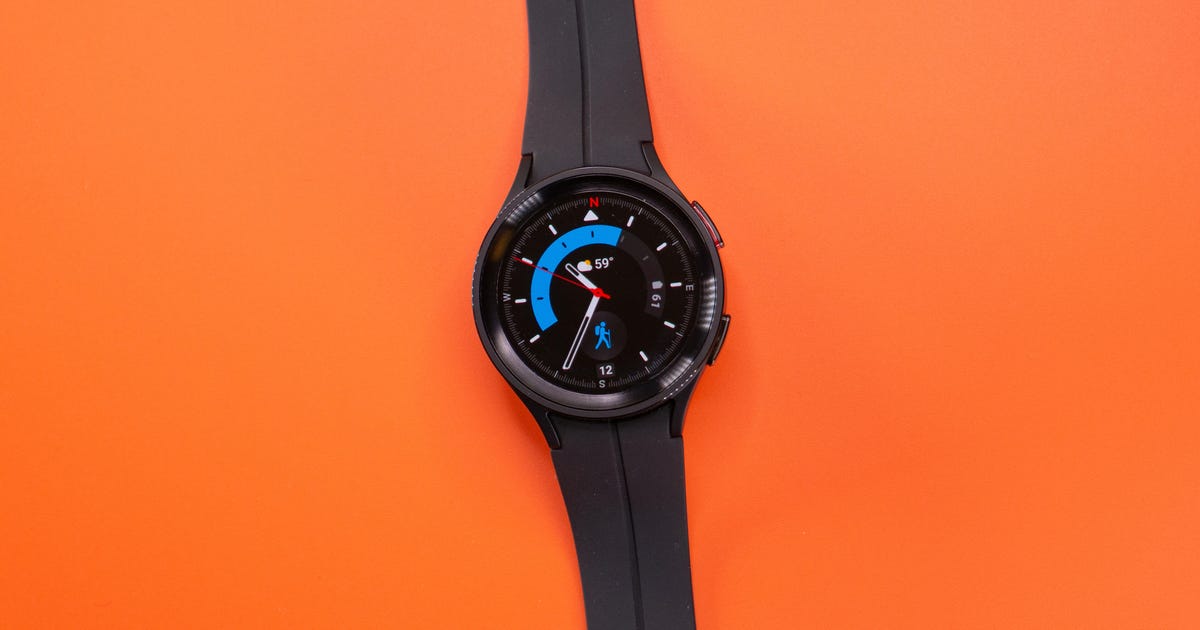
There's a lot to like about the $450 Samsung Galaxy Watch 5 Pro. Not only does it have all the trimmings of a smartwatch, but it adds extra sports functions that athletes may want -- and for almost half the price of some other outdoor watches with similar construction like the $900 Garmin Epix 2.
It also has a tougher design and bigger battery than the regular Galaxy Watch 5. Just don't expect it to be a true outdoor watch that you can take on multi-day adventures, because the battery life isn't as strong as the competition.
Both the Galaxy Watch 5 and Galaxy Watch 5 Pro are Samsung's second-gen Galaxy watches running Wear OS 3. Until we see the new Pixel Watch and a range of long-promised watches also on the new platform, they're the best Android watches you can get.
But the Galaxy Watch 5 Pro only comes in one 45-millimeter case size, which might be too big for smaller wrists. Note that even though this is an Android watch, some of Samsung's key health features require a Samsung phone to use.
Tough design with a bulky fit on the wrist
The Watch 5 Pro is more durable than the regular Galaxy Watch 5. It has a raised rim around the screen, titanium construction and stronger sapphire crystal glass on the screen. With an IP68 rating, it's also dust- and water-resistant. While I haven't deliberately dropped it or tried to scratch it, I've taken it on a dusty bike ride, scuffed it in sand at the beach and lifted weights that banged up against the watch. It still looks brand new, but only time will tell how it might stand up in tougher environments such as construction sites.
Lexy Savvides/CNET
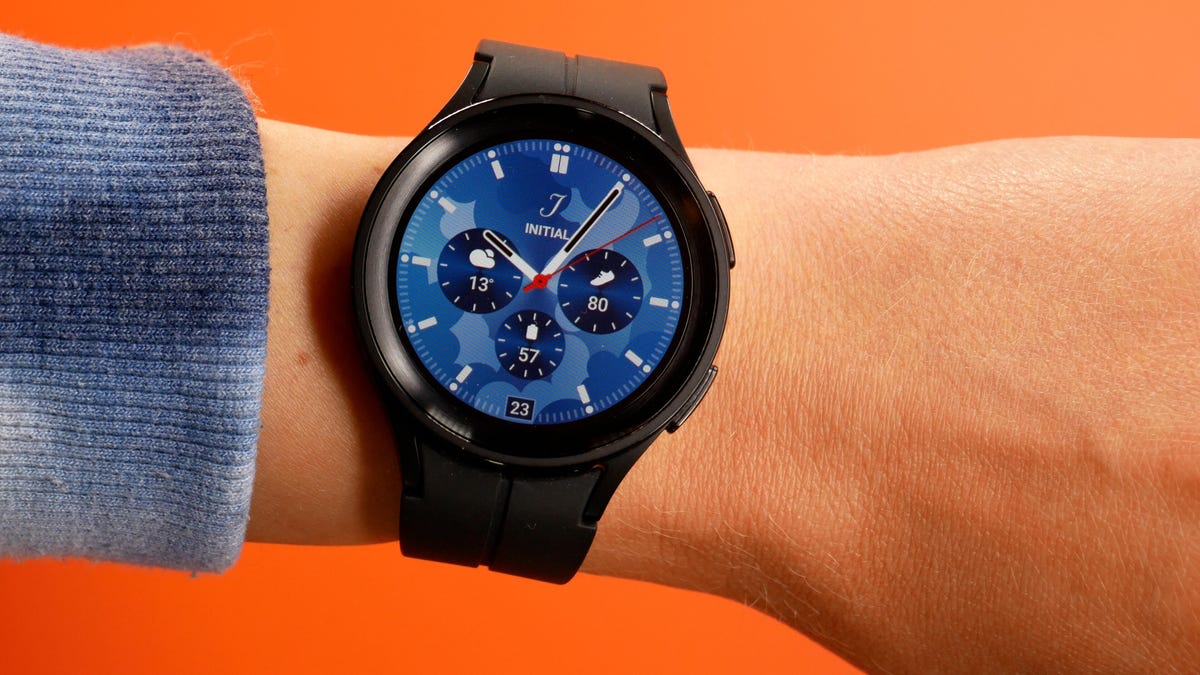
It only comes in one 45mm size, which makes it more difficult for those with smaller wrists to wear, unlike the 40mm and 44mm options on the regular watch. I've worn larger watches before -- the Garmin Epix 2 comes to mind, with its hefty 47mm frame. But for people with even smaller wrists than mine, it will probably be too big and possibly too heavy at 76 grams (2.6 ounces) with the included magnetic buckle strap. I'm disappointed that the watch's bulky design will inherently limit its appeal. But the 1.4-inch AMOLED screen is bright, sharp and shows Wear OS (and Samsung's One UI interface) in the best light.
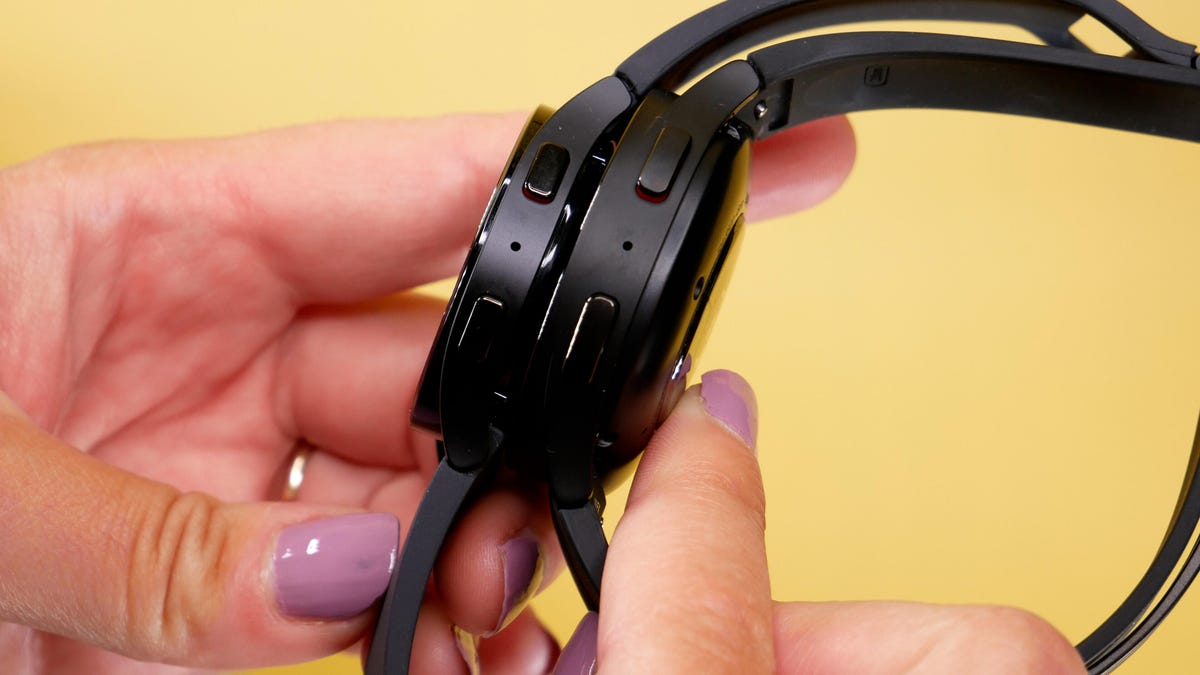
Instead of a physical rotating bezel, the Galaxy Watch 5 Pro comes with a touch bezel that lets you navigate menus alongside the touchscreen and side buttons. It's easier to use on the Watch 5 Pro compared to the regular Watch 5 because of the Pro's raised edge. You can almost rest your finger against it as you "turn" the bezel. It's still not as precise as having a physical bezel that clicks into place, especially if you have wet or sweaty hands -- which seems inevitable if you're really using this watch for its sports capabilities.
I can see why Samsung opted to remove the physical rotating bezel, given it's another moving part that could potentially get damaged or jammed if you're using this watch in tough environments. But I still miss having that option and feel Samsung could have made other compromises instead. For example, I could imagine using the inner rim of the raised edge as a small rotating bezel instead.
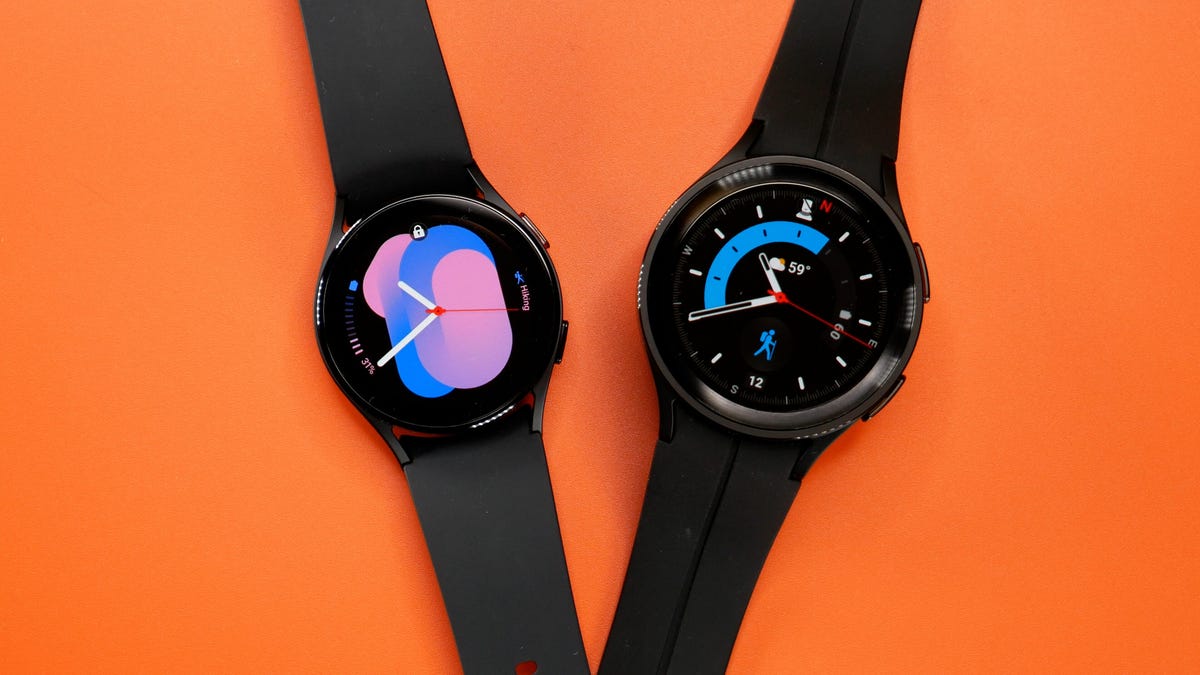
Thickness comparison between the Galaxy Watch 5 (left) and Pro (right).
Lexy Savvides/CNET
The Galaxy Watch 5 Pro uses the same processor as last year's Galaxy Watch 4, rather than the new Qualcomm Snapdragon W5 chip. Performance is snappy for the most part and the watch loads apps quickly, though there were a few occasions when the raise-to-wake was a little sluggish compared to the regular Galaxy Watch 5. There's an LTE variant available that costs $499, though I haven't tested that model.
It shares the exact same Wear OS platform and user interface as the regular Galaxy Watch 5, which uses Google apps alongside Samsung services like Samsung Health. You can read more about apps and functionality in my full review of the Galaxy Watch 5.
Galaxy Watch 5 Pro track back and sports modes
Both Galaxy Watch 5 versions can track more than 90 exercise types and can auto-detect certain workouts like running, swimming and elliptical after 10 minutes of activity. But the Galaxy Watch 5 Pro has a few more sports features. Do they warrant this watch's "Pro" title? Maybe.
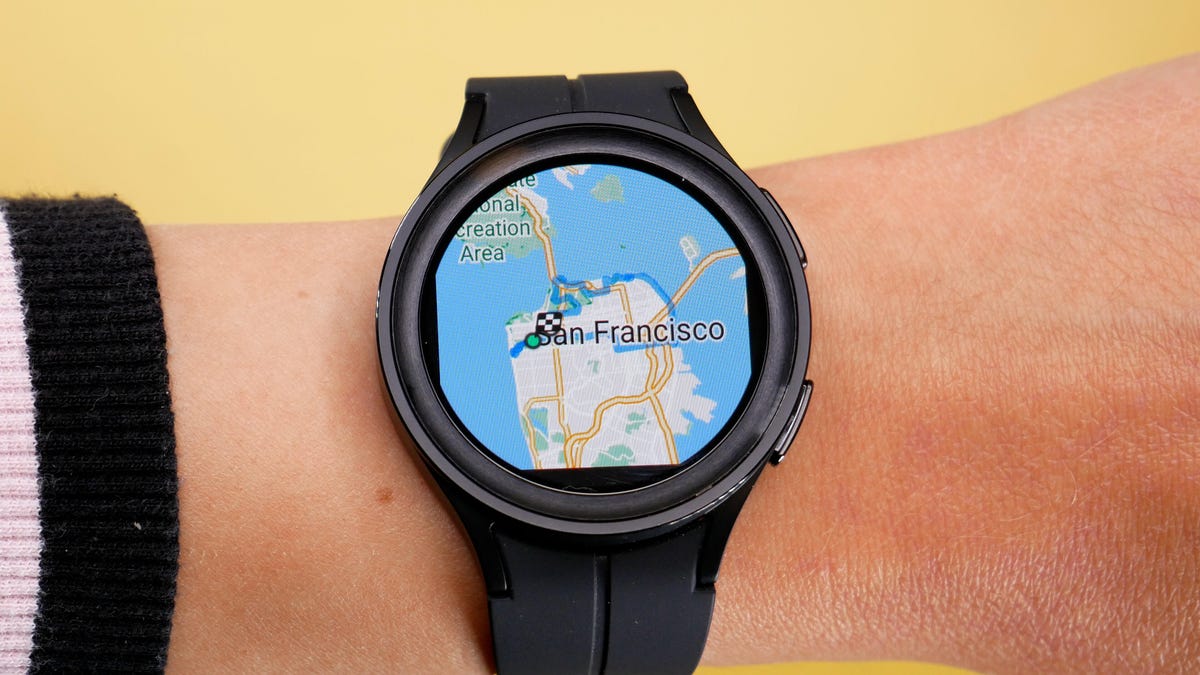
The first is track back. This works with hikes and outdoor cycling, helping route you back to your start point on the same path. Just swipe over to the settings cog, find track back and the watch will show a map on screen with your current location, turn-by-turn guidance and distances. The path you traveled to arrive at your current location is shown in blue, and it's overlayed in green as you start navigating back. It's easy to use, with the watch either buzzing or providing audible notifications when you need to make your next turn. It routed me back home on exactly the same path I hiked in on when I tried it out on a trail I've never taken before. Maybe a future software update could bring this to other outdoor GPS workout types like runs and walks, as it's a helpful feature.
A route displayed on the Galaxy Watch 5 Pro screen.
Lexy Savvides/CNET
You can also import routes to the watch and get turn-by-turn navigation. It only works with hikes and bike rides at the moment, but it's really easy to import a GPX file. I exported a previous ride from Strava and uploaded it to the Watch 5 Pro in seconds from the Samsung Health app. Like track back, the map (which uses Google Maps) looks great on the screen and it's easy to view. You can also export routes you've done on the watch from the Samsung Health app, too.
The Samsung Health app only provides two suggested routes for cycling and hiking, just in case you don't have any routes of your own saved yet, but they're based in New York and London, so not super helpful if you don't live in either of those cities. But I don't mind because the mapping interface is cleaner and easier to read than some other sports watches I've used thanks to Google Maps. The watch also offers turn-by-turn navigation, which can guide you through a route with voice, vibrations and on-screen alerts.
Some of the track back and mapping features on this watch aren't new to the world of dedicated running watches -- even watches that cost half as much. But it doesn't really feel like Samsung is trying to position this watch to be a replacement or direct competitor with the likes of higher-end Garmin watches anyway. If you're a serious athlete, you'd want more in-depth analysis and features than what the Galaxy Watch 5 Pro can provide with its first-party workout apps.
Also, the always-on display is pretty dim when you're in direct sunlight. I had to squint in a couple situations to see elapsed time or my pace, which prompted me to stop and tap the screen to wake it up to check my stats. Fortunately, I didn't have any issues with visibility indoors or in shaded conditions.
Track back on the Galaxy Watch 5 Pro.
Lexy Savvides/CNET
Sensor accuracy is great for workouts, but temperature is TBD
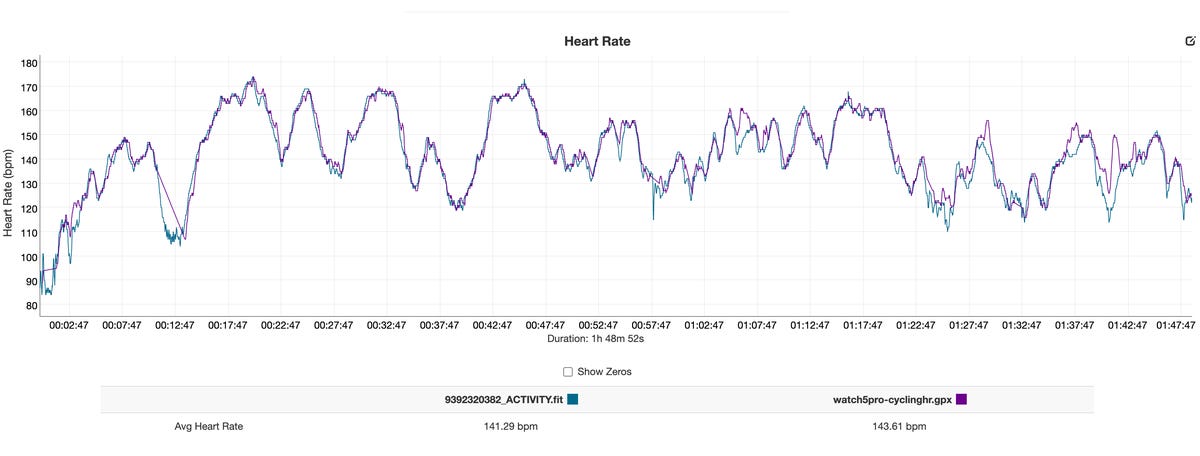
I tested the Galaxy Watch 5 Pro's optical heart rate sensor against a chest strap to see how it would fare through a range of cardio workouts.
For an outdoor bike ride, which involves extra variables like bumps in the road and more arm movement that you wouldn't get on a stationary bike, the Galaxy Watch 5 Pro did a good job keeping close to the readings from the chest strap. There were only two small intervals during the almost 2-hour workout where it deviated slightly from the control sensor, as you can see in the chart below. For a more steady cardio walkout like a regular walk, the watch also did a good job of sticking close to the heart rate monitor. Unlike some other running watches, you can't pair an external heart-rate monitor with the Galaxy Watch 5 Pro.
The Galaxy Watch 5 Pro (purple line) compared to a chest strap (blue line).
Lexy Savvides/CNET
GPS accuracy is really good on both Galaxy Watch 5 models. I had no issues locking on to a signal within 5 seconds in San Francisco, either with or without a phone in range.
The infrared sensor is what sets the Watch 5 series apart from last year's models. But it's not active yet and we don't have an ETA on when it will get switched on via software update. Samsung says it will be used nightly while sleeping. Competitors like Fitbit and Oura use the infrared sensors on their devices for skin temperature tracking during sleep. It gives more insights into whether or not you may be running a fever, or to give insight into menstrual cycles.
This isn't the first time a wearable has been launched without a key feature or sensor active. Fitbit's Charge 5 launched without its key daily readiness score active, and the ECG on Samsung's earlier Galaxy Watch 3 was unlocked about a month after launch once it received FDA clearance. I'm disappointed that we don't have too much extra detail about how Samsung or third-party developers could use this temperature sensor yet, because it's the main new feature of both Galaxy Watches. I hope at the very least when it does launch that it shows nightly sleep temperature trends like those other wearables I mentioned.
Most of the other health features and sensors remain largely unchanged from the Galaxy Watch 4. You still get that bioimpedance sensor to measure body composition, plus a blood oxygen sensor and ECG. But to use the ECG and blood pressure sensor (only available in select countries), you will need to pair with a Samsung Galaxy phone.
The Galaxy Watch 5 and Watch 5 Pro need a Samsung phone to use the ECG. This is what you'll see if you pair with any other Android phone.
Lexy Savvides/CNET
I've had mixed results from the blood oxygen sensor, which tends to read a little lower than both a pulse oximeter and other wearables, especially at night. At times, I've had both the Galaxy Watch 5 and Watch 5 Pro say my lowest blood oxygen level was anywhere from 80 to 87% which is particularly low and could indicate signs of sleep conditions like sleep apnea. No other wearable has ever given me such low readings, especially when I charted the same night's sleep with both the Fitbit Charge 5 and Oura ring. Blood oxygen sensors are generally not medically cleared, so take their readings with a grain of salt and always consult a medical professional for proper guidance. I've reached out to Samsung about the mysteriously low readings and will update this review when I hear back.
Recovery metrics are the missing piece of the puzzle
One of the biggest advantages of wearing a smartwatch in recent years is learning more about how your body recovers after a workout or from illness. There are limited recovery metrics available in Samsung Health and on the watch itself, including a sleep score and stress readings that don't really tell you much beyond a scale of high, average or low. What does that mean? It's up to you to work that out.
You can also track sweat loss after an outdoor run, plus recovery heart rate when you set body composition targets. But again, the onus is really on you to interpret this data, and the Galaxy Watch 5 Pro doesn't go as far as the competition in making all this easy to understand.
Garmin offers the Body Battery, which takes into account heart rate variability, sleep and activity levels to determine if you can push yourself to do another workout or should take it easy. Similarly, Fitbit has the Daily Readiness Score that also gives you suggested workouts to do based on your score. Even if the Galaxy Watch 5 Pro had a recovery time metric to let you know how long your body needs between workouts, that would be better than nothing.
The biggest battery on a Galaxy Watch, but I want even more
The Galaxy Watch 5 Pro has the biggest battery from the 2022 range at 590 mAh. Samsung claims it can last up to 80 hours in total with regular use, or 20 hours with GPS. I did a 2-hour hike with airplane mode active to ensure I was using GPS-only, and the battery dropped by just 10% even with the always-on display active. That's promising performance, and under those conditions the watch would meet the 20-hour claim with GPS alone. (I wasn't quite ready to do a 20-hour hike to test continuous drain.)
With regular usage, including phone notifications, always-on display, sleep tracking, continuous heart rate monitoring and a 1-hour GPS workout every day, the Watch 5 Pro lasted for 2.5 full days, or a little over 58 hours. That's better than last year's Galaxy Watch 4 range, but nowhere near similarly priced competitors like the Garmin Venu 2 Plus, which can reach a week or more between charges. Samsung claims a maximum of 80 hours of use under normal conditions, which you might meet if you do fewer outdoor workouts and turn the always-on display off.
Fortunately, both the regular Watch 5 and Watch 5 Pro support faster charging and can reach 45% charge in 30 minutes. I tested this with the Watch 5 Pro and recharged from flat to 42% full in half an hour. It takes a little over 2 hours for the watch to fully juice up from flat. But you need a 25-watt USB-C charger to take advantage of this faster charge speed and, just like the Apple Watch, there's no charging brick included in the box.
The Galaxy Watch 5 Pro can also take advantage of reverse wireless charging if you have a Samsung phone, but it's tricky to get the watch to lie flat with the magnetic buckle strap, so I usually end up relying on the included charging puck.
Lexy Savvides/CNET
Galaxy Watch 5 Pro: 'Pro' in name, almost enough in practice
Samsung has a legacy in sports watches, including the Gear range. But it feels like the company could have gone one step further in making this a true fitness watch with even more sports features. That said, this is a really strong smartwatch with a durable construction to suit casual athletes or anyone who needs a tougher wearable.
So it's easy to recommend the Galaxy Watch 5 Pro if you're looking for an Android watch that skews more to being a true smartwatch with a few sports features thrown in, rather than a fitness watch. I'd also pick this over the regular Galaxy Watch 5 simply because it has better battery life.
Vivo's X60 Pro Plus has a Snapdragon 888 and a 55-watt charger in the box
Vivo's X60 Pro Plus has a Snapdragon 888 and a 55-watt charger in the box
Vivo is one of China's biggest phone brands, and now it's teaming up with German lensmaker Zeiss to level up its photography game. Those boosted cameras, plus a gorgeous display and impressive battery features, make Vivo's newest phones worthy of your attention.
Vivo unveiled its inaugural global flagship phones for this year, announcing the X60, X60 Pro, and the X60 Pro Plus, on Thursday. Positioning the X60 Pro Plus as a "professional photography flagship," Vivo is flexing its maiden collaboration with Zeiss, which co-engineered the device's image system. Although Vivo is relatively unknown in the West, the Chinese company is one of the world's top 10 phone manufacturers by market share -- and it's used by several Avengers too.
I spent a couple of days with the highest-end X60 Pro Plus, and can say it delivers on a premium Android experience complete with some extra bells and whistles you may not expect. There's a 6.56-inch AMOLED display, a speedy refresh rate (120Hz), the newest Qualcomm processor available (Snapdragon 888), fast charging (55-watt bundled charger) and a periscope-style telephoto camera seen on ultra-premium flagships such as Samsung's Galaxy S21 Ultra.
Apart from the Zeiss collaboration and the incremental upgrades, new to the series is the X60 Pro Plus' so-called extended RAM technology. Vivo claims 3GB of the phone's "idle" storage can be used as RAM to "achieve a +3GB RAM effect," promising to boost the device's performance.
Missing in the X60 Pro Plus are things like an IP rating for water resistance, which many phones of this class have, and expandable storage. That will be forgivable for most since the one variant of this phone has 256GB storage.
At the time of this writing, Vivo didn't share how much these phones will cost internationally, but we can look at the X60's pricing in its native China as a reference point (although prices tend to vary depending on country). The base X60 Pro starts at 4,498 yuan (converts to about $690, £500 or AU$910), and the X60 Pro Plus starts at 5,998 yuan (about $920, £670 or AU$1,210). Unfortunately, Vivo currently has no US rollout plans, but it shouldn't be too difficult to import. It's being released in more than 20 markets worldwide including the UK, India, the Middle East and Europe over the next few months.
The X60 Pro Plus has periscope lens bragging rights
The Vivo X60 Pro Plus has four rear cameras, consisting of a standard lens, ultra-wide lens, portrait lens, and a periscope-style telephoto lens (just like its predecessor). Huawei's P30 Pro was the first phone to include a Periscopic lens, which allows for insane long zooming, and it's since been picked up by Samsung on its Ultra phones. Apple is rumored to adopt the technology late next year. Compared to regular telephoto cameras that offer 2x or 3x optical zoom, periscope-style cameras can typically do 5x or even 10x optical zoom by using more than one lens along with the camera sensor. For its part, the X60 Pro Plus boasts 5x optical zoom, and 60x digital zoom.
Last year, I showed you how far you can zoom in with 60x zoom on the Vivo X50 Pro, so you can take a look at that to get a sense of this phone's digital zoom capabilities.
The X60 Pro Plus has a periscope-style telephoto camera capable of 10x optical zoom and 60x digital zoom.
Sareena Dayaram/CNET
Vivo X60 Pro Plus cameras in action
Whether I was attempting to snap the perfect portrait of my dog napping in our living room or action shots of Rocky running on a hiking trail, the five cameras on this phone, along with the many accompanying modes, made it easy to take wonderful and versatile shots. Night-time imaging was impressive too, with the X60 Pro Plus taking crisp, detailed photos. There is also night mode for video on the main camera.
Even when I took pictures facing bright, sunlit windows, the camera managed to capture punched-up images of the indoor surroundings. Below you can see what I'm talking about, especially when juxtaposed with iPhone 12 Pro Max photo, which took more true-to-life, albeit less saturated photos. Whatever you prefer is likely a matter of personal preference. I realize this might not be an apples-to-apples comparison (pun intended), but my hope is that it gives you an indication of where the X60 Pro Plus stands on the spectrum of phone cameras.
Taken with the Vivo X60 Pro Plus. The furniture looks more saturated here than in the image below taken with the iPhone 12 Pro Max below.
The X60 Pro Plus features a design similar to a number of high-end Android phones we've seen in recent years. On the front is a curved display with a centrally located punch-hole notch, and on the back there's a "vegan" leather rear that reminds me of last year's Oppo's Find X2 Pro.There's a camera bump on the back and a blue Zeiss label emblazoned on its right side. I realize Vivo wants to flex its partnership with the 175-year-old German lensmaker, but I think it could have achieved a similar result with more subtle labelling.
Speaking of the display, the X60 Pro Plus relied on a high-res AMOLED display (made by Samsung). It has a speedy refresh rate of 120Hz, but you can dial it back to 60Hz if you want to save on battery life. Most phones have refresh rates of 60Hz, which means the screen refreshes 60 times in a second. 120Hz displays can look a lot smoother when scrolling through webpages.
Vivo
Vivo X60 Pro Plus has 55-watt bundled charger
The X60 Pro Plus astounded me with its blazing-fast charging speeds. In fact, this was probably one of my favorite features because you only need 20 minutes for your phone to get enough charge to last you between a half or full day. Within 20-25 minutes, the 55-watt in-box charger juiced up the phone from 0% to around 70%, and within 45 minutes the 4,200-mAh battery was fully revitalized.
The X60 Pro Plus runs on the Snapdragon 888, Qualcomm's latest processor found in a number of Android flagships including Samsung's Galaxy S21 Ultra and Xiaomi's Mi 11. This chipset is backed by 12GB RAM and 256 GB of storage. Vivo claims 3GB of the phone's storage can be used as RAM, giving you that extra dose of power when multiple apps are running in the background. Vivo claims its new memory management relies on algorithms to lets 3GB of idle storage to "assume the function" of RAM, resulting a boost in memory usage efficiency by 37%. You probably won't notice a difference at first, but in theory it should mean better performance when your phone is loaded with apps.
Vivo X60 Pro Plus vs. X60 Pro
Vivo X60 Pro Plus
Vivo X60 Pro
Display size, resolution
6.56-inch AMOLED "flexible screen", FHD+ (1080 x 2400 pixels)
6.56-inch AMOLED "flexible screen", FHD+ (1080 x 2400 pixels)
Midnight black: 158.58x73.24x7.59 mm and shimmer blue: 158.58x73.24x7.69 mm
Weight (Ounces, Grams)
191 grams
177 grams for midnight black, 179 grams for shimmer blue
Mobile software
Android 11
Android 11
Video capture
4K
4K
Processor
Snapdragon 888
Snapdragon 870
Storage
256GB
256GB
RAM
12GB
12GB
Expandable storage
No
No
Battery
4,200 mAh
4,200 mAh
Special features
55-watt fast charging (in box charger), 120Hz, 60x hybrid zoom, 5x optical zoom, dual SIM
33-watt fast charging (in box charger), dual SIM, 120 Hz screen
Price off-contract (USD)
N/A
N/A
Price (GBP)
N/A
N/A
Price (AUD)
N/A
N/A
§
Apple analyst Ming-Chi Kuo says in a research note that iPhones will likely get a periscope-style telephoto camera lens in 2022 if lens suppliers Semco and Sunny Optical join the Apple supply chain this year, according to reports from MacRumors and 9-to-5 Mac. This means that a much better camera could be coming to iPhones, with lenses similar to those used in some Huaweiphones today.
The design differences would likely be minimal, since periscope-style telephoto lenses don't extend out from the body of a phone, but rather within it, according to the reports. Apple previously adopted 2x telephoto lenses in its 2016 iPhone 7 Plus, but a shift to periscope-style lenses could bring that zoom power up to 5x or more. The improved range and depth of the lens would bring its cameras into competition with the Samsung Galaxy S20 Ultra and Huawei P40 Pro Plus, both of which have cameras with up to 10x zoom.
Kuo said he believes the new lenses will be featured in the iPhone 12 in 2022.
Apple didn't immediately respond to CNET's request for comment.
Xiaomi Yi review: A higher-end piece cam with an entry-level price
Editors’ note: The Yi is now available in a US version exclusively above Amazon for $99.95 . This review is for the Chinese version of the Xiaomi Yi. The cameras are identical, but with the US version, the packaging inserts are in English as is a new version of the mobile app to use with the camera.
Among all of the smartphone and wearable tech news that came out of 2015’s Mobile World Assembly was a surprise from Chinese electronics brand Xiaomi — the tiny Yi piece cam.
Outside of China the company is best eminent for its smartphones, but it has a growing lineup of related devices such as the Mi Band fitness tracker and headphones that it’s been putting the Xiaomi name on.
The Yi is one of those, continuing its expansion into other categories beyond smartphones (not unlike what HTC did last year with the Re camera ) and further creation its reputation for offering products with high-end features at budget-friendly prices.
Though it’s primarily available in China for 399 yuan, you can buy one for just notion $100 (about £65 and AU$120) from online retailers like GearBest.com, which is where we got ours. That price isn’t quite as good as the converted trace of about $65, but is still excellent for what you’re pulling.
Sarah Tew
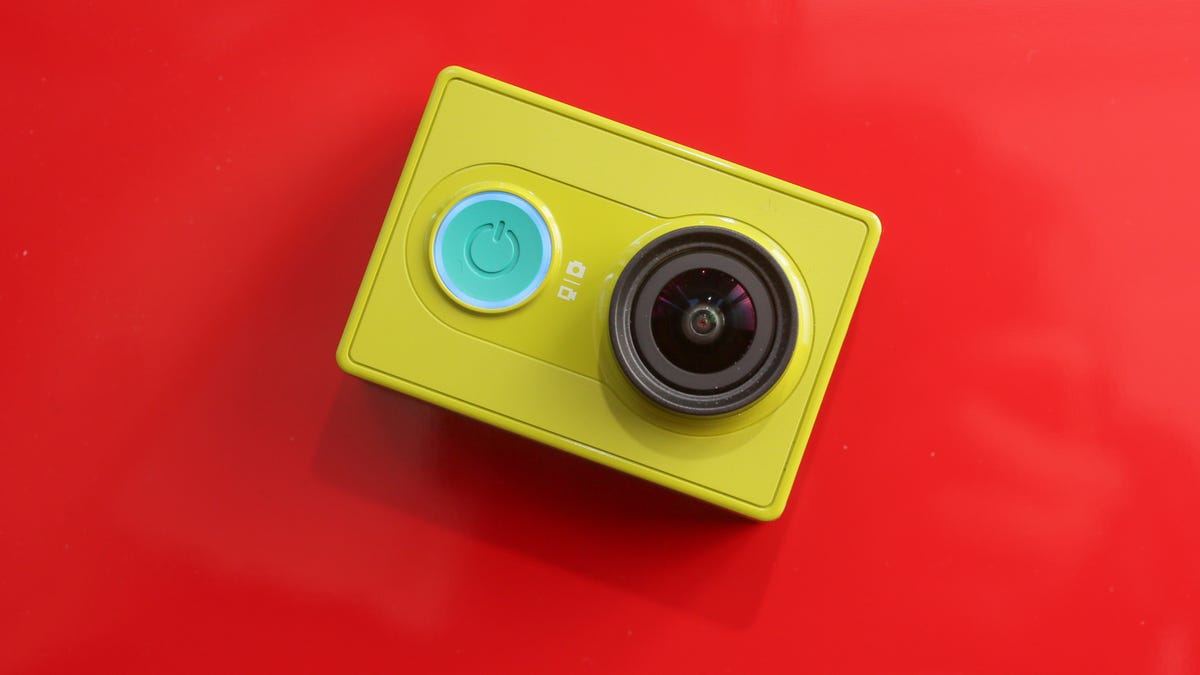
Out in precedent of the little lime-green and teal box (it’s available in all white, too) is a nice f2.8 wide-angle lens with a 155-degree Causes of view, while inside is a Sony-made 16-megapixel backside-illuminated CMOS sensor, a Broadcom wireless module and an Ambarella A7LS systems on a chip (SoC) running the show.
To give you some perspective, Ambarella’s chips can be found in many POV cameras and DJI’s quadcopters and, more specifically, the GoPro Hero3+ Silver, Ion Air Pro 3 and Drift Innovation Ghost-S use the A7LS chip family. Aside from the SoC, those cameras all have one latest thing in common: prices of $300 or more.
Now, those cameras do offer things that the Yi doesn’t, but the Yi can do more than others at its trace such as the Polaroid Cube and Monoprice MHD 2.0. Also, although the some more expensive entry-level GoPro Hero has very good video quality, the Yi still beats it there and on features and, depending on your contains, design.
Sarah Tew
Features and design
For starters, the higher-end specs mean it can capture 1080p video at 60, 48, 30 or 24 frames per uphold (fps); 960p (also called tall HD) at 60 or 48fps; 720p at 120, 60 or 48fps; and 480p at 240fps. It can also snap pictures at resolutions up to 16 megapixels one at a time; in bursts at 3, 5 or 7fps or 7 frames over 2 seconds; or at time intervals of 0.5, 1, 2, 5, 10, 30 or 60 seconds. You can also set up a self-timer for 3, 5, 10 or 15 seconds. There’s also a Snapshot mode that captures 10 seconds of VGA-quality video for vivid social sharing.
Other cameras at the Yi’s price moneys a fraction of those options and typically record video at a very of just 1080p at 30fps and 720p at 60fps. However, unless you read Chinese, using the camera to do all that it can do is a minor tricky at first.
Again, this camera is made for the Chinese market, so the instructions that come with it are in Chinese (a US version of the camera is now available on Amazon). If you’ve used a similar action cam or aren’t worried to press buttons, the Yi is simple to figure out. If you haven’t or are worried, well, it’s still easy.
Sarah Tew
The camera has three buttons. The one on front is for power and switching between capturing stills and video. (The defaults, by the way, are single, 16-megapixel photos and 1080p at 30fps.) A button on top is the shutter reduction and for starting and stopping recordings. On the left is a exiguous button for turning on and off the camera’s wireless. There are record lights on the top, back and bottom and a luscious around the power button gives you a battery location by changing color.
On back you’ll find a door for the battery compartment and latest covering the microSDXC card slot, Micro-USB port and Micro-HDMI output. A battery and short Micro-USB cable are included for charging and transfers, but you’re on your own for storage; it supports cards up to 128GB.
If you’re looking for the cut corners that got the trace so low, the lack of included accessories is one of them. There is no polycarbonate waterproof housing and the camera isn’t waterproof minus one.
Sarah Tew
Also, unlike almost every other action cam I’ve reviewed, not one spacious is included. Xiaomi has accessories coming in April such as a 40-meter (131-feet) waterproof housing, but that will of course cost you more. It has a nefarious 1/4-20 tripod mount on the bottom, so you do have a lot of available third-party mounts to resolve from and an inexpensive adapter for GoPro mounts opens you up to even more. But, anti, out of the box you have nothing.
There is also no shroud of any kind, so to change camera settings you’ll need to use the camera’s Wi-Fi to connect to an Android or iOS method running the Yi app. Fortunately, much of the app is in English, so getting around in it even if you can’t read Chinese shouldn’t be much of an philosophize. (A US version of the camera is now available on Amazon.)
Press the camera’s Wi-Fi button for a binary to start up the wireless and after a few more seconds it will create to blink, which is your signal to connect. Launch the app, tap a camera icon at the bottom of the shroud and it should start the direct connection to the Yi. If it doesn’t you may have to retract the camera from your available networks listed under Wi-Fi settings on your mobile method. After the first time, though, it will automatically connect when you inaugurate the app and tap the icon.
Screenshot by Josh Goldman
With the app you get a live preview of what the camera sees as well as a live stream while recording. I tested with a Samsung Galaxy S5 and it worked near flawlessly and held onto the connection very well. The app can be used to inaugurate and stop recordings, snap photos, change all of the camera’s settings and view your photos and videos and download them to your method, too.
Along with changing what resolution and frame rate you report at and selecting other photo modes, you can set the camera for loop recording — nefarious for using it as a dashcam — as well as correcting the wide-angle distortion from the lens (assuming you don’t want it), turning on an auto low-light option to proceed exposure indoors or at night and other miscellaneous settings.
Battery life and video quality
Small battery packs typically don’t dusk long continuous recording times on action cams, and that’s certainly the case with the Yi. Set to report at the default 1080p at 30fps with the Wi-Fi off, the camera continuously captured video for an denotes of 1 hour and 45 minutes. Bumped up to 60fps, the average time dropped to just less than an hour.
Sarah Tew
By comparison, the similarly featured GoPro Hero3+ Silver gets near 2 hours of continuous 1080p recording at 60fps and 3 hours at 1080p at 30fps with Wi-Fi off. Granted it uses a 1,180mAh battery compared with the Yi’s 1,010mAh pack, but the Yi’s battery life is certainly something to much. The positive here is that it is easily swapped out if you’re OK with buying and carrying extras.
Picking high-end parts doesn’t defense good results, but that is what you get with the Yi. Excellent results actually, especially given the low price. Color and exposure are very good, and the camera recovers posthaste and smoothly under abrupt lighting condition changes.
As with most section cams, the larger you view the video and the closer you are to the shroud, the more artifacts you’ll see. Still, when recording at 1080p at 60fps video looks enthralling and smooth and with a bit rate of near 25Mbps, details don’t turn to complete mush, even when enthralling at high speeds.
Low-light video is noticeably softer with more visible artifacts and some knowing noise, but far better than from any other sub-$100 section cam I’ve reviewed. Note that you may notice some glitches in the clips following the initial driving scenes in the video above. Those were caused by a faulty microSD card, not the camera.
The Micro-HDMI port does support live video output while recording to a microSD card in the camera. There is an overlay of recording time, battery and Wi-Fi site shown on the display you’re attached to, but it’s not visible in the continue recording.
Photo quality is good, too, however you can only shoot in 4:3 formats, so you might want to crop photos to 16:9 if you want to drop them into your videos. Otherwise, they’re not unlike what you get with video: enthralling, well-exposed images with good fine detail in daylight, but softer, noisier images in dimly lit conditions.
Conclusion
The Xiaomi Yi Perform Cam’s video quality and shooting options are well above those of spanking cameras in its class, but you’ll need to bring your own accessories.
Mi 11 Ultra hands-on: Xiaomi has truly outdone itself with this superphone
Are two screens better than one? Xiaomi hopes to despise so with the Mi 11 Ultra. Announced last month, it’s the Chinese company’s latest superphone and rounds out its new Mi 11 lineup. With the regular Mi 11, Xiaomi already gave us an suitable device, packing nearly everything we expect from an Android flagship in 2021. But Xiaomi has outdone itself with the Mi 11 Ultra. After a week with the Mi 11 Ultra, I can say Xiaomi has once against leveled up its flagship game by stacking a incredible array of features — it really left me stunned.
Xiaomi has tons of brag material here. The Mi 11 Ultra has the world’s largest camera sensor, the world’s widest ultrawide camera, one of the brightest screens nearby, it shoots 8K video on all three cameras, and of streams there’s that headline-making second screen on the rear.
But that additional display is really just icing on the cake. The Mi 11 Ultra holds its own deprived of it. There’s also a 6.5-inch OLED panel, Qualcomm’s fastest chip, the Snapdragon 888, a intelligent and punchy front display, and a loud set of stereo speakers co-developed by Harman Kardon. Xiaomi usually gets a small ding in our coverage for leaving out the IP including for water and dust resistance, but that’s no longer the case: the Mi 11 Ultra’s IP68 including means it’s waterproof.
One thing absent in the Mi 11 Ultra is a memory card slot for expandable storage, but this phone has 256GB of storage — at least the European version I was given did — so most won’t need the incredible storage, at least not for a while. Models are probable to vary depending on the country.
If I had to nitpick, the Mi 11 Ultra would lose points for not entirely living up to what Xiaomi says it can do, at least in my known. For instance, Xiaomi markets its second screen as an alternative always-on exhibit, but it can’t actually do that. In fact, the longest it can stay on is 30 seconds. Admittedly, when you’re using it as a viewfinder, you won’t run into this state. Also, despite the many fancy features Xiaomi can brag approximately, several of them are gratuitous — but maybe that’s OK, because isn’t that what a superphone is all about?
Either way, there’s no denying this is one of Xiaomi’s smartphone jewels, but you’ll have to import if you want in — there are no plans for a reduction stateside. You won’t have to buy a Chinese version, which doesn’t have Google, as the Mi 11 Ultra will initiate in Europe for 1,119 euros, which converts to $1435, £970 or AU$1,860. That’s almost exactly the same as the Galaxy S21 Ultra‘s starting imprint of 1,124 euros, which includes Europe’s 20% sales tax. The S21 Ultra starts at $1,125 for the 256GB version in the US, for comparison.
Mi 11 Ultra design: Business in leash, party in the back
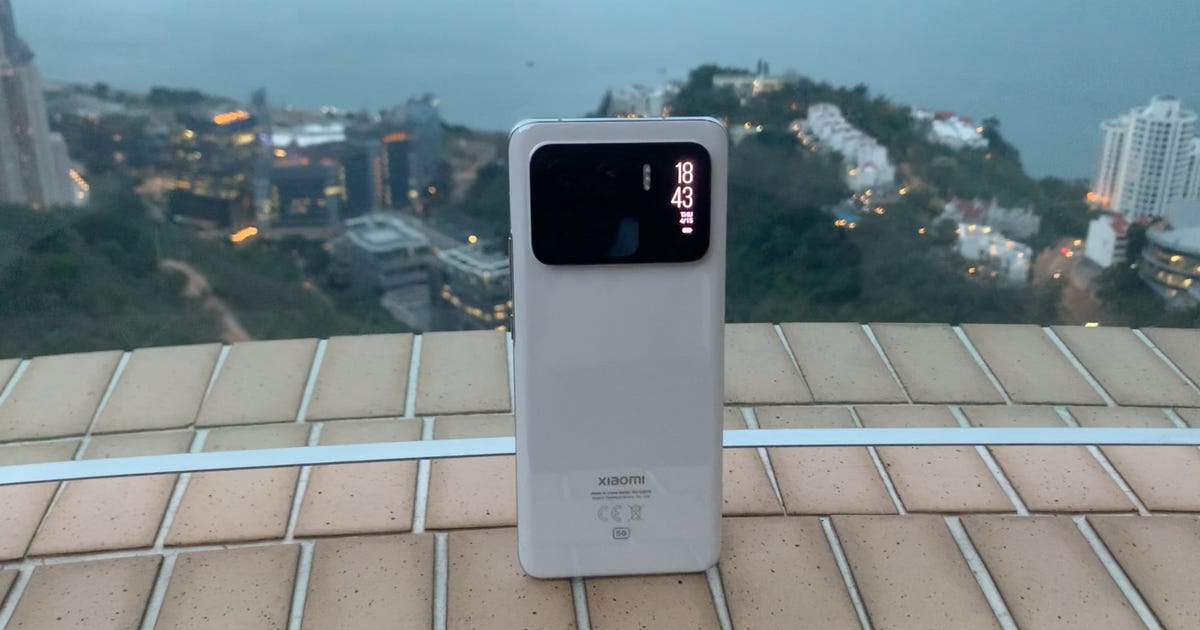
The Mi 11 Ultra features the develop trappings of a standard Android flagship in 2021 — from the leash, at least. It has a hole-punch notch housing the leash selfie camera, a gently curved display and ports or buttons in their unnovel locales. Once you flip this behemoth of a handset over, you won’t miss the standout feature: a uphold display, living in a supersized camera bump that takes up roughly a quarter of the Mi 11 Ultra’s rear. It’s probably the biggest camera bump I’ve ever seen and eclipses the bulky bump seen on 2020’s Galaxy S20 Ultra.
The best use of the 1.1-inch AMOLED cloak is to display selfie previews, meaning you have the confidential of using the three higher-resolution cameras, usually reserved for queer photos, to help you nail selfies or group photos. But when the phone’s main screen is facing down, the uphold screen can display notification alerts from apps like WhatsApp, or show you what audio you’re listening to, or tell you the time. That said, the uphold display certainly contributes to the Mi 11 Ultra’s weight, which adds up to 234 grams (8.25 ounces), so it probably won’t be depressed to use one-handed for most people.
Meanwhile, the front display is the same as on the Mi 11. There’s a 6.81-inch AMOLED with a 120Hz refresh rate, however it’s brighter with a peak brightness of 1,700 nits. Unlike most flagships, which typically use glass shielding, the Mi 11 Ultra has a ceramic rear, which is derived to be more durable than glass. Corning’s tough Gorilla Glass Victus is on the leash.
Mi 11 Ultra’s rear display is the icing on the cake
Although phones sporting rear displays do existed (the Nubia Z20, for instance), it’s a rare feature that seems even more novel considering the Mi 11 Ultra isn’t foldable. Plus it’s the trustworthy time I’ve ever used one, so I’m definitely soaking it all in. Customizing the image or signature on the rear indicate added an extra layer of personalization, a cool mopish that made the phone feel even more my own.
At the same time, nonetheless, I can’t say I’m convinced the second screen will rep on. It has limitations in its current form. It’s tantalizing to see any detail when snapping selfies since you’re depending on a tiny indicate, but it does function as a rough guide. You can only take 15 seconds of video comic the selfie viewfinder, and portrait mode can’t be used at all. By the way, the selfie preview feature isn’t part of the default settings, and needs to be switched on from the Special Features menu in settings.
Mi 11 Ultra has the largest camera sensor on a smartphone colorful now
The party on the back of the Mi 11 Ultra corpses with the stellar camera module, composed of three rear sensors: a 50-megapixel main lens with a 1/1.12-inch sensor; a 48-megapixel ultrawide lens, with a 128-degree field of view; and a 48-megapixel telephoto lens. The 1/1.12-inch sensor on the main camera, Samsung’s GN2, is probably the largest ever on a smartphone. Bigger sensors can let more light enter, helping develop all-around better photos, especially at night. For context, the GN2 sensor is nearly 20% larger than the one on the S21 Ultra, and more than 18% bigger than the one in the iPhone 12 Pro Max.
Those aren’t just numbers: Taking vibrant and detailed photos was effortless. Zoom was impressive too. The Mi 11 Ultra has 120x zoom, which based on the specs at least, means it’s better than the 100x zoom of the Galaxy S21 Ultra, but I didn’t have a Galaxy device on hand to compare. Either way, pictures taken with 120x zoom were a jumble of pixels and entirely unusable. You can get away with crisp photos up pending 15x zoom, maybe 20x on a clear day, but at what time that it gets pretty blurry.
Auxiliary features not forgotten
The Mi 11 Ultra is a meticulously planned device, and it’s clear that Xiaomi paid attention to auxiliary features that don’t score attention on other devices. For instance, the flashlight’s distinguished rays beam bright and far thanks to its triple LED ftrips. Using the Mi 11 Ultra, I managed to make it ended an otherwise dark night with limited visibility. I’ve harped on at lengthways before about the Mi 11 lineups’ excellent stereo speakers, so if you want to read about the quality, take a look at my review of the Mi 11. The Mi 11 Ultra uses the same speaker rules, co-developed by Harman Kardon.
As has been the case with the rest of the Mi 11 lineup, Xiaomi includes accessories that main rivals Apple and Samsung have contained from their boxes. There’s a 67-watt charger, a plastic case and a USB-C substandard inside the Mi 11 Ultra’s black box.